#7
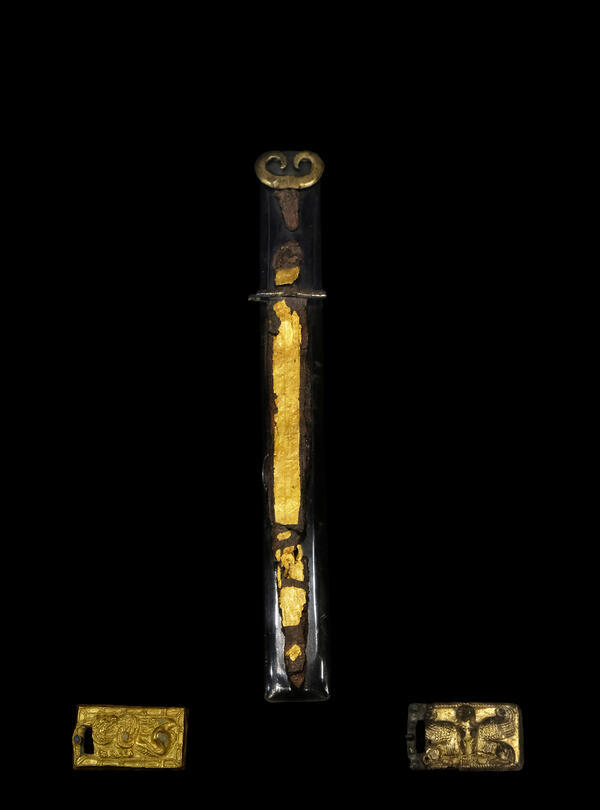
Dagger, Belt buckle, Belt buckle
#8
#10
#11
The dagger was found in the course of archaeological excavations in the vicinity of BarAnovka village of the ChernoYArsky District of Astrakhan region in 1972. The excavations were led by Herman FYOdorov-DavYdov, a Soviet historian and archaeologist, a specialist in numismatics of the Golden Horde and medieval Eastern Europe, head of the Volga archaeological expedition.
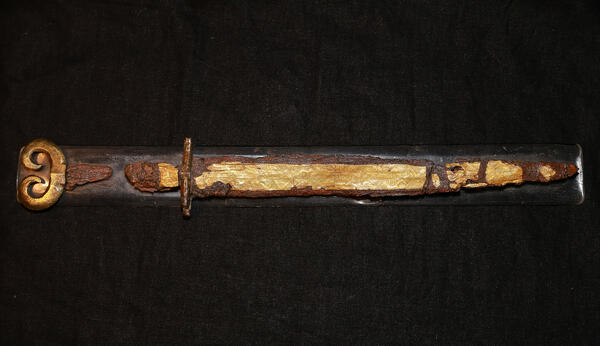
The dagger was made of iron in the 2nd - 3rd centuries AD. It is complemented with a decorative top - a figured bronze pommel. A bronze crosshair with gold foil on a scabbard has also survived.
That time, the Sarmatians had a common approach to decorating daggers: the front part of the scabbard and the handle were covered with a solid gold plate, which resembled the decoration of Scythian ceremonial swords. However, new elements also appeared: repoussé compositions in the animal style (depicting animals) were replaced by geometric patterns.
The Sarmatians were considered a very warlike people, this was even especially emphasized by ancient authors. The way of life among the tribes was largely associated with wars. After the conquest of Scythia, they became the most powerful people in the northeastern part of the ancient ecumene. The writings by Greek and Roman authors indicate that the Sarmatian tribes participated in many important military-political events in the Northern Black Sea region, in the Caucasus, on the Danube. The main worship item both among the Scythians and the Sarmatians was the sword that personified the god of war. The Roman historian Ammianus Marcellinus wrote: ‘They stick a sword into the ground and worship it with reverence like Mars.’ The main type of Sarmatian weapon was short swords no more than 50-60 cm long. Their scabbard was attached to the belt with a special clip through which a harness belt was passed. This method of attaching the sword was convenient only for horsemen. In addition to the sword, a dagger was obligatory for the Sarmatian. The dagger was fixed either on the belt or on the leg with straps.
In 2005, the iron dagger and other valuable finds were exhibited at the Astrakhan Steppe Treasures show at the National Museum of the Palazzo Venezia in Rome.
The dagger was made of iron in the 2nd - 3rd centuries AD. It is complemented with a decorative top - a figured bronze pommel. A bronze crosshair with gold foil on a scabbard has also survived.
That time, the Sarmatians had a common approach to decorating daggers: the front part of the scabbard and the handle were covered with a solid gold plate, which resembled the decoration of Scythian ceremonial swords. However, new elements also appeared: repoussé compositions in the animal style (depicting animals) were replaced by geometric patterns.
The Sarmatians were considered a very warlike people, this was even especially emphasized by ancient authors. The way of life among the tribes was largely associated with wars. After the conquest of Scythia, they became the most powerful people in the northeastern part of the ancient ecumene. The writings by Greek and Roman authors indicate that the Sarmatian tribes participated in many important military-political events in the Northern Black Sea region, in the Caucasus, on the Danube. The main worship item both among the Scythians and the Sarmatians was the sword that personified the god of war. The Roman historian Ammianus Marcellinus wrote: ‘They stick a sword into the ground and worship it with reverence like Mars.’ The main type of Sarmatian weapon was short swords no more than 50-60 cm long. Their scabbard was attached to the belt with a special clip through which a harness belt was passed. This method of attaching the sword was convenient only for horsemen. In addition to the sword, a dagger was obligatory for the Sarmatian. The dagger was fixed either on the belt or on the leg with straps.
In 2005, the iron dagger and other valuable finds were exhibited at the Astrakhan Steppe Treasures show at the National Museum of the Palazzo Venezia in Rome.
#12
Date: II–III centuries AD
Technique: forging, casting, cutting
Dimensions: 2,5×35 cm
Collection: State budgetary institution of culture of the Astrakhan region ‘Astrakhan Museum-Reserve’
Copyright: State budgetary institution of culture of the Astrakhan region ‘Astrakhan Museum-Reserve’
Goskatalog Number: 17112896
Technique: forging, casting, cutting
Dimensions: 2,5×35 cm
Collection: State budgetary institution of culture of the Astrakhan region ‘Astrakhan Museum-Reserve’
Copyright: State budgetary institution of culture of the Astrakhan region ‘Astrakhan Museum-Reserve’
Goskatalog Number: 17112896
#13
Belt buckle
#15
#14
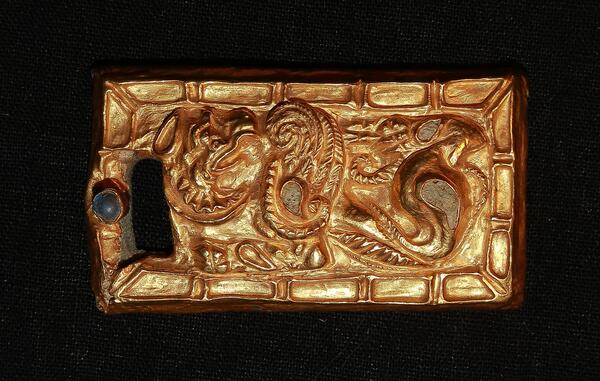
The rectangular belt buckle from the Astrakhan Museum Reserve collection was found by the Astrakhan archaeological expedition sent by Leningrad branch of the Institute of Archeology and led by ValentIn ShIlov in 1965. The excavations took place in the village of NikOlskoye, YenotAyevsky District, Astrakhan Region.
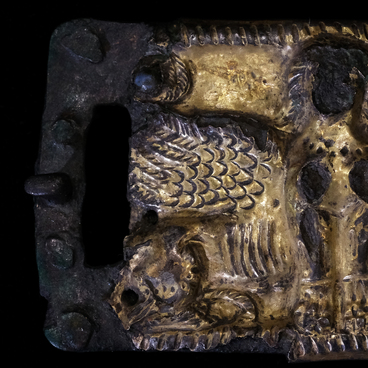
The buckle depicts a repousse griffin; it is a mythological winged creature with the body of a lion and the head of an eagle. The accessory is made of bronze and covered with gold plate on one side.
The buckle may be attributed to the items of the so-called Sarmatian animal style where animal images were depicted. Based on the style, the Sarmatians crafted many various gold jewelry: bracelets and buckles, bridle appliques and torcs — pendants that were usually worn around the neck.
At various times, zoomorphic images were scribed on the dishes and luxury items by various peoples. But the Sarmatians had their own stylistic devices, so scholars singled out their style into a special independent group. The Sarmatians depicted animals in an emphasized decorative manner: they extra brightly decorated their bodies with coloured inserts and linear ornaments. On the buckle from the Astrakhan Museum Reserve collection, we can see such an insert made of dark stone, as well as holders that are special sockets used by ancient craftsmen to fix decors. The holders were usually made separately, then they were soldered onto the items, and then additional decorations were inserted into them. Coloured stones emphasized repoussé muscles, sharp teeth and claws, eyes and feathers. And sometimes (as in our case) they simply fixed several figured holders with decor, inscribing them into a embossed patterned image of an animal.
Items in the Sarmatian animal style were widespread in the steppes of the Lower Volga and Don Regions from the beginning of the II century BC to the beginning of the I century AD. They are found in the rich burials of the Sarmatian-Alan nobility.
In 2005, the buckle and other archaeological finds from the Astrakhan Museum Reserve collection were exhibited in 2005 at the Astrakhan Steppe Treasures show at the National Museum of the Palazzo Venezia in Rome, and in 3 years at the Gold of the Sarmatians exhibition in the State Historical Museum (Moscow).
The buckle depicts a repousse griffin; it is a mythological winged creature with the body of a lion and the head of an eagle. The accessory is made of bronze and covered with gold plate on one side.
The buckle may be attributed to the items of the so-called Sarmatian animal style where animal images were depicted. Based on the style, the Sarmatians crafted many various gold jewelry: bracelets and buckles, bridle appliques and torcs — pendants that were usually worn around the neck.
At various times, zoomorphic images were scribed on the dishes and luxury items by various peoples. But the Sarmatians had their own stylistic devices, so scholars singled out their style into a special independent group. The Sarmatians depicted animals in an emphasized decorative manner: they extra brightly decorated their bodies with coloured inserts and linear ornaments. On the buckle from the Astrakhan Museum Reserve collection, we can see such an insert made of dark stone, as well as holders that are special sockets used by ancient craftsmen to fix decors. The holders were usually made separately, then they were soldered onto the items, and then additional decorations were inserted into them. Coloured stones emphasized repoussé muscles, sharp teeth and claws, eyes and feathers. And sometimes (as in our case) they simply fixed several figured holders with decor, inscribing them into a embossed patterned image of an animal.
Items in the Sarmatian animal style were widespread in the steppes of the Lower Volga and Don Regions from the beginning of the II century BC to the beginning of the I century AD. They are found in the rich burials of the Sarmatian-Alan nobility.
In 2005, the buckle and other archaeological finds from the Astrakhan Museum Reserve collection were exhibited in 2005 at the Astrakhan Steppe Treasures show at the National Museum of the Palazzo Venezia in Rome, and in 3 years at the Gold of the Sarmatians exhibition in the State Historical Museum (Moscow).
#16
Date: 1st century BC – 2nd century AD
Technique: embossing, repoussé work
Dimensions: 1,0×3,7×6,7 cm
Collection: State budgetary institution of culture of the Astrakhan region ‘Astrakhan Museum-Reserve’
Copyright: State budgetary institution of culture of the Astrakhan region ‘Astrakhan Museum-Reserve’
Goskatalog Number: 17112910
Technique: embossing, repoussé work
Dimensions: 1,0×3,7×6,7 cm
Collection: State budgetary institution of culture of the Astrakhan region ‘Astrakhan Museum-Reserve’
Copyright: State budgetary institution of culture of the Astrakhan region ‘Astrakhan Museum-Reserve’
Goskatalog Number: 17112910
#17
Belt buckle
#18
#19
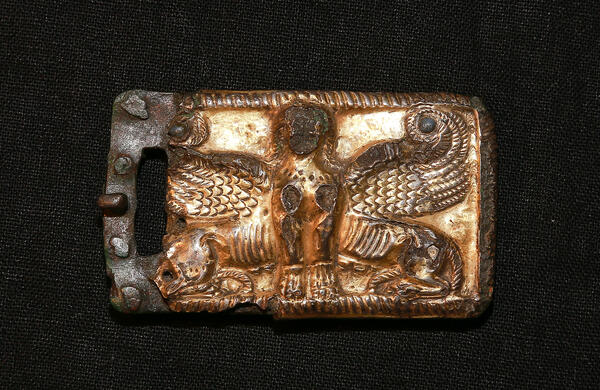
The rectangular belt buckle from our collection was crafted within the period from the 1st century BC to the 1st century AD. It is made of bronze and decorated with a repoussé image of a winged sphinx and a decorative frame in the form of a pseudo-string. The buckle has a belt slot and a protruding pin. An ancient craftsman carefully decorated the Sphinx with a pattern: the details of its wings are neatly worked out with a wavy ornament and small shading; the front legs are decorated with longitudinal stripes. There are traces of gilding on the belt buckle.
The lion personified the power of the Sun or one of the sun gods in most ancient eastern civilizations. The Great Sphinx was built for the pharaoh of the Khafre dynasty (literally ‘like the sun’), but the etymology of the word ‘sphinx’ is not Egyptian, but Greek. In Greece, this word — it translates as ‘strangler’ — was used to name a lion with a human head. This is connected with the legend about Oedipus, who freed the inhabitants of Thebes from the monster Sphinx who was a winged creature with the body of a lion and the head of a woman. The creature offered a riddle to passers-by and threw all those who could not solve it into the abyss. Only Oedipus solved the Sphinx’s riddle, and then the monster threw itself off the cliff.
Unlike the Egyptian Sphinx, the Greek one consisted of four animals: its body and legs were like a lion’s, a tail like a bull’s, wings like an eagle’s and a head like a man’s.
The buckle was considered not only an ornament in the ancient world, but also had a sacred function: it was assumed that it protects the owner from trouble. The object where the sphinx is depicted could be considered a very powerful amulet.
The belt buckle was found in 1972 during archaeological activities at the construction sites of the KalmYk-Astrakhan and NikOlsk rice irrigation systems, namely, in the BarAnovka village of the ChernoYArsk District of the Astrakhan Region. The excavations were led by V.V. DvornichEnko and G.A. FEdorov-DavYdov.
In 2005, this valuable find and other items were exhibited at the Astrakhan Steppe Treasures show at the National Museum of the Palazzo Venezia in Rome. In 2008, it was presented at the Gold of the Sarmatians show at the State Historical Museum in Moscow.
The lion personified the power of the Sun or one of the sun gods in most ancient eastern civilizations. The Great Sphinx was built for the pharaoh of the Khafre dynasty (literally ‘like the sun’), but the etymology of the word ‘sphinx’ is not Egyptian, but Greek. In Greece, this word — it translates as ‘strangler’ — was used to name a lion with a human head. This is connected with the legend about Oedipus, who freed the inhabitants of Thebes from the monster Sphinx who was a winged creature with the body of a lion and the head of a woman. The creature offered a riddle to passers-by and threw all those who could not solve it into the abyss. Only Oedipus solved the Sphinx’s riddle, and then the monster threw itself off the cliff.
Unlike the Egyptian Sphinx, the Greek one consisted of four animals: its body and legs were like a lion’s, a tail like a bull’s, wings like an eagle’s and a head like a man’s.
The buckle was considered not only an ornament in the ancient world, but also had a sacred function: it was assumed that it protects the owner from trouble. The object where the sphinx is depicted could be considered a very powerful amulet.
The belt buckle was found in 1972 during archaeological activities at the construction sites of the KalmYk-Astrakhan and NikOlsk rice irrigation systems, namely, in the BarAnovka village of the ChernoYArsk District of the Astrakhan Region. The excavations were led by V.V. DvornichEnko and G.A. FEdorov-DavYdov.
In 2005, this valuable find and other items were exhibited at the Astrakhan Steppe Treasures show at the National Museum of the Palazzo Venezia in Rome. In 2008, it was presented at the Gold of the Sarmatians show at the State Historical Museum in Moscow.
#20
Date: 1st century BC – 1st Century A.D.
Technique: casting, forging, embossing, gilding
Dimensions: 3,9×6,8 cm
Collection: State budgetary institution of culture of the Astrakhan region “Astrakhan Museum-Reserve”
Copyright: State budgetary institution of culture of the Astrakhan region “Astrakhan Museum-Reserve”
Goskatalog Number: 17112939
Technique: casting, forging, embossing, gilding
Dimensions: 3,9×6,8 cm
Collection: State budgetary institution of culture of the Astrakhan region “Astrakhan Museum-Reserve”
Copyright: State budgetary institution of culture of the Astrakhan region “Astrakhan Museum-Reserve”
Goskatalog Number: 17112939
read morehide
00:00
00:00
1x
1
 Point your smartphone camera to open in the app
Open in app
Share