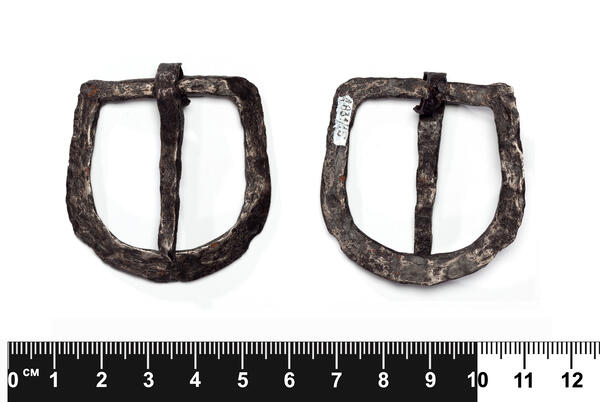
The permanent exhibition “Relics from the Battle of Kulikovo” features a buckle — a part of horse tack dating back to the 12th–17th centuries. It has a lyre-shaped frame with rounded corners. The side of the frame, on which the tip of the prong rests, is rounded. The side, to which the prong is attached, is rectangular in cross section (0.4×0.5 cm), the other sides are triangular in cross section (they are 0.5–0.7 cm wide). The prong is curved, S-shaped, and attached to the frame with a hinge. The prong is 4.3 cm long, made of a rectangular cane. It is 0.6 cm wide near the hinge. The tip of the prong is pointed.
In 2003, this buckle was discovered in excavations conducted by the State Historical Museum and the State Museum-Reserve “Kulikovo Field” on the watershed of the Verkhodub and Orzhevik ravines, to the south of the Monastyrshchino village, Kimovsky District, Tula Oblast, on site No. 22, grid 3. It is currently housed by the State Museum-Reserve “Kulikovo Field”.
The dimensions of the frame suggest that the buckle connected the ends of a belt that were no more than 3 cm wide, so it could belong to a bridle or belt set. The buckle belongs to the multifunctional type. Both now and then, the general term “bridle” was often used to designate a headgear with a bit. A bridle is a piece of equipment and harness — a headgear used to control the horse. The Russian word “uzda” (bridle) is obviously associated with the word “snuznik” — a rider who set out on a campaign in the 11th–14th centuries. The controlling and restraining function of the bridle is precisely defined in Russian records of the 11th and 15th centuries by the following words: “the bridle is the ruler of the horse”, and “a fierce horse will be restrained by the bridle.”
Needless to say, that the head straps of the horse bridle (the headpiece, browband, throat latch, cheek straps, noseband, and curb bit strap), which were about 1.8 cm wide in the Middle Ages, were nondurable. Most often, the parts of the harness that have been preserved were made of metal — these were rings, belt plates, and buckles. It is difficult to identify the initial location of these items, and sometimes even their purpose, especially if they ended up on a funeral pyre in a heap of other objects.
In 2003, this buckle was discovered in excavations conducted by the State Historical Museum and the State Museum-Reserve “Kulikovo Field” on the watershed of the Verkhodub and Orzhevik ravines, to the south of the Monastyrshchino village, Kimovsky District, Tula Oblast, on site No. 22, grid 3. It is currently housed by the State Museum-Reserve “Kulikovo Field”.
The dimensions of the frame suggest that the buckle connected the ends of a belt that were no more than 3 cm wide, so it could belong to a bridle or belt set. The buckle belongs to the multifunctional type. Both now and then, the general term “bridle” was often used to designate a headgear with a bit. A bridle is a piece of equipment and harness — a headgear used to control the horse. The Russian word “uzda” (bridle) is obviously associated with the word “snuznik” — a rider who set out on a campaign in the 11th–14th centuries. The controlling and restraining function of the bridle is precisely defined in Russian records of the 11th and 15th centuries by the following words: “the bridle is the ruler of the horse”, and “a fierce horse will be restrained by the bridle.”
Needless to say, that the head straps of the horse bridle (the headpiece, browband, throat latch, cheek straps, noseband, and curb bit strap), which were about 1.8 cm wide in the Middle Ages, were nondurable. Most often, the parts of the harness that have been preserved were made of metal — these were rings, belt plates, and buckles. It is difficult to identify the initial location of these items, and sometimes even their purpose, especially if they ended up on a funeral pyre in a heap of other objects.