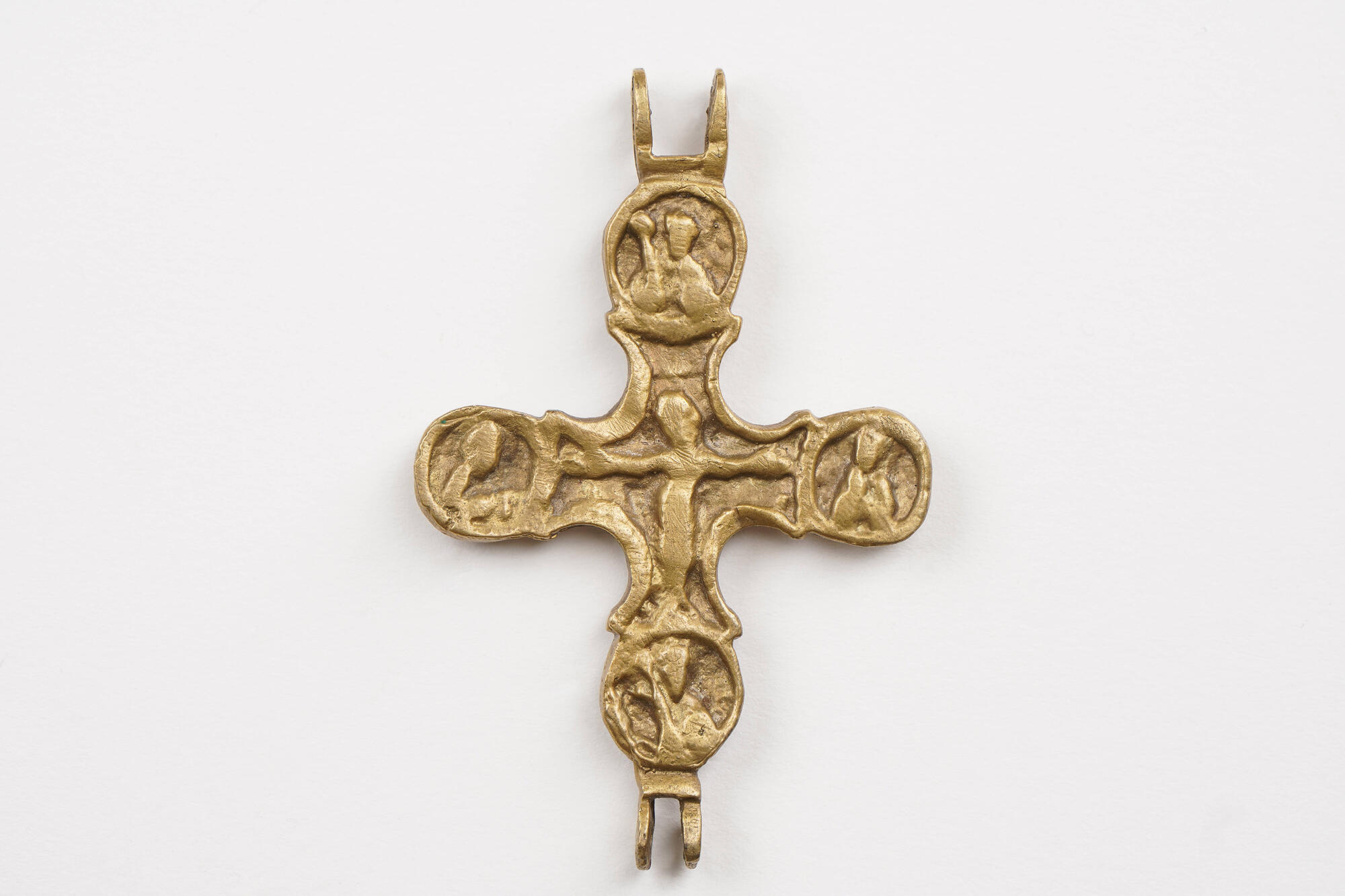


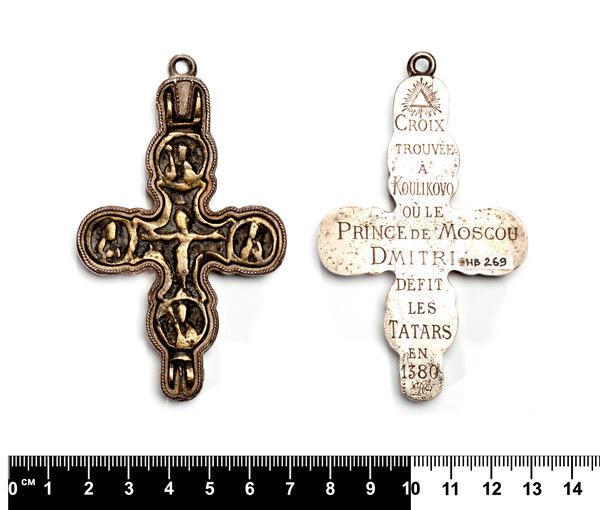
The front part of the bronze encolpion presented in the exhibition “Relics of the Battle of Kulikovo” dates back to the 13th and 14th centuries. This is a cross with rounded points, paired extensions at the ends and suspension loops. The images are in relief. In the center is the Crucifixion of Jesus Christ. The ends of the left and right arms feature half-length images of the Mother of God and the Apostle John the Theologian. The top and bottom arms terminate in the half-length images of archangels. The inner angles are arc-shaped and rounded. The original encolpion cross is housed by the State Historical Museum, and the State Museum-Reserve “Kulikovo Field” has a replica of this item.
Similar pendants have been known since the 13th century and come from both Southern Rus and central Russian lands.
The iconographic image of the Crucifixion tells about the last day of the earthly life of Jesus Christ. This day went down in the history of the church as Good Friday: the Savior was condemned to death and carried his cross to the place of execution. During the crucifixion, it was not an ordinary person who died — it was God, who had become flesh. The death of Jesus Christ was of exceptional importance: he gave his life to atone for the sins of all mankind.
The canonical icon of the Crucifixion of Christ usually includes the figure of Jesus and many additional figures. The icon was often called “the illustrated Gospel” or “the Gospel for the illiterate”. In this image, believers saw the main symbols of faith. The composition has always had multiple meanings and gave people the opportunity to reflect on Christianity or to become filled with and inspired by faith. In the works created before the beginning of iconoclasm, there were many different characters and additional details. The icon depicted the Mother of God — most often on the right side of the Savior; John the Theologian — one of the 12 apostles and 4 evangelists — on the other side of the cross; two thieves crucified side by side who flanked the figure of Jesus (one of them — Rakh — found faith at the moment of his crucifixion and became the first person to be saved by Christ and enter Paradise); three Roman soldiers — they are depicted below, as if under a cross.
Similar pendants have been known since the 13th century and come from both Southern Rus and central Russian lands.
The iconographic image of the Crucifixion tells about the last day of the earthly life of Jesus Christ. This day went down in the history of the church as Good Friday: the Savior was condemned to death and carried his cross to the place of execution. During the crucifixion, it was not an ordinary person who died — it was God, who had become flesh. The death of Jesus Christ was of exceptional importance: he gave his life to atone for the sins of all mankind.
The canonical icon of the Crucifixion of Christ usually includes the figure of Jesus and many additional figures. The icon was often called “the illustrated Gospel” or “the Gospel for the illiterate”. In this image, believers saw the main symbols of faith. The composition has always had multiple meanings and gave people the opportunity to reflect on Christianity or to become filled with and inspired by faith. In the works created before the beginning of iconoclasm, there were many different characters and additional details. The icon depicted the Mother of God — most often on the right side of the Savior; John the Theologian — one of the 12 apostles and 4 evangelists — on the other side of the cross; two thieves crucified side by side who flanked the figure of Jesus (one of them — Rakh — found faith at the moment of his crucifixion and became the first person to be saved by Christ and enter Paradise); three Roman soldiers — they are depicted below, as if under a cross.