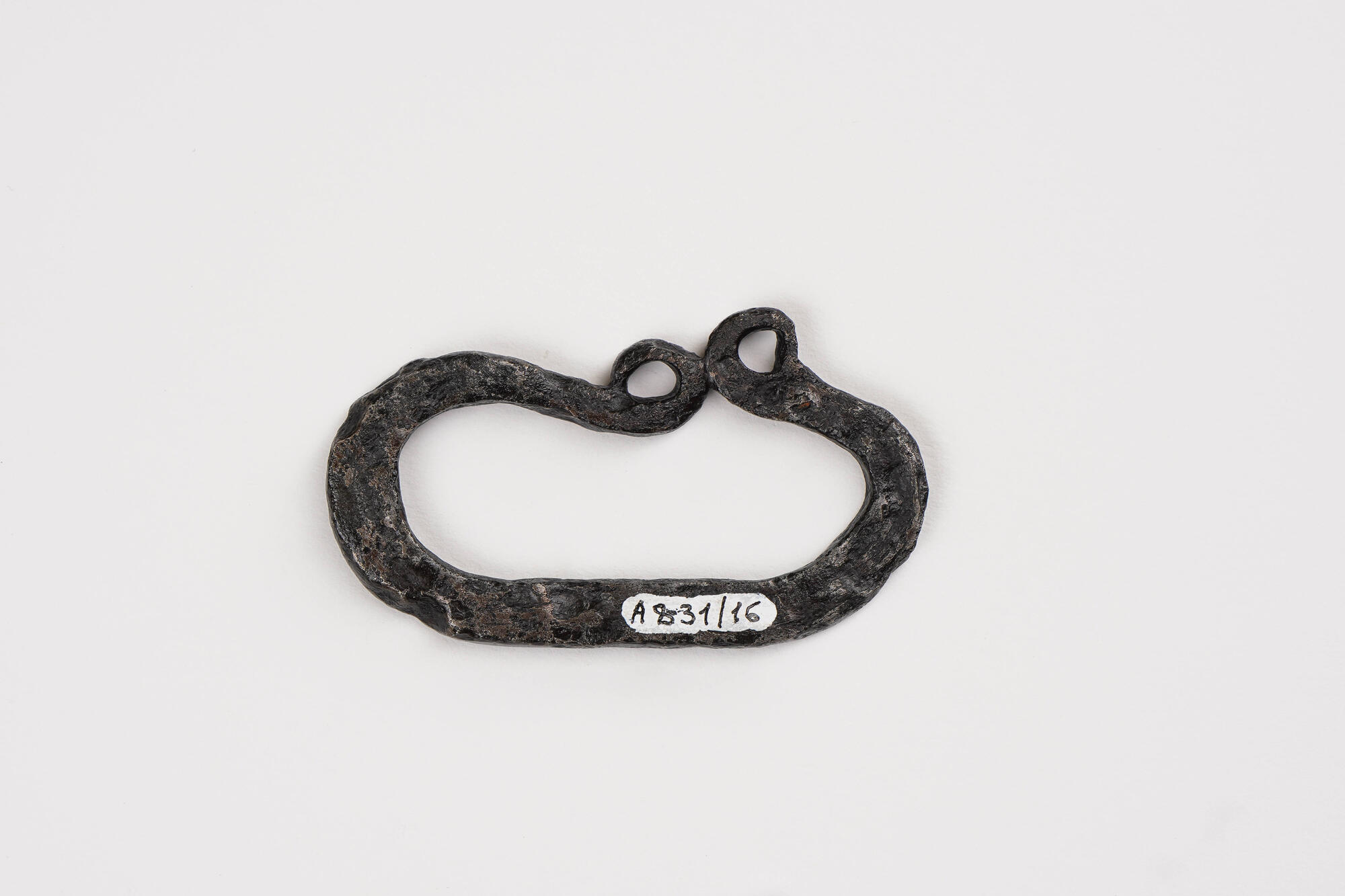


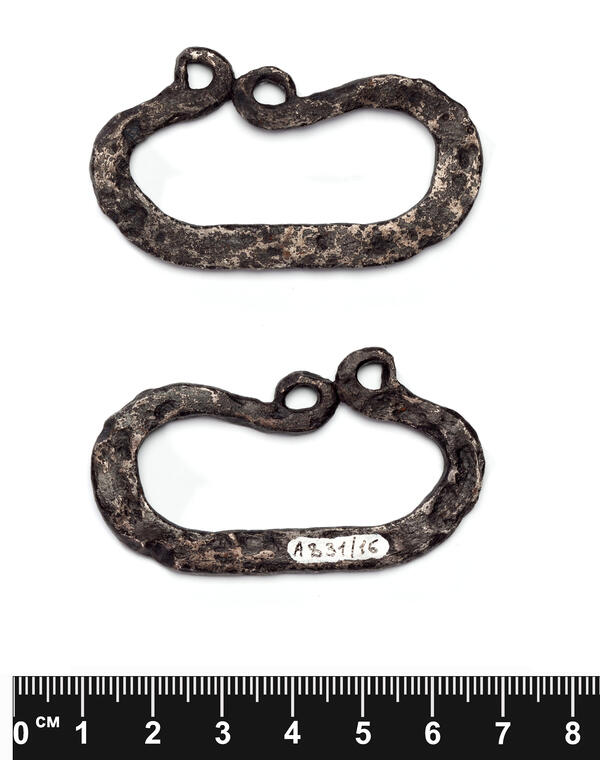
The fire striker from the museum’s permanent exhibition is a tool used in firemaking from the 12th to the 17th centuries. It is shaped as a narrow (up to 0.6 cm) sub-rectangular frame with a large oval opening and loop ends curled around into a circle.
The fire striker was uncovered in 2003 in excavations conducted by the State Historical Museum and the State Museum-Reserve “Kulikovo Field” on the watershed between the Rybiy Verkh ravine and the Smolka River, to the north of the Khvorostyanka village, Kurkinsky District, Tula Oblast, on site No. 22, grid 3. The fire striker now belongs to the collection of the State Museum-Reserve “Kulikovo Field”.
A fire striker — an implement for striking a spark to light a fire — is usually kept in a metal tinderbox with flint and tinder. The Russian word “kresalo” (“kresat” means to create a spark, to strike the fire steel; the other names being “ognivo”, “plashka”) is a piece of metal with an abrasive surface. The flint is used to strike the fire steel and generate a shower of sparks that ignite the tinder. Air has to be gently wafted over the glowing tinder, and if the tinder is right it immediately bursts into flame.
This C-shaped exhibit has curved ends and one edge without a high (triangular or rounded) middle part. Similar items have been found across the territory of Old Rus, Volga Bulgaria, East European steppe, Northern and Central Europe, and to the east of the Urals. The Novgorod finds date to the 12th century. From the second half of the 13th century to the 14th century they were most popular among the nomads in Eastern Europe.
Since olden times fire-starting was done using various devices. Since the 6th and 7th centuries, fire strikers remained the most popular tools. The use of flint and steel was common until the invention of the friction match.
Initially fire strikers were made from iron. However, iron is a difficult material, and it was hard to generate sparks. A flint is a hard rock which is much harder than a fire striker. Tinder was virtually any flammable material that could be ignited by sparks.
The fire striker was uncovered in 2003 in excavations conducted by the State Historical Museum and the State Museum-Reserve “Kulikovo Field” on the watershed between the Rybiy Verkh ravine and the Smolka River, to the north of the Khvorostyanka village, Kurkinsky District, Tula Oblast, on site No. 22, grid 3. The fire striker now belongs to the collection of the State Museum-Reserve “Kulikovo Field”.
A fire striker — an implement for striking a spark to light a fire — is usually kept in a metal tinderbox with flint and tinder. The Russian word “kresalo” (“kresat” means to create a spark, to strike the fire steel; the other names being “ognivo”, “plashka”) is a piece of metal with an abrasive surface. The flint is used to strike the fire steel and generate a shower of sparks that ignite the tinder. Air has to be gently wafted over the glowing tinder, and if the tinder is right it immediately bursts into flame.
This C-shaped exhibit has curved ends and one edge without a high (triangular or rounded) middle part. Similar items have been found across the territory of Old Rus, Volga Bulgaria, East European steppe, Northern and Central Europe, and to the east of the Urals. The Novgorod finds date to the 12th century. From the second half of the 13th century to the 14th century they were most popular among the nomads in Eastern Europe.
Since olden times fire-starting was done using various devices. Since the 6th and 7th centuries, fire strikers remained the most popular tools. The use of flint and steel was common until the invention of the friction match.
Initially fire strikers were made from iron. However, iron is a difficult material, and it was hard to generate sparks. A flint is a hard rock which is much harder than a fire striker. Tinder was virtually any flammable material that could be ignited by sparks.