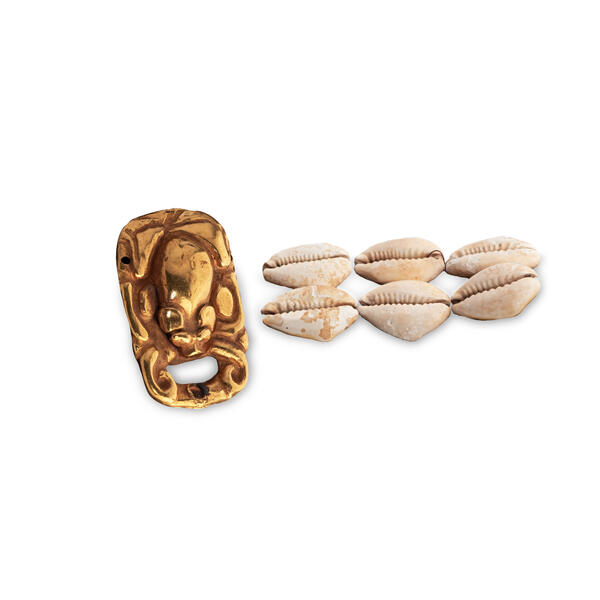
Artifacts from the museum’s collection were discovered by archaeologists during excavations of a burial site near the Novy farm in the Martynovsky district of the Rostov region between 1982 and 1983. The excavations revealed burials dating back to various periods in the history of Sarmatian people. In one of the burials, containing the remains of a male nomad, there was a rare gold belt buckle crafted in the zoomorphic style.
The nomad’s belt was adorned with two rows of cowry shells and secured with the zoomorphic-style belt buckle. The entire surface of the belt buckle is decorated with a relief image of a fantastic creature.
A rectangular, cast gold buckle features several basic elements that comprise its design. In the center, there is a depiction of a long-eared hedgehog. The eyes and ears are located on a narrow muzzle, which has a blunt end. The needles are not emphasized. The absence of this specific feature can be attributed to the ancient craftsman’s desire to accentuate the fantastical nature of this image.
The hind legs of the animal are clearly identifiable: based on morphological features, they resemble those of a frog. The front paws appear to be made offhandedly, and next to them are curved appendages that look like stylized images of snakes. In the front part of the animal’s head, there are whiskers that cover a slit-like opening. The interpretation of this motif is rather difficult due to the high degree of abstraction. It is very possible that these whiskers represent the heads of predatory birds or vultures, or even deer horns. A loop for attaching to a belt has been preserved at the back of the buckle.
The closest analogs to the buckle on display are part of the Siberian collection of Peter the Great from the village of Kosika in the Astrakhan region. However, they all have distinct differences. The motif based on the image of a hedgehog is extremely rare and not widely distributed. Images of frogs or parts of their bodies are also infrequent motifs, mainly represented in amulet pendants.
Images of fantastic animals may stem from ancient totems that combine the characteristics of multiple animals. Typically, a transformation in an animal’s appearance was associated with increased strength and power.
Objects made in the animal style functioned as amulets, with fantastic creatures intended to enhance the amulet’s power. By combining elements that mystically embody various animal properties, “supersyncretic” creatures — the most potent apotropaic symbols — were created.