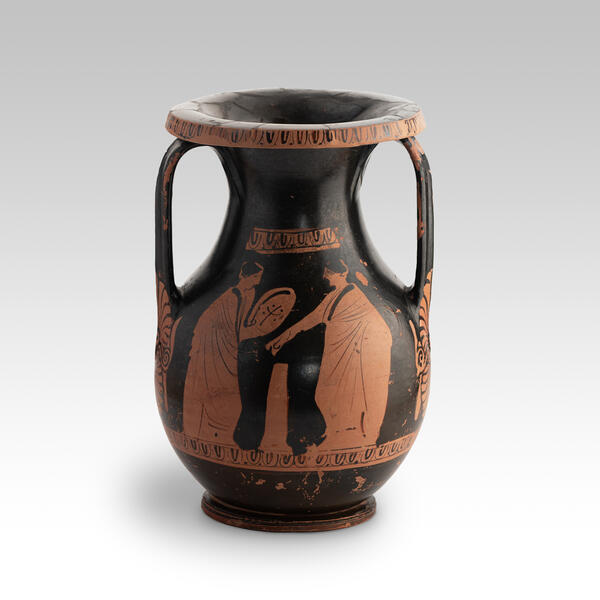
A pelike is a type of two-handled drinking vessel that the ancient Greeks used to mix wine and water.
The clay pelike on display was found in 1954 in a burial chamber of the kurgan complex “Five Brothers”, part of the larger burial site in the village of Yelizavetovskaya.
This particular pelike was crafted in the style of red-figure pottery. In ancient Greek ceramic art, there were two distinct methods of painting images: black-figure and red-figure pottery styles.
In black-figure painting, images were applied with a slip that turned black during firing, while the background was left the color of the clay.
The red-figure technique was more challenging. The potter would first create a sketch or outline of the desired design on the vessel using a sharp instrument, leaving the images to be the natural color of the clay. The remaining areas were then covered with a layer of black lacquer.
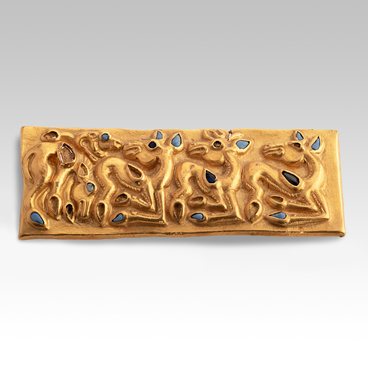
On one side of the pelike, there is a depiction of an Amazon warrior fighting a Greek foot soldier. The Amazon is shown riding a horse and holding a spear. Her clothing is embellished with gold patches. Based on the position of the Amazonian in the scene, experts who study ancient combat tactics believe that she likely would emerge victorious in this battle.
Numerous burials of female warriors with weapons have been discovered at the Yelizavetovskaya site. Ancient written sources also contain numerous references to female fighters, and their images have been preserved through the ages on ceramic vessels and in sculpture.
The Amazons were a women-only people in ancient Greek mythology. They formed their own military state and engaged in military campaigns, led by a queen. They were said to have descended from Ares, the god of war, and Harmonia, the nymph of harmony. To reproduce, the Amazons would enter into relationships with men from other nations. According to some versions, if a baby boy was born, he would be either sent to his father’s home or killed. If a baby girl was born, she would be raised as an Amazon.
Myths also mention that these Amazons lived near the banks of the Amazon and Thermodon rivers, in what is now the southern and southeastern part of the Black Sea region. From these areas, they would embark on campaigns to Asia. They were associated with the establishment of several cities, for instance, Ephesus and Smyrna.