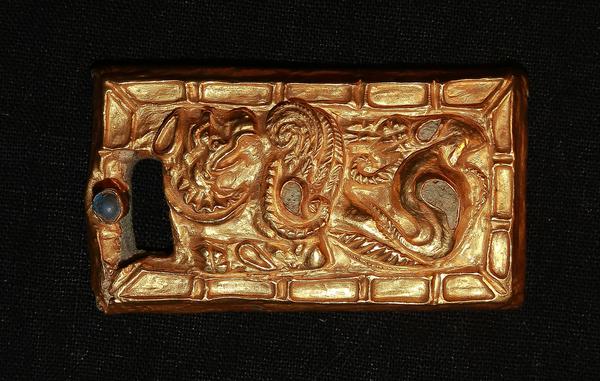
The rectangular belt buckle from the Astrakhan Museum Reserve collection was found by the Astrakhan archaeological expedition sent by Leningrad branch of the Institute of Archeology and led by ValentIn ShIlov in 1965. The excavations took place in the village of NikOlskoye, YenotAyevsky District, Astrakhan Region.
The buckle depicts a repousse griffin; it is a mythological winged creature with the body of a lion and the head of an eagle. The accessory is made of bronze and covered with gold plate on one side.
The buckle may be attributed to the items of the so-called Sarmatian animal style where animal images were depicted. Based on the style, the Sarmatians crafted many various gold jewelry: bracelets and buckles, bridle appliques and torcs — pendants that were usually worn around the neck.
At various times, zoomorphic images were scribed on the dishes and luxury items by various peoples. But the Sarmatians had their own stylistic devices, so scholars singled out their style into a special independent group. The Sarmatians depicted animals in an emphasized decorative manner: they extra brightly decorated their bodies with coloured inserts and linear ornaments. On the buckle from the Astrakhan Museum Reserve collection, we can see such an insert made of dark stone, as well as holders that are special sockets used by ancient craftsmen to fix decors. The holders were usually made separately, then they were soldered onto the items, and then additional decorations were inserted into them. Coloured stones emphasized repoussé muscles, sharp teeth and claws, eyes and feathers. And sometimes (as in our case) they simply fixed several figured holders with decor, inscribing them into a embossed patterned image of an animal.
Items in the Sarmatian animal style were widespread in the steppes of the Lower Volga and Don Regions from the beginning of the II century BC to the beginning of the I century AD. They are found in the rich burials of the Sarmatian-Alan nobility.
In 2005, the buckle and other archaeological finds from the Astrakhan Museum Reserve collection were exhibited in 2005 at the Astrakhan Steppe Treasures show at the National Museum of the Palazzo Venezia in Rome, and in 3 years at the Gold of the Sarmatians exhibition in the State Historical Museum (Moscow).
The buckle depicts a repousse griffin; it is a mythological winged creature with the body of a lion and the head of an eagle. The accessory is made of bronze and covered with gold plate on one side.
The buckle may be attributed to the items of the so-called Sarmatian animal style where animal images were depicted. Based on the style, the Sarmatians crafted many various gold jewelry: bracelets and buckles, bridle appliques and torcs — pendants that were usually worn around the neck.
At various times, zoomorphic images were scribed on the dishes and luxury items by various peoples. But the Sarmatians had their own stylistic devices, so scholars singled out their style into a special independent group. The Sarmatians depicted animals in an emphasized decorative manner: they extra brightly decorated their bodies with coloured inserts and linear ornaments. On the buckle from the Astrakhan Museum Reserve collection, we can see such an insert made of dark stone, as well as holders that are special sockets used by ancient craftsmen to fix decors. The holders were usually made separately, then they were soldered onto the items, and then additional decorations were inserted into them. Coloured stones emphasized repoussé muscles, sharp teeth and claws, eyes and feathers. And sometimes (as in our case) they simply fixed several figured holders with decor, inscribing them into a embossed patterned image of an animal.
Items in the Sarmatian animal style were widespread in the steppes of the Lower Volga and Don Regions from the beginning of the II century BC to the beginning of the I century AD. They are found in the rich burials of the Sarmatian-Alan nobility.
In 2005, the buckle and other archaeological finds from the Astrakhan Museum Reserve collection were exhibited in 2005 at the Astrakhan Steppe Treasures show at the National Museum of the Palazzo Venezia in Rome, and in 3 years at the Gold of the Sarmatians exhibition in the State Historical Museum (Moscow).