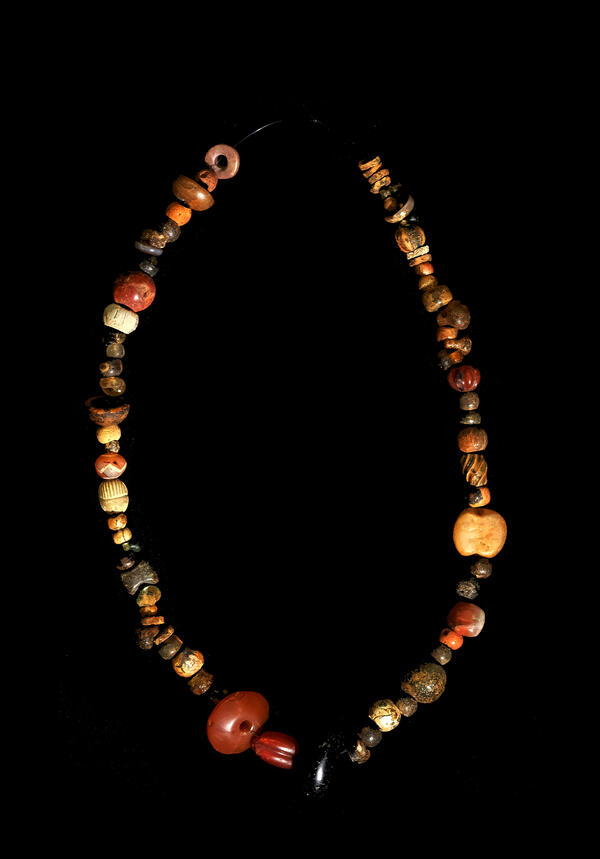
The beads were found in the course of archaeological excavations near the KomsomOlsky village of the KrasnoYArsky District in the Astrakhan Region in 1987-1988. The items were found in a woman’s burial mound, which gave to the researchers an idea that the woman was a family or clan priestess high-ranked in the society during her lifetime. The burial place was covered with beads that were consolidated for the exposition as a necklace.
A few of the finds are particularly interesting: an Egyptian faience dung beetle-shaped pierced bead, blue glass bead and carnelian bead.
There is Anubis depicted on the back side of the faience bead. The material, Egyptian faience, was crushed quartz covered with a glassy alkaline glaze. Most of such ornaments in Eastern Europe date back to the 1st — 2nd centuries AD. At that time, such patterns were widespread from the Urals to the Dniester; sometimes faience items were found in Kazakhstan, India and Central Europe. They were found especially often in the Crimea, the Kuban region, and on the Lower Don. The inhabitants of these regions received jewelry from ancient centers: Panticapaeum, Chersonesos, Tanais and other Greek cities located on the northern and eastern shores of the Black Sea. The farther a location is distant from the developed Greek city-states, the fewer faience items are found.
The figurine faience pendants convey mainly Egyptian plots and images of those cults that arose after two large cultures merged: ancient and Egyptian. The dung beetle was considered a symbol of rebirth; in Egypt, dung beetle-shaped items served as personal seals bearing the owner name carved in hieroglyphs. Anubis is an ancient Egyptian deity with a jackal’s head and a human body. The deity in Egypt was considered a guide of the dead to the afterlife and the patron of necropolises and cemeteries.
This blue glass bead is short barrel-shaped and has three eyes. One of them is a faceted pattern in the form of a green dot with a green circle around on a yellowish background. The image of the ‘eye’ in many cultures is considered a strong amulet, therefore, such beads are quite common.
This spherical bead is made of carnelian. Carnelian is a kind of chalcedony; its colours range from shades of orange and brown to sometimes brown or reddish. It is assumed that this colour is a result of exposure to the sun and weathering.
A few of the finds are particularly interesting: an Egyptian faience dung beetle-shaped pierced bead, blue glass bead and carnelian bead.
There is Anubis depicted on the back side of the faience bead. The material, Egyptian faience, was crushed quartz covered with a glassy alkaline glaze. Most of such ornaments in Eastern Europe date back to the 1st — 2nd centuries AD. At that time, such patterns were widespread from the Urals to the Dniester; sometimes faience items were found in Kazakhstan, India and Central Europe. They were found especially often in the Crimea, the Kuban region, and on the Lower Don. The inhabitants of these regions received jewelry from ancient centers: Panticapaeum, Chersonesos, Tanais and other Greek cities located on the northern and eastern shores of the Black Sea. The farther a location is distant from the developed Greek city-states, the fewer faience items are found.
The figurine faience pendants convey mainly Egyptian plots and images of those cults that arose after two large cultures merged: ancient and Egyptian. The dung beetle was considered a symbol of rebirth; in Egypt, dung beetle-shaped items served as personal seals bearing the owner name carved in hieroglyphs. Anubis is an ancient Egyptian deity with a jackal’s head and a human body. The deity in Egypt was considered a guide of the dead to the afterlife and the patron of necropolises and cemeteries.
This blue glass bead is short barrel-shaped and has three eyes. One of them is a faceted pattern in the form of a green dot with a green circle around on a yellowish background. The image of the ‘eye’ in many cultures is considered a strong amulet, therefore, such beads are quite common.
This spherical bead is made of carnelian. Carnelian is a kind of chalcedony; its colours range from shades of orange and brown to sometimes brown or reddish. It is assumed that this colour is a result of exposure to the sun and weathering.