The gold bracelet - bracer - was found in the BEra burial mound near the KOsika village in the YenotAyevsky District. This burial was opened and destroyed in 1984, when a water culvert trench was laid there.
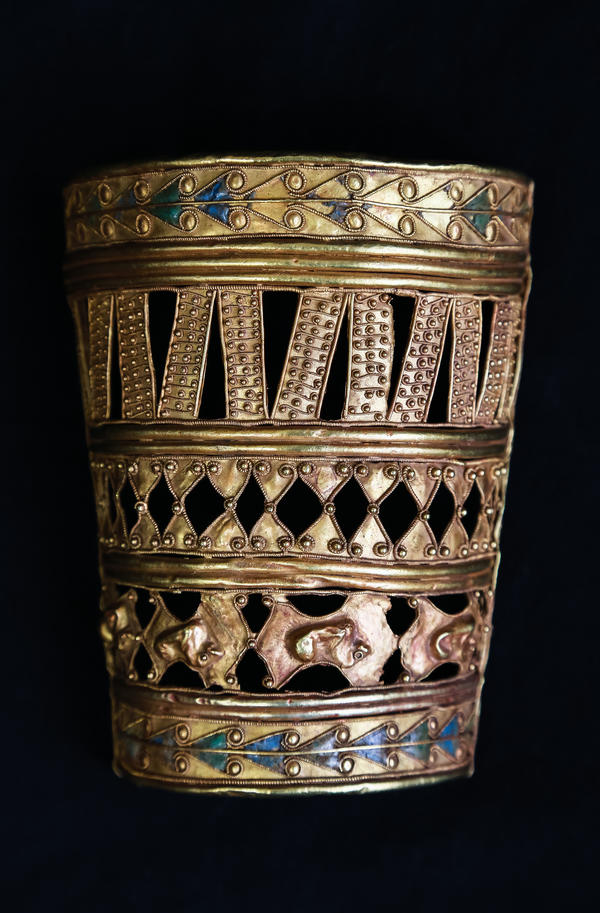
The bracer consists of two parts, one of which is well preserved. The decoration item has a shape of a truncated cone soldered from five friezes, horizontal decorative elements. They are separated with tube stripes.
The upper and lower friezes are decorated in the same way: they depict an ornament in the form of waves that swirl in circles. The waves are decorated with blue and green enamel; their contours are made of twisted wires; each curl has a granule that is a small hollow ball.
The ornament of the second, openwork, frieze consists of four stretched smooth skins also framed with enamel. There is a deeply embossed carcass of a ram in the middle of each skin: the legs are repoussé; the eyes are marked with a wire ring and a ball in the middle. Researchers believe that the decor reflects the ancient Greek’s myth of the Golden Fleece that was the skin of a ram, on the back of which Frix and Gella, children of the Orkhomenian king Afamant, set out to the shores of Asia to flee the persecution by their stepmother Ino or, according to another version of the myth, by their aunt Biadiki. On the way, Gella fell into the sea, while Frix reached the coast of Colchis (Western Georgia). He sacrificed a ram to Zeus, and presented the golden fleece to the king of Colchis. The Golden Fleece became the magical guarantor of the prosperity of the Colchians, and later it was stolen and taken to Greece by the Argonauts under the leadership of Jason.
The third frieze, also openwork, consists of a row of figures that resemble an hourglass. They are also decorated with enamel and grains.
The fourth frieze was cut from one plate. It consists of triglyphs. The triglyph is an architectural term for rectangular, vertically elongated slabs with grooves. The triglyphs are tilted towards each other and decorated with wires and grains.
In 2005, the bracer and other ancient items from the Astrakhan Museum Reserve collection were exhibited at the Astrakhan Steppe Treasures show at the National Museum of the Palazzo Venezia in Rome.
The bracer consists of two parts, one of which is well preserved. The decoration item has a shape of a truncated cone soldered from five friezes, horizontal decorative elements. They are separated with tube stripes.
The upper and lower friezes are decorated in the same way: they depict an ornament in the form of waves that swirl in circles. The waves are decorated with blue and green enamel; their contours are made of twisted wires; each curl has a granule that is a small hollow ball.
The ornament of the second, openwork, frieze consists of four stretched smooth skins also framed with enamel. There is a deeply embossed carcass of a ram in the middle of each skin: the legs are repoussé; the eyes are marked with a wire ring and a ball in the middle. Researchers believe that the decor reflects the ancient Greek’s myth of the Golden Fleece that was the skin of a ram, on the back of which Frix and Gella, children of the Orkhomenian king Afamant, set out to the shores of Asia to flee the persecution by their stepmother Ino or, according to another version of the myth, by their aunt Biadiki. On the way, Gella fell into the sea, while Frix reached the coast of Colchis (Western Georgia). He sacrificed a ram to Zeus, and presented the golden fleece to the king of Colchis. The Golden Fleece became the magical guarantor of the prosperity of the Colchians, and later it was stolen and taken to Greece by the Argonauts under the leadership of Jason.
The third frieze, also openwork, consists of a row of figures that resemble an hourglass. They are also decorated with enamel and grains.
The fourth frieze was cut from one plate. It consists of triglyphs. The triglyph is an architectural term for rectangular, vertically elongated slabs with grooves. The triglyphs are tilted towards each other and decorated with wires and grains.
In 2005, the bracer and other ancient items from the Astrakhan Museum Reserve collection were exhibited at the Astrakhan Steppe Treasures show at the National Museum of the Palazzo Venezia in Rome.