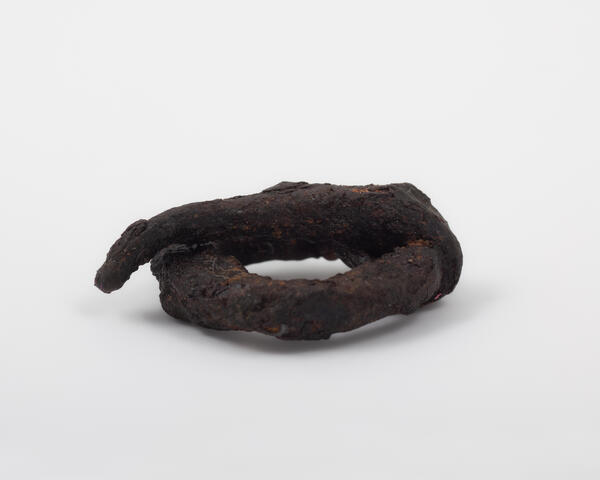
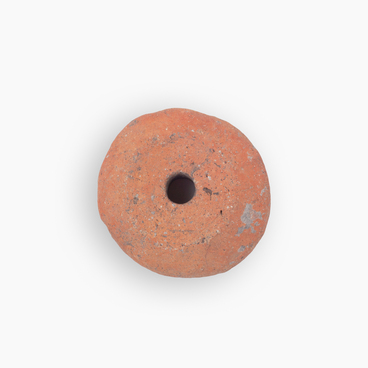
The object was found near the village of Dronyaevo in the Kurchatovsky district of the Kursk region during the explorations of the Middle Seym Expedition of the Institute of Archaeology of the Russian Academy of Sciences in 2010–2011. The expedition was led by Oleg Alexandrovich Radyush. In 2012, the artifact was transferred to the collections of the Kursk Museum of Archaeology.
The forged iron buckle consists of two parts: an oval “bagel-shaped” frame with a massive, heavily thickened front part, and a beak-shaped, narrowing, and sharply curved tongue. Both parts are faceted in cross-section. The artifact belongs to the Chernyakhov archaeological culture, the bearers of which were the Germanic tribes — Goths, who inhabited the territory from the lower Danube in the west to the Seversky Donets in the east during the 3rd–4th centuries.
In Roman and Migration periods, the Gothic costume was a complex symbolic system that included headdress, clothing, shoes, jewelry, accessories, equipment, hairstyles, and tattoos. Buckles were an essential attribute of men’s and military attire. They are very frequently found in Chernyakhov burials. Most were made of bronze, silver, and less commonly iron. Their design is simple, consisting of a cast (or forged) frame and a tongue. Usually, buckles were equipped with a strap made of forged metal plates.
In many cases, men were buried with two belts, one of which was intended for carrying weapons. Buckles were often used to attach knives in scabbards to belts, as well as pouches in which small everyday items were kept, such as awls, flints, and others. Less commonly, bagel-shaped buckles were used to fasten shoes with leather straps, as evidenced by male burials in Southwestern Crimea.
During the Renaissance, the Goths were viewed by
humanists as bearers of barbarism, responsible for the destruction of ancient
civilization. Before the term “Middle Ages” was coined, all Germanic-barbarian
elements in European culture were referred to as “Gothic.” This is where the
terms “Gothic” and “Gothic script” originate, although these phenomena have no
direct connection to the Goths.