Font
Color
Graphics
Изображение точки

To see AR mode in action:

1. Install ARTEFACT app for iOS or Android;

2. Find the exhibition «The Gold of the Huns»

3. Push the «Augmented reality» button and point your phone's camera at the exhibit;

Скрыть точки интересаПоказать точки интереса
Показать в высоком качестве

Shield-shaped fibula

Creation period
the late 4th — the early 5th century
Place of сreation
Dnieper’s Left Bank
Dimensions
8,5x5,6 cm
Technique
copper; casting, forging
0
Open in app
#1

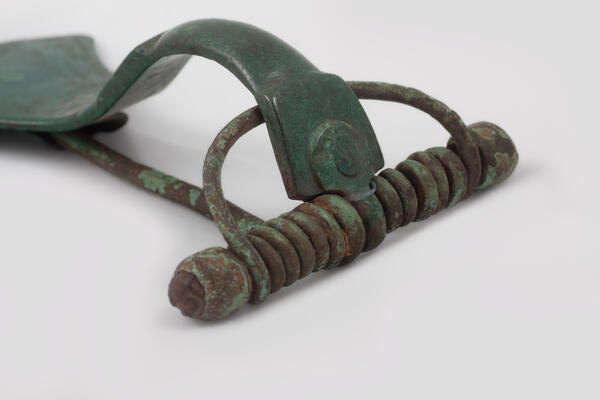
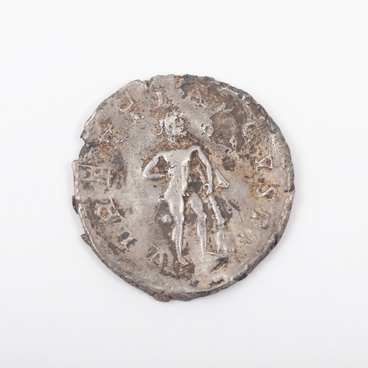
The fibula was discovered during the archaeological explorations of the Middle Seym Expedition of the Institute of Archaeology of the Russian Academy of Sciences in 2008–2009 in the village of Shmyrevo, Belovsky District, Kursk Region. The expedition was led by Oleg Alexandrovich Radyush. In 2010, the artifact was transferred to the collections of the Kursk State Museum of Archaeology.

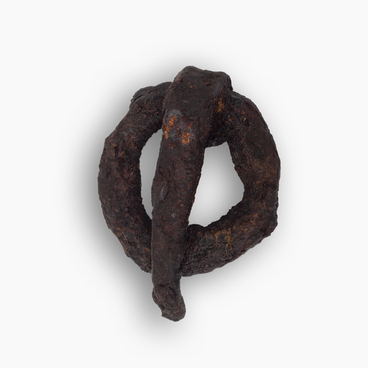
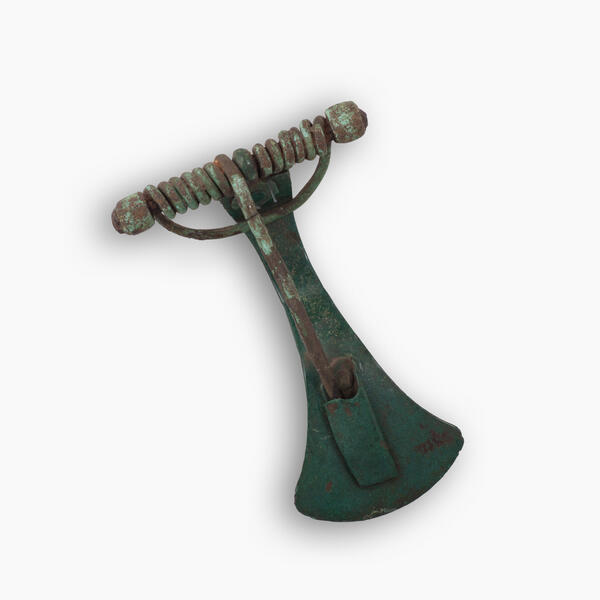
The pin is cast from a copper alloy. It is fitted with a simple spring mechanism on an iron pin, clamped on both sides by fixing rings. The back has a symmetrical curve, smoothly transitioning into a shield of rounded sector shape. The artifact is dated to the late 4th to early 5th century CE and belongs to the Chernyakhov archaeological culture, whose bearers were the Gothic tribes — Goths — who settled from the Lower Danube in the west to the Seversky Donets in the east during the 2nd to 4th centuries. Their ancestral homeland is localized in Southern Sweden, where the historical region of Götaland and the city of Gothenburg still exist. The Goths traveled a long way from the shores of Scandinavia, reached the northern coast of the Black Sea, and settled on the territories between the Dnieper and the Sea of Azov. In the early 3rd century, they entered into active interaction with the Roman Empire, where military conflicts alternated with trade relations and mercenary service.
#3
Shield-shaped fibula
#4

During Roman and Migration periods, the Gothic costume was a complex system that included headgear, clothing, footwear, jewelry, accessories, equipment, hairstyles, and tattoos. An essential attribute of both men’s and women’s sets — complexes of jewelry connected into a unified system that carried not only decorative but also semantic meaning — were fibulae, which were made of copper alloy, and less often of silver. They are very often found in Chernyakhov burials. Women wore fibulae in pairs, most often symmetrically on either side of the chest, with the spring mechanism facing downward. Fibulae were used to fasten peplos — a sleeveless women’s outer garment with folds hanging over the chest and back. Men used fibulae to fasten their cloaks.

#5
Shield-shaped fibula
#2
View in the State Catalogue
read morehide
00:00
00:00
1x

Shield-shaped fibula

Creation period
the late 4th — the early 5th century
Place of сreation
Dnieper’s Left Bank
Dimensions
8,5x5,6 cm
Technique
copper; casting, forging
0
Point your smartphone camera to open in the app
Share
VkontakteOdnoklassnikiTelegram
Share on my website
Copy linkCopied
Copy
Open in app
To see AR mode in action:
  1. Install ARTEFACT app for 
  2. iOS or Android;
  3. Find and download the «Paintings in Details» exhibition
  4. Push the «Augmented reality» button and point your phone's camera at the painting;
  5. Watch what happens on your phone screen whilst you flip through the pictures.
 
We use Cookies
Cookies on the Artefact Website. We use cookies to ensure that we give you the best experience on our website. If you continue without changing your settings, we'll assume that you are happy to receive all cookies on the Artefact website. However, if you would like to, you can change your cookie settings at any time.
Learn more about useHide
Content is available only in Russian

X

Нашли опечатку?...

%title%%type%