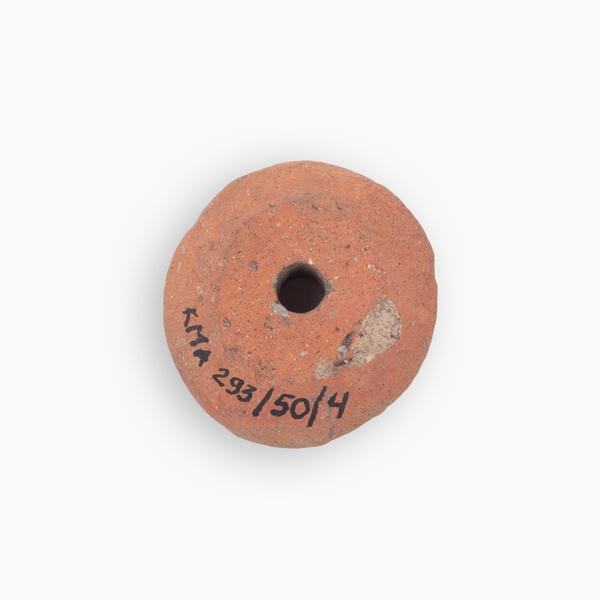
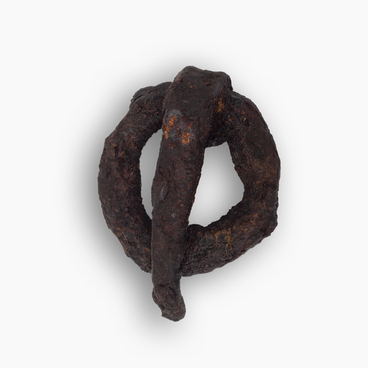
The spindle whorl was found at the Dichnya I settlement site in the Kurchatovsky District of Kursk Region and is associated with the Chernyakhov archaeological culture, which inhabited the vast territory from the Lower Danube in the west to the Seversky Donets in the east during the 2nd–4th centuries. This light brown weight has the shape of a low biconical cylinder with a through hole. It is hand-molded from a clay-sand mixture and fired. Such a spindle whorl was used to weigh down the spindle and secure the yarn on it.
The artifact is dated to the 4th — early 5th century. Spinning threads for fabric is one of the oldest types of domestic production. The necessary tool for hand spinning was a spindle, which in its simplest form is a wooden rod with a flywheel load at the lower end. Among some peoples of Eastern Europe, these devices were used until the early 20th century. Spindle whorls vary in size and weight and were used for different spinning fibers. Smaller and lighter weights were needed for wool, while heavier ones were used for flax. In burial sites of various archaeological cultures, they typically accompany female burials, as spinning was traditionally a female occupation.
Spindle whorls are a common find at Chernyakhov
culture sites. The vast majority of spindle whorls were made from clay and then
fired, but other materials were also used, such as glass, bone, and marl.
Specimens made from polished sherds of locally produced pottery, as well as
from the walls and bottoms of imported vessels, are often found. A large number
of spindle whorls are products of pottery workshops. The precise geometric
shape, clay composition, and uniform gray kiln firing indicate that they were
produced alongside tableware or, less frequently, kitchenware. Handmade spindle
whorls are often less carefully crafted, with uneven firing, likely done in an
open hearth. These tend to deviate more from traditional types. The main types
of decoration on Chernyakhov spindle whorls include graphic, stamped, and
mouldable designs, which sometimes are combined. The application of
inscriptions and individual images, which could serve as ownership marks or
talismans, can also be considered a form of decoration.