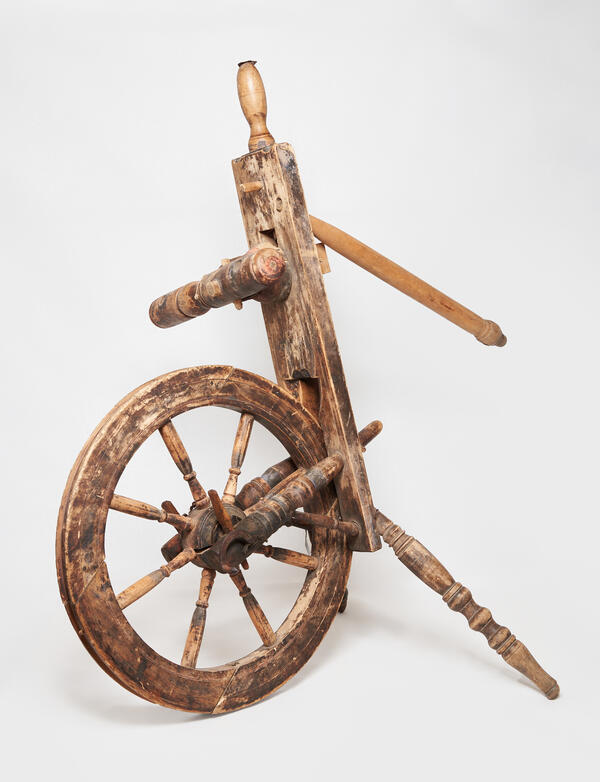
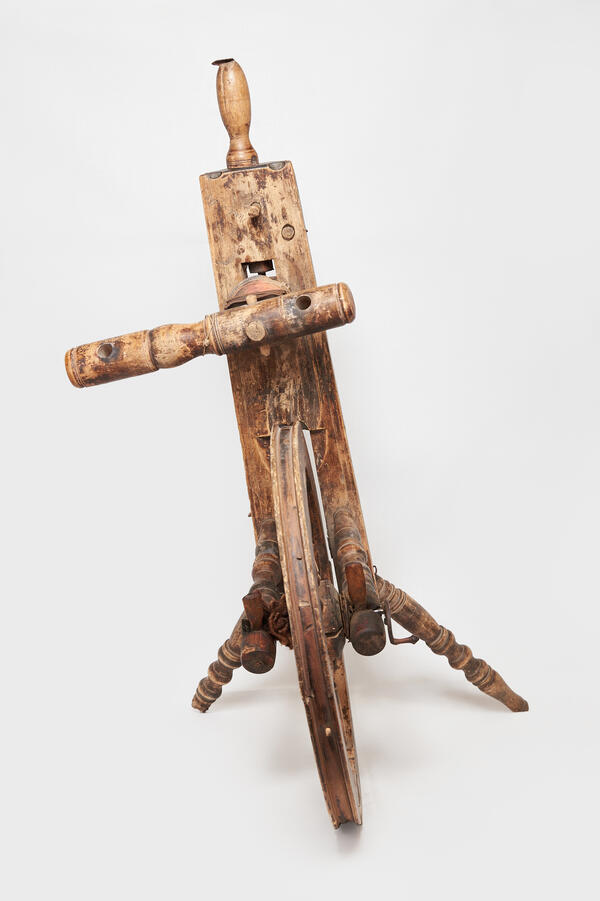
It is believed that the first spinning wheel was invented in India more than two and a half thousand years ago. No such devices have been preserved, however, there is evidence that substantiates this hypothesis. The American historian and archaeologist Jonathan Mark Kenoyer studied ancient Indian fabrics and came to the conclusion that such homogeneous threads, capable of producing a tight weave, could only be obtained with the help of a special spinning mechanism.
There are other versions of the origin of this device: it is mentioned, for example, in Chinese written sources of the 2nd century AD; a drawing depicting a spinner in front of a spinning wheel was found on an even older monument from Baghdad. One way or another, the eastern regions should be considered the homeland of spinning wheels. Many examples of the Indian spinning wheel called charkha have survived to the present day. When working with it, the spinner rotates the wheel with one hand, and with the other twists the thread fed to the sharp tip of the spindle.
Thanks to travelers and merchants, this invention was brought to Europe. The oldest image of a European spinning wheel shows a board with a cylinder mounted on it, inside of which a spinning wheel is installed horizontally. The monument was dated 1480. At that time, the mechanism was not very popular: historians explain the numerous prohibitions on its use by the low quality of products — a weak and knotty thread. The device was perfected over time by adding a flier and a bobbin.
In the 15th century, spinning wheels were already used on Russian soil. The spinner rotates the wheel with her right hand, feeding fibers to the spindle with her left hand. The rotation is transmitted to the spindle via a belt. When the thread reaches the length of the human arm, it is reeled onto the spindle rod, and then the spinning process starts again.
Spinning wheels allowed twisting, pulling and winding threads at the same time, hence, it was a much faster spinning process: 400 grams of wool, which took several days to spin with a spindle, could now be processed within a few hours.