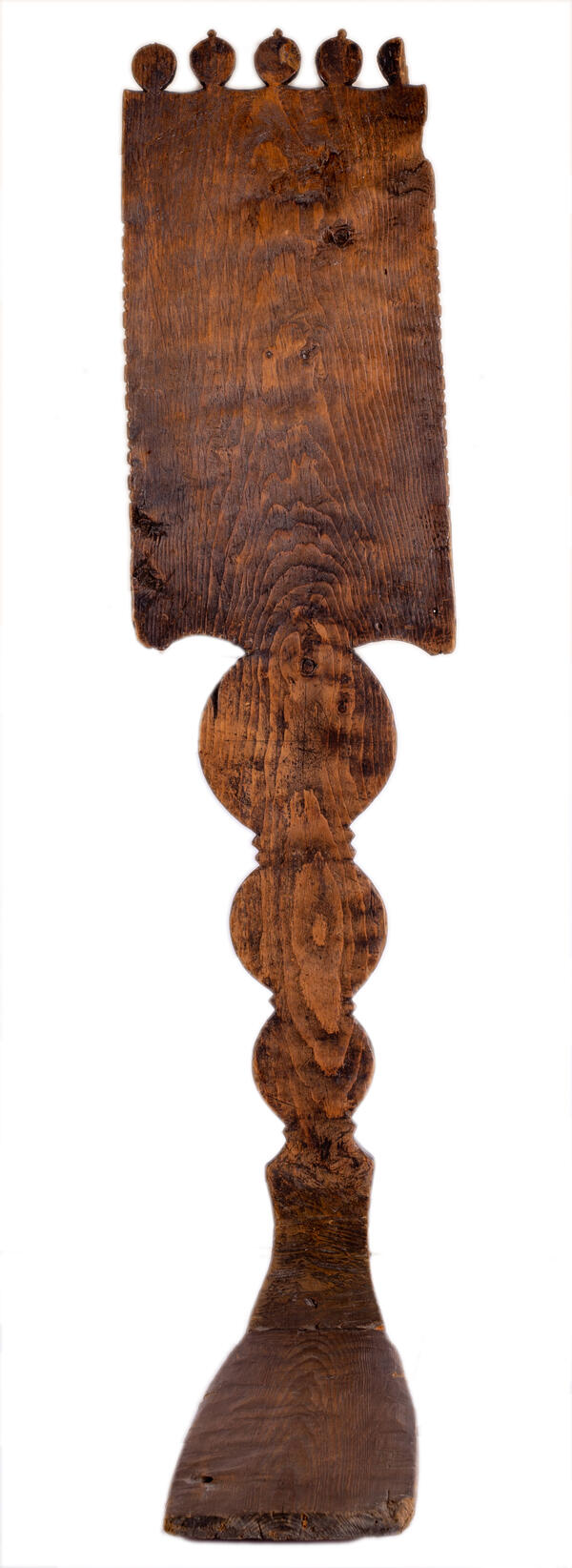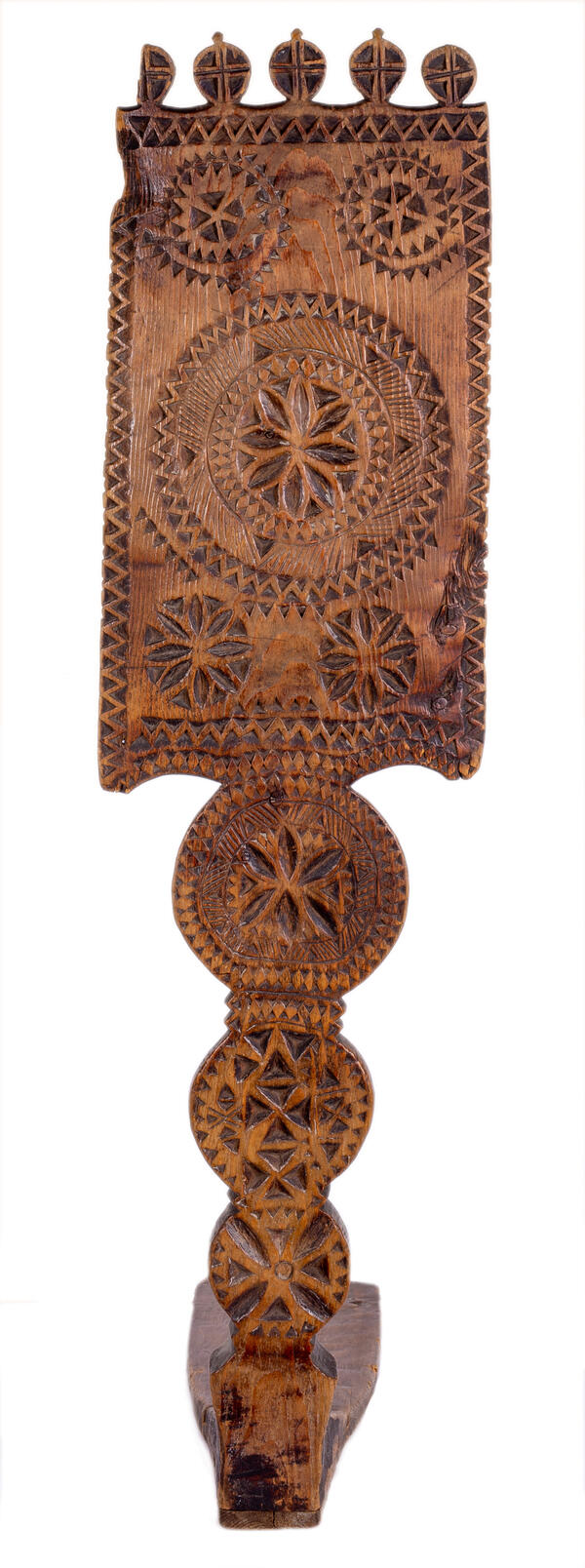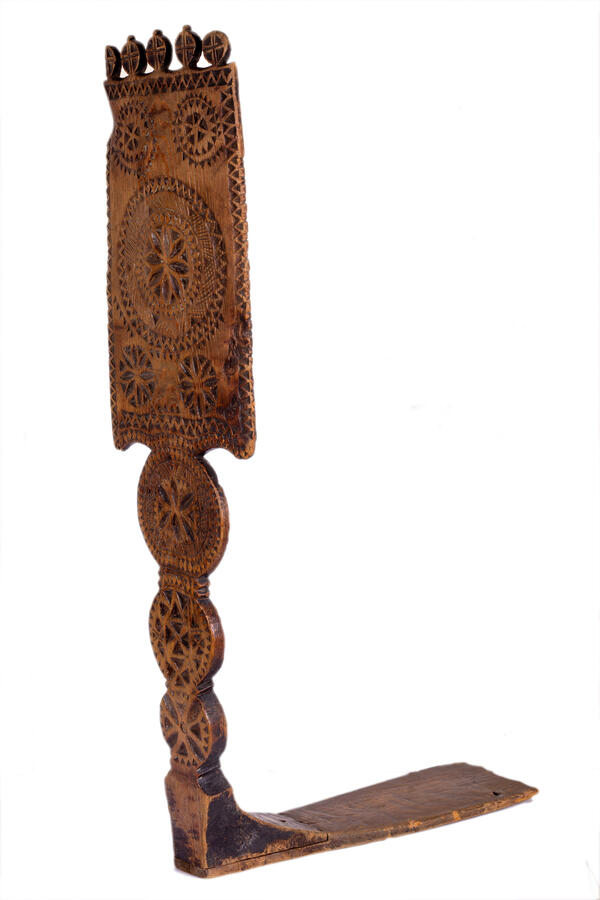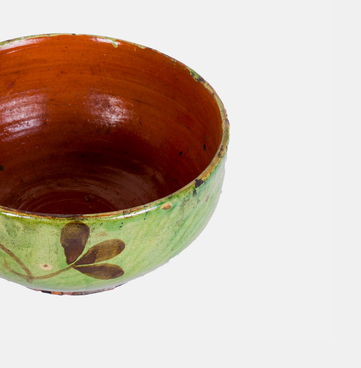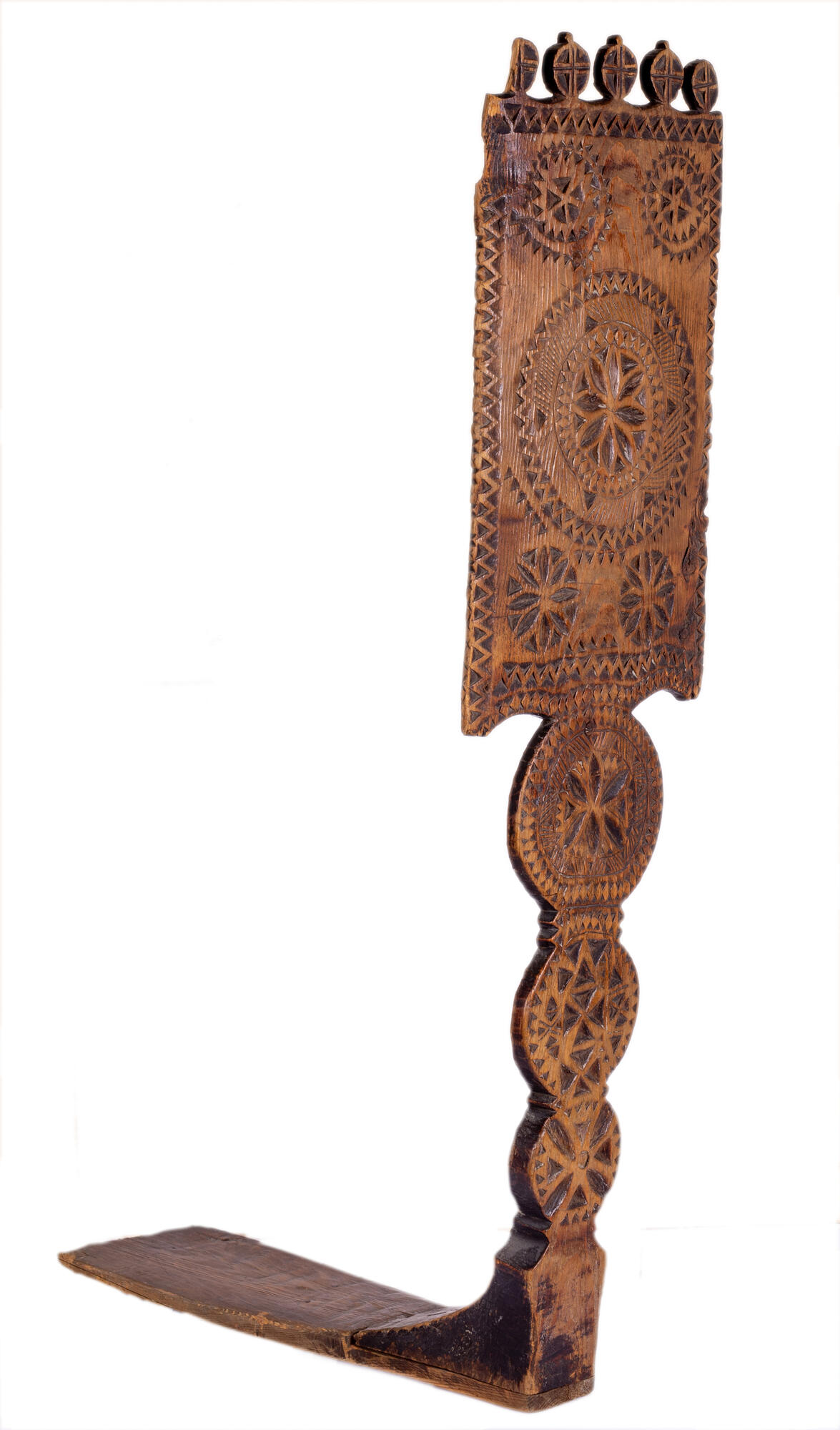


A distaff is a spinning tool, which consists of a platform, where the spinner sat (bottom) and a stand with a blade, on which rolled up tow — fiber, cleaned from the woody parts of the stem and prepared for spinning — is fixed. The most ancient “kopylny” distaffs were carved out of a whole stump, uprooted together with the root. For later, two- or three-piece ones, several types of wood could be used: ash or maple for the stand, aspen or linden for the bottom.
A spinner sat on the bottom, tied flax tow to the blade, and wove (twisted) yarn with the help of a spindle.
The spinning and weaving season was between October and March, the months free from field work. To brighten up the difficult, monotonous labor, spinners would gather for “supryadki”: they would spin yarn and sing at the same time, listen to stories and legends, and then relax together dancing and playing games.
A distaff and a spindle accompanied a woman from birth: during the birth ritual, the umbilical cord was cut on the distaff of the future housewife, so that when she grew up, she would be a good spinner.
Peasant girls learned to spin from the age of five or seven. The father made a small spinning wheel especially for his daughter. The first spun yarn was supposed to be burned and mixed with water. This water was to be drunk in order for the girl to remain diligent and industrious.
The distaff was one of the most prominent symbols of women’s culture. At weddings, the bride would throw a distaff over the gate of the groom’s house and wonder: if he threw it back over the gate — a boy would be born, if he brought it through the gate — a girl would be born. If the couple wanted a girl, then during the conjugal act the woman put a “little distaff” made of slivers under the pillow, if they wanted a boy — she put an axe there. The giving of a distaff to a newlywed couple was a ritual that took place on one of the significant days of the calendar.
At the gatherings a distaff was a symbol of an individual girl’s place: if a girl took a wrong place, her distaff was tossed to the threshold; the expression “to sit near the distaff” meant to sit next to the girl. The girl could have her distaff broken for violating certain norms — cheating on her partner, or not participating in youth gatherings.
On Shrove Monday women slid down the hills on distaff bottoms. This was done with the incantation “for a clean flax crop”.