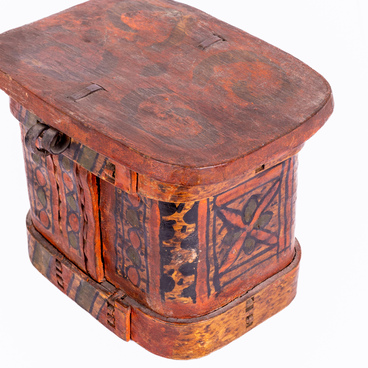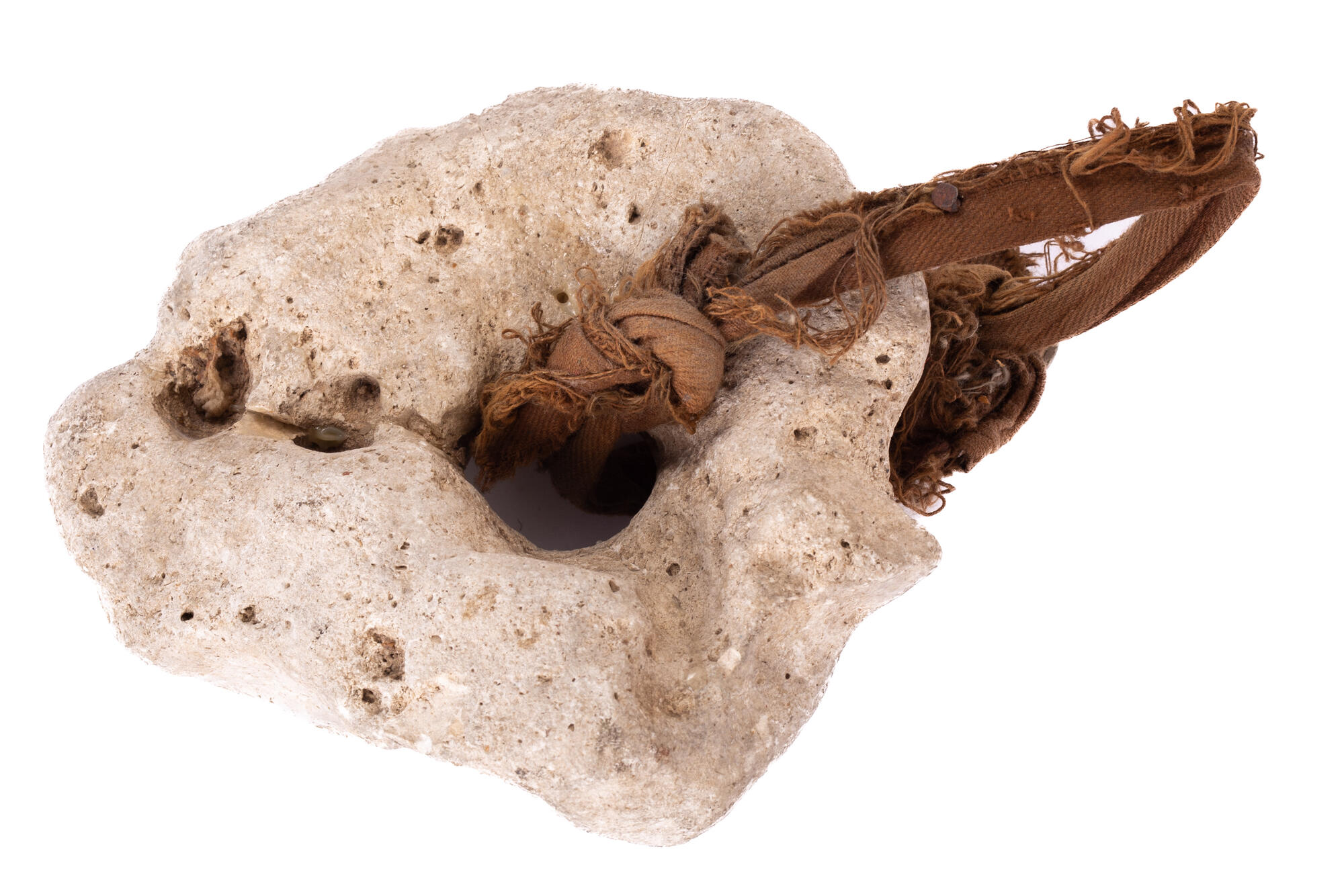


A chicken god, also “chicken priest” was one of the amulets in Russia. It was a stone or other object with an opening, which was traditionally suspended in the hen house. According to peasant beliefs, it served as a kind of icon for hens that protected them from tricks of the house spirit and kikimora, as well as from diseases increasing the fecundity of poultry.
Amulets in the form of stones with openings were also widespread among the peoples of Europe, Siberia, and the Caucasus. In Europe, they were referred to as holy, bewitching, adder stones, and used to protect homes, people, domestic animals, and crops from sorcery, evil spirits, and accidents.
In the Kostroma, Vologda, and Yaroslavl provinces, a stone with an opening was known as an “urochny stone”. This name comes from the word “urok”, which was also used to describe a jinx. A person suffering from a fever, fright or insomnia drank or was sprinkled with the water, which had been previously affected by the talisman dipped into it. A “chicken god” was hung not only in hen-houses, but also in the yard (for the well-being of livestock) and at the head of the bed (to get rid of nightmares). The healers of Tambov governorate treated teeth by means of incantation and sixfold cross application of such a stone to a sore spot.
The peasants of the Vladimir and Nizhny Novgorod governorates believed that for a “chicken god” to have magical powers, it had to be acquired accidentally rather than intentionally. They were treasured and handed down as heirlooms along with the family home.
Not only stones but also other objects could serve as “chicken gods”: an old bast shoe, scraps of red cloth, a neck of a broken clay jug or washbasin, a pot, a bottomless basket, a fir branch, and other things. The openings in the object and its shabby condition were considered signs of closeness to the netherworld.
To enhance the protective properties, chicken droppings and a straw cross were placed in the bast shoe, and a juniper branch or a piece of incense was put in the pot. In Moscow, Kostroma, and Vladimir governorates, anthropomorphic figures made of wood and stone served as chicken gods.
In the villages of different governorates the “chicken gods” were the patron saints of hens: St. Demetrius of Thessaloniki in Moscow Governorate, St. Cosmas and Damian in Penza Governorate, St. Nicholas in Ryazan, St. Cyricus and Julitta in Tobolsk Governorate.