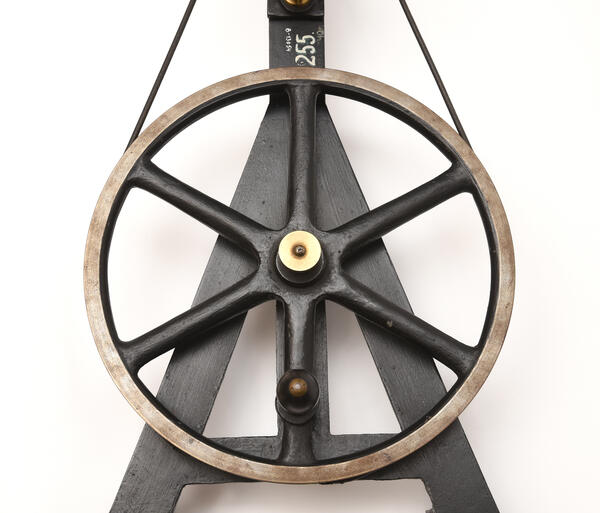
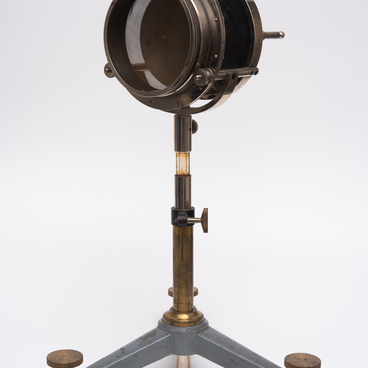
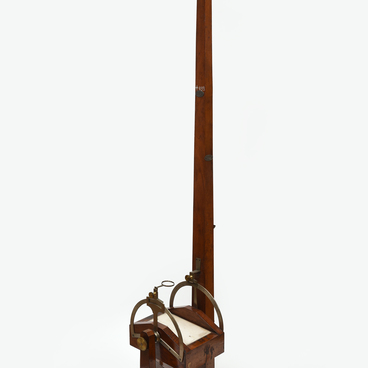
The Puluj’s apparatus was designed to measure the mechanical equivalent of heat. Based on the principle of the conservation of mechanical energy, the total mechanical energy of a system can be divided into kinetic and potential energy. For instance, during friction, mechanical energy can be converted into internal energy — thermal energy, as the bodies involved in friction heat up. The operation of the Puluj’s apparatus is based on this phenomenon.
Ivan Pavlovich Puluj was a Ukrainian physicist and electrical engineer who made significant contributions to the field of physics. The bulk of his research focused on the study of electric currents in vacuum. He presented his device in 1875 while working as an assistant at the Physics and Mechanics Department of the Naval Academy in Fiume, now Rijeka in Croatia, which was then part of the Austro-Hungarian Empire.
The numerical values for the mechanical equivalent of heat obtained by Puluj through the use of this device were accurate and consistent with those discovered by the English physicist, James Joule. Puluj’s invention was showcased at the World’s Fair in Paris in 1878, where it received a silver medal.
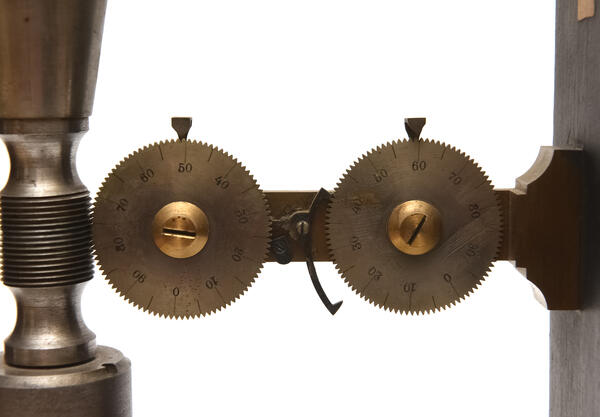
The device consists of several key components: a centrifuge, a block that rotates a cone with a fluid, and a thermometer (the device on display does not have this last component). The operation of the device involves using a handle on the centrifuge to rotate the cone. The body itself begins to heat up. The temperature of the fluid is then measured using the thermometer. The mechanical work and the heat produced can be calculated by measuring the moment of force and the angular momentum which can be determined by gears. By knowing the amount of work and heat, it is possible to determine the mechanical equivalent of heat and, therefore, the numerical value for the amount of mechanical work.