This device is designed to demonstrate and investigate the principles of elastic collision. A collision is a short-term interaction between two or more objects. As a result of the collision, significant internal forces are generated within the objects. An elastic collision is a type of collision where no deformation occurs in either object, and the energy is instantaneously distributed throughout the object. A clear example of such an interaction is the collision between billiard balls.
All the kinetic energy possessed by the objects before the collision is converted back into kinetic energy afterwards. The principles of conservation of momentum and conservation of energy apply to elastic collisions. The term “kinetic” originates from the Greek word kinesis, meaning motion. Kinetic energy is the work needed to accelerate a body of a given mass 𝑚 from rest to a velocity 𝑣. Alternatively, it is the work that an object with a mass 𝑚, having an initial velocity 𝑣, can make when stopping.
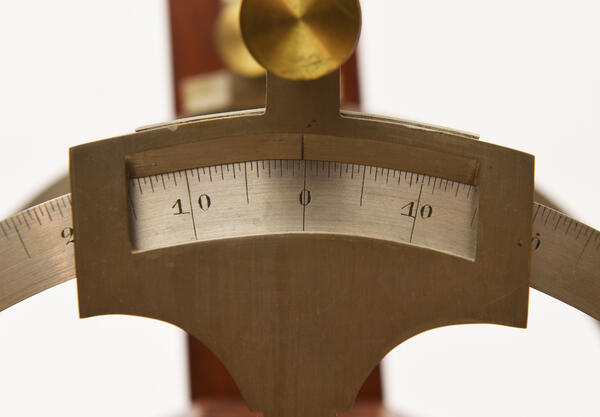
The device for demonstrating the principles of elastic collision consists of a wooden stand that is 1.2 meters high. The base is positioned in a strictly horizontal orientation using screws. At the top of the stand, there is a bar with a hole 40 mm in diameter. Below the bar, there are two metal arms that allow for adjustment of the ball’s movement. In the lower portion of the device, there is a marble slab housed in a wooden casing. One end of the casing is attached to the main frame, while the other end is attached to a smaller frame that is also mounted on the shared base. Using a screw, the slab within the casing can be adjusted to an angle between 0° and 90° by following the scale markings on the metal arm. On the arm, there is also a fixed ring that is positioned directly below the hole in the bar when the angle of adjustment is 0°.