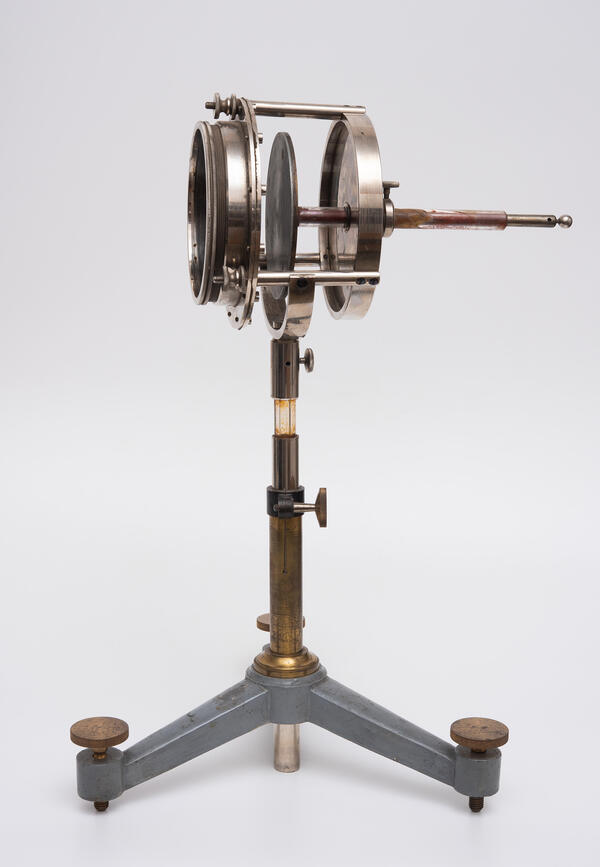
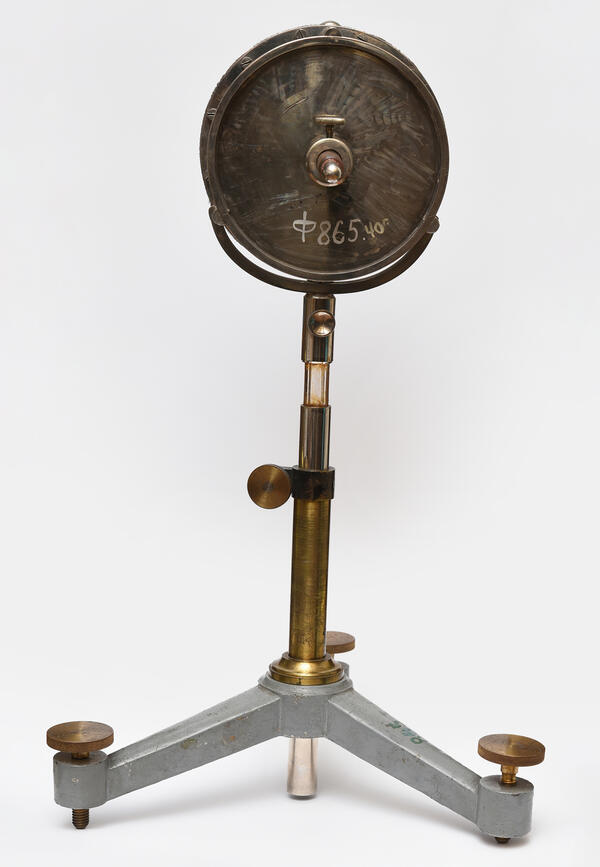
The device presented at the exhibition is designed for experimental research and demonstration of the photoelectric effect phenomenon. The photoelectric effect, also known as the photoeffect, is the process by which metallic objects lose their electric charge when exposed to light.
In 1887, the prominent German physicist Heinrich Hertz discovered this phenomenon while studying electromagnetic waves. He simultaneously discovered that ultraviolet rays impact electric discharge, facilitating it. Despite the significance of his discovery, Hertz returned to studying electromagnetic waves. The discovery by Hertz caught the attention of scientists worldwide. One such scientist was Alexander Grigoryevich Stoletov, who conducted actinoelectric research in 1888. This research allowed for a comprehensive study of the photoelectric effect and the formulation of one of its fundamental laws, later named after him.
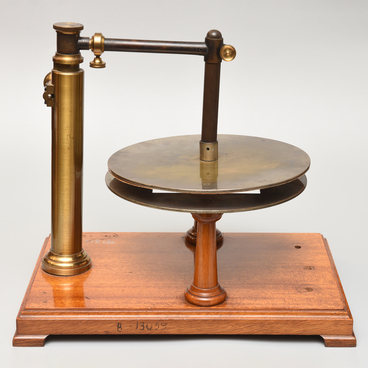
The museum displays a device designed by Stoletov’s assistant, the talented experimentalist Ivan Filippovich Usagin. Using this device, Stoletov carried out a study on the photoelectric effect. The apparatus consists of two small disks — a solid zinc plate and a fine mesh. They are mounted vertically facing each other to form a capacitor, which is an element that can accumulate an electric charge for temporary storage.
To conduct the experiment, Stoletov connected the
device, a galvanometer and a battery to a circuit. He then illuminated the
plates using the light from an electric lamp. The light freely passed through
the mesh and illuminated the surface of the solid zinc disk. Stoletov observed
that when the zinc plate of the capacitor was connected to the negative pole of
the voltage source (acted as a cathode), the galvanometer in the circuit
indicated the presence of current. However, when the cathode was the mesh, no
current was observed. This finding suggested that the illuminated zinc plate emitted
negatively charged particles that caused the flow of current between it and the
mesh, a phenomenon known as photocurrent. Subsequent experiments confirmed that
the photocurrent was indeed a stream of electrons emitted from the metal
surface under the influence of light.