The Morin apparatus is used to analyze and demonstrate the principles of free fall motion. Efforts to experimentally study the phenomenon of falling bodies began in the Middle Ages, yet the formulation of the principles of free fall is attributed to the great Italian scientist, Galileo Galilei, dating back to 1590. These experiments revealed that all objects, regardless of their mass, reach the surface of the Earth approximately at the same time. Galileo’s work also led to the realization that free fall represents a uniform motion, that is, all free-falling objects fall with the same acceleration. This acceleration is referred to as the gravitational acceleration. At each location on the Earth’s surface, the strength of gravity varies: it increases from the equator towards the poles due to the decrease in distance to the Earth’s center of mass and also due to the reduction in distance to the rotational axis.
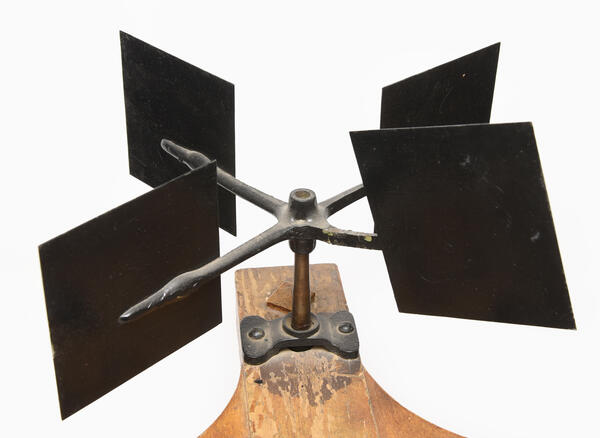
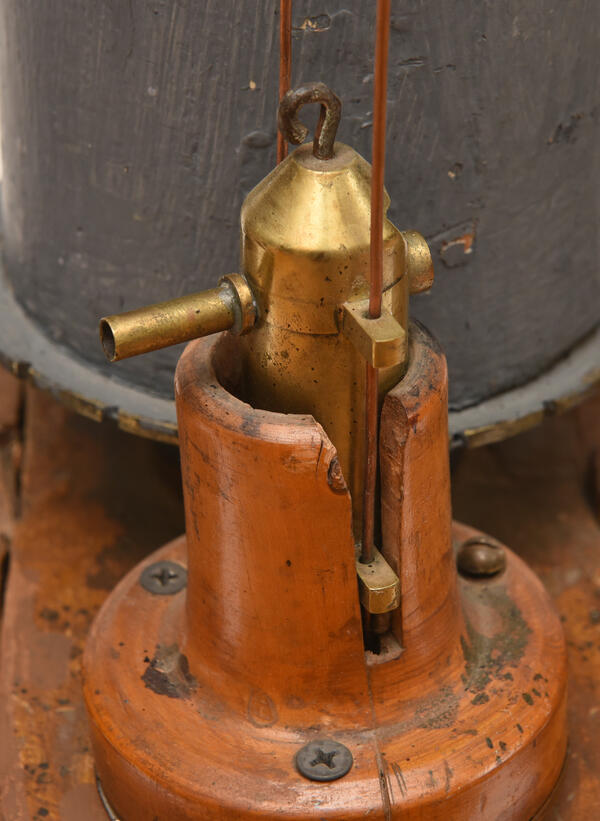
The device on display was developed by the French physicist and expert in applied mechanics, Arthur Jules Morin, in 1833. It records the trajectory and time of a falling body. The device consists of a cylinder wrapped in paper that rotates freely around an axis, a weight designed to be dropped (in this instance, a kettlebell), a recording element, and a flywheel for the uniform rotation of the cylinder.
The flywheel imparts rotational motion to the cylinder, which initially accelerates and then maintains a constant speed. The weight falls, and the recording element attached to the weight traces a path on the paper as it moves. If a vertical line is drawn on this paper and it intersects with the line of path of the weight, one will determine segments of the path at corresponding time intervals.