Electrometers are instruments used to measure charge and potential in conductors. They come in various types. Less accurate devices, electroscopes, are able to detect the presence of charge in a body, but provide only a general indication of its potential. On the other hand, absolute electrometers allow for more precise measurements of potentials in absolute electrostatic units.
The museum displays a device that can measure several electrical quantities, including charge and voltage. It can be used for both absolute voltage measurements and calibration of other voltage-measuring devices.
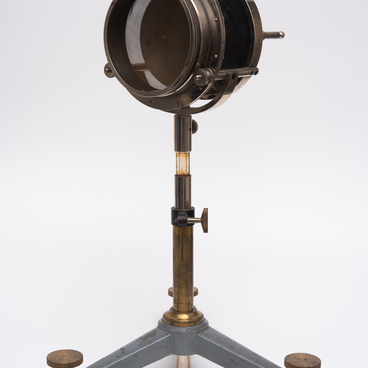
Attempts to develop an absolute electrometer, which would allow for the measurement of the intensity of an electric field, were made by the Russian scientist Georg Wilhelm Richmann in the mid-18th century. However, reliable electrometers did not become available until a hundred years later, during the second half of the 19th century. The first absolute electrometer was developed by the British physicist, William Thomson. The exhibit on display is a modified version of Thomson’s absolute electrometer designed by the German scientist, Gustav Kirchhoff.
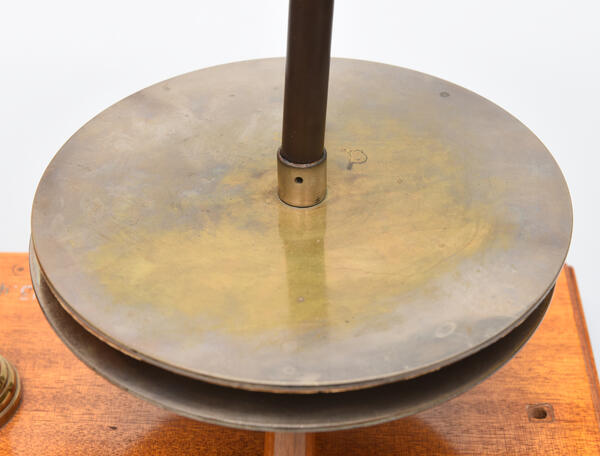
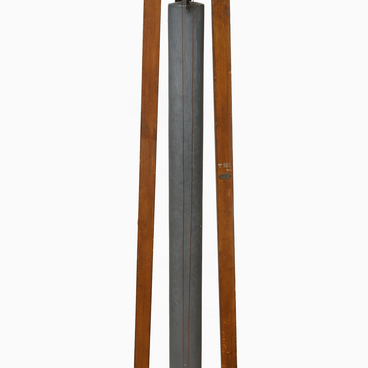
An electrometer is a type of capacitor, which is an electrical component that can temporarily store an electric charge. It consists of two conductive plates that can carry electric current. These plates are positioned close to each other and are insulated from one another. Kirchhoff based his design on the Thomson’s electrometer, which had the upper plate suspended on springs. However, he replaced the springs with lever scales. These scales with a dial and an arrow, which were originally present in Kirchhoff’s device, are not included in the displayed version of the device.
The device operates as follows. A voltage is
applied to the upper plate. Due to induction, the voltage is transferred to the
lower plate, which is attached to a movable square platform and forms part of
the scale lever. The distance between the plates can be adjusted. If the upper
plate becomes charged, there is an attractive force between the two plates that
can be regulated via the lever scale. The magnitude of the electrical
capacitance of the capacitor can be determined by the deflection of the scale’s
arrow. The smaller the distance between the plates, the larger the capacitance.
Alternatively, it can also depend on the thickness of any dielectric material
(such as air): the thinner the dielectric material, the larger the capacitance.
Therefore, the presence of a dielectric can influence the capacitance.