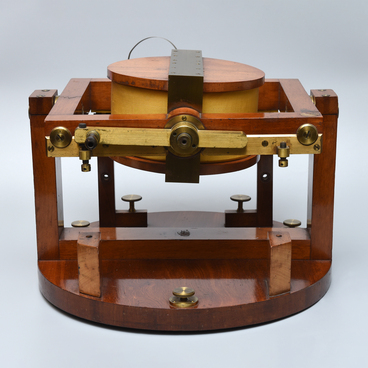
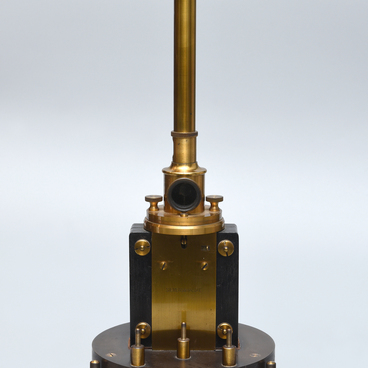
The device is designed for the study of electrostatic induction in conductors. Electrostatic induction refers to the process of inducing an electric charge in conductors or dielectric objects when placed in a uniform electric field.
In conductive objects, free electrons move under the influence of an external electric field, until the charges are redistributed in such a way that the electric field created by it inside the conductor completely compensates (or balances) the external field, and the total field inside the conductor becomes zero. This results in equal and opposite charges being induced on specific sections of the conductor’s surface (which is generally neutral).
The museum displays a device that consists of a vertical glass stand, with metallic hollow cylinders with holders mounted on it. The upper cylinder is connected to a hollow ball, and the bottom one is connected to a metallic disk.
The charge on the upper cylinder and, accordingly, the ball, can be created by rubbing silk or wool cloth against a glass or ebony rod, followed by transferring the resulting charge to the upper hollow cylinder. Alternatively, an electrostatic generator can be used. This method can generate high voltages.
If the ball is given a positive charge, a constant electric field will be created near its surface due to the phenomenon of electrostatic induction. As a result, free electric charges in the vicinity of the ball will be attracted to it, causing negative charges to accumulate on the surface of the conductor (the ball). By moving the conductor along the glass stand, either by removing it or bringing it closer to the source charge, one can study how the strength of the electric field is dependent on distance.
This device was manufactured by Ferdinand Ernecke
Company in Berlin. The company was founded in 1859 and specialized in the
production of laboratory equipment and demonstration models for physical
experiments. Devices made by this company were designed for use in classrooms
in schools and were also sold in Russia.