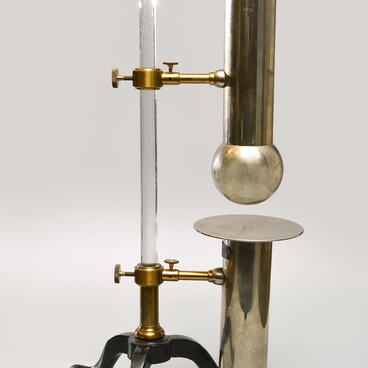
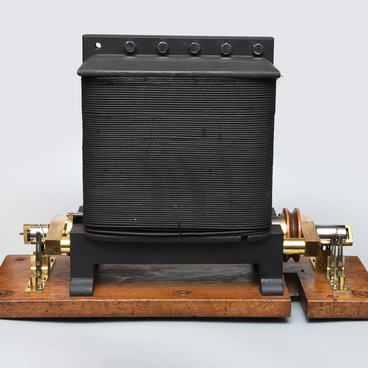
Mirror galvanometers are highly sensitive magnetoelectric devices designed to measure small electric currents. These devices are particularly useful for measuring currents of very low magnitude.
Such measurements are often required in various scientific experiments, in which mirror galvanometers are indispensable. When an electric current passes through a conductor placed in a magnetic field, the conductor will rotate by a certain angle. The stronger the current, the larger the deflection angle.
Galvanometers were developed in the early 19th century. The instrument was named after Luigi Galvani, an Italian scientist and founder of experimental electrophysiology. The second part of the word derives from the ancient Greek word μετρέω — “I measure”.
The museum displays a galvanometer, developed by the French physicist and physiologist Jacques-Arsène d’Arsonval, and patented by him in 1881. The d’Arsonval galvanometer was the first of its kind: it utilized a magnetoelectric measurement mechanism. Its unique feature was its insensitivity to magnetic fields and electrical objects. The device was produced by Siemens & Halske AG, a German company specializing in electrical equipment, rail transportation, and household appliances. No scale is present in the galvanometer on display.
The primary components of the device include a frame made up of a single coil, thin metallic strips for mounting the frame (also serving as conductors), a small mirror attached to the frame, and a metallic casing that protects the device against air currents.
A beam of light is projected onto the reflecting
mirror, which is connected to a frame. When a current flows through the frame,
the beam is deflected. It begins to travel along a scale. The deflection angle
of the deflected beam is proportional to the strength of the current. One can
also observe the deflection angle by using a telescope, in which case,
depending on the current strength, one or another segment of the scale will be
visible. Mirror galvanometers are still used for high-precision measurements.