The Weber’s inductor is used to demonstrate the electromagnetic induction phenomenon that occurs in a closed conductor as it crosses the magnetic field lines of the Earth. This device can be employed to verify the presence of the Earth’s magnetic field and to measure the horizontal component of the magnetic field.
The Earth’s magnetic field is a region of space surrounding our planet. This field results from the movement of liquid metal within the Earth’s core, creating an electric current. The magnetic field serves as a natural shield for our planet, protecting it from solar winds, cosmic rays, and radiation. The direction of the magnetic field can vary, and it may tilt toward the north or south, depending on the position of the planet. One important characteristic of the Earth’s magnetic field is induction, which is a vector field present at each point on the planet, with a specific strength and direction. The German scientists Wilhelm Eduard Weber and Carl Friedrich Gauss conducted research on geomagnetism and published the “Atlas of Geomagnetism” in 1840.
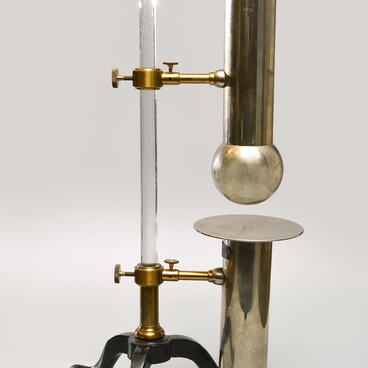
The device on display in the museum is a coil onto which insulated wires have been wound. The coil is encased in a brass casing and can be rotated 180 degrees by a special handle. It is secured to a stand with a wooden base. In order to measure the Earth’s magnetic field, an additional instrument is required — a galvanometer — which is a device for measuring electric current, which in this instance is absent.
First, the resistance of the coil and galvanometer must be determined. For this purpose, the device is positioned in the direction of the magnetic meridian, and then shifted 180 degrees. Simultaneously, a current flows through the circuit, the strength of which is measured by the galvanometer and is proportional to the horizontal component of the geomagnetic force. Subsequently, the axis is adjusted to a horizontal orientation and, upon rotating the coil another 180 degrees, another current is generated, the strength of which again is measured by the galvanometer but is now proportional to the vertical component.
Therefore, by using the Weber’s inductor, it is
possible to measure the horizontal component of the geomagnetic field — a kind
of projection of the Earth’s magnetic field onto a horizontal plane.