

In the late 17th century, the royal court was fascinated with everything “Latin”; at the same time, distinct features of the Western European school began to appear in Russian iconography.
The source of iconographic novelties were mainly engravings, which were published in large editions in the West and were brought to Russia by merchants and diplomats. Those were both individual plates and entire collections with illustrations of the Holy Scriptures.
In the 1680s, the Moscow master Vasily Andreyev created an original engraving on the theme of the Crucifixion and the Passion of Christ. He took engravings made by the Roman artist Battista di Parma as references, and added a number of details. Andreyev’s prints were popular and soon became known outside of Moscow.
In 1689, the icon painter and engraver of the Solovetsky Monastery Savva Nikiforov repeated the plot. The work was not distinguished by a masterful execution, but the iconographic plot of the original was copied accurately. Thanks to numerous pilgrims, the new composition depicting the Crucifixion of Christ spread throughout the Russian North, and at the turn of the 18th century it was already popular among educated merchants. Masters began to create independent pieces of genuine icon art based on the original, rather than simple copies.
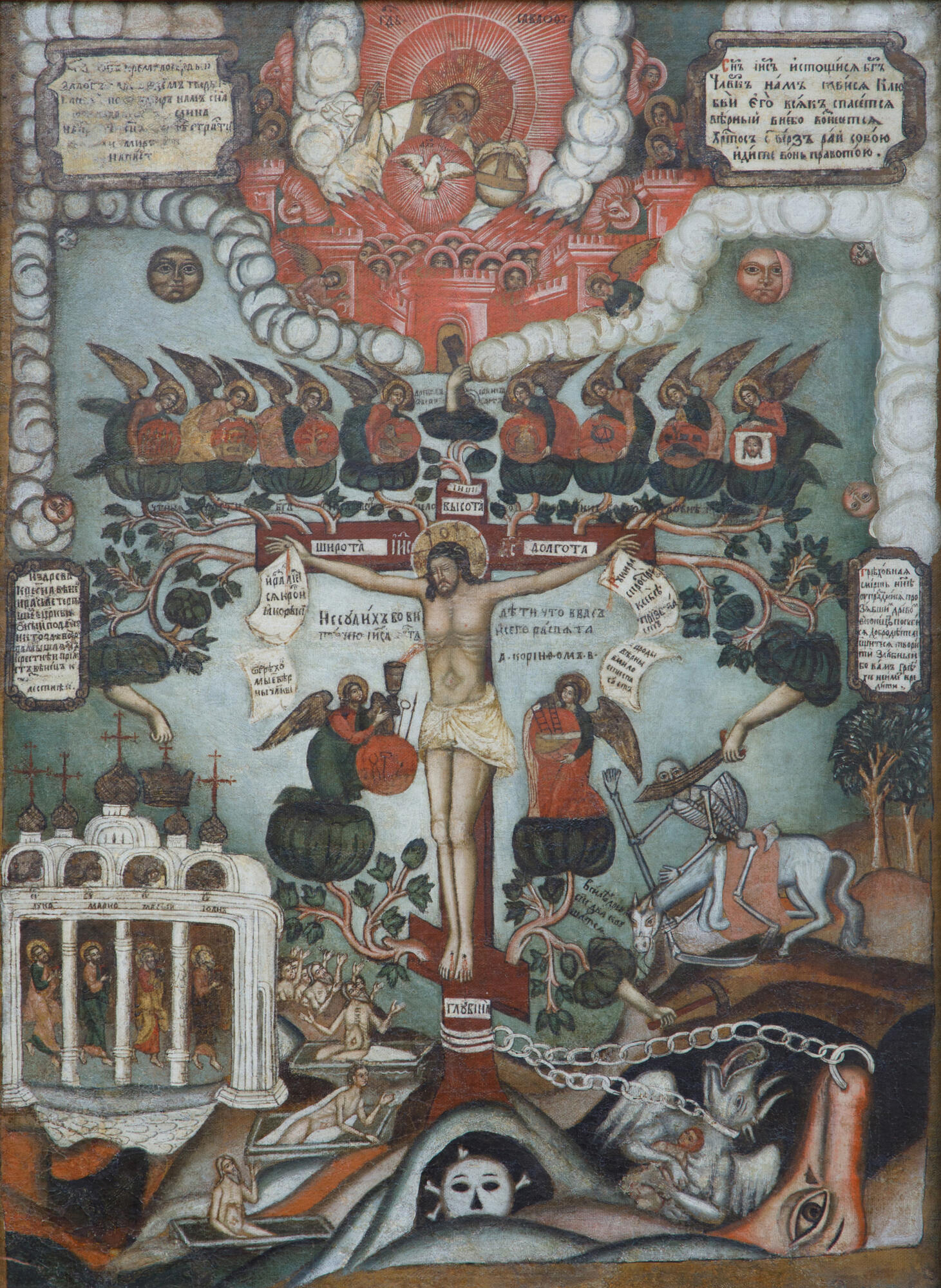
The multi-figure composition includes the Savior crucified on a flourishing cross, God the Father and the Holy Spirit in the form of a white dove surrounded by heavenly powers, as well as four evangelists between the columns of the church and angels with instruments of Passion placed in red medallions. The devil, in chains, holds Judas in his arms; the dead rise from the graves on the day of the Last Judgment.
The hands protruding from the buds of flourishing branches convey an allegorical meaning: one holds the keys to the gates of Paradise, another crowns the church, the third strikes the devil, and the fourth crushes Death on horseback.
The icon’s innovative composition was manifested not only in the plot, but also in the technique: instead of the board typical of Russian iconography, the artist used canvas and oil paints, along with tempera. The image is complemented by the verses of the court poet Sylvester Medvedev.
Presumably, the engraving was supposed to be used
as a book illustration, but that never happened.