The Venerable Anthony and Theodosius of the Caves, who lived in the 11th century, are revered as the founders of Russian monasticism.
Saint Anthony (born as Antipas) took vows on Mount Athos, probably in the Xylourgos Monastery. Having reached spiritual maturity, with the blessing of the abbot, he went to Rus. Although there were already monasteries built by the Greeks, the saint settled in a cave, and people began to flock there. Anthony’s closest associate was Saint Theodosius. They founded the Kyiv Pechersk Lavra in 1051, which was destined to become a princely burial vault.
While staying at the caves as hermits, the monks built a wooden church of the Dormition of the Blessed Virgin Mary. However, later as an old man, the Venerable Anthony regretted the construction of a wooden, rather than a stone church. According to tradition, the Mother of God responded to the prayers of Saints Anthony and Theodosius and miraculously sent Greek masters to Kyiv. They came to Prince Svyatoslav, told him about the omen, and the prince granted a field and money for the construction of a stone church. It acquired its modern look with the features of the Ukrainian Baroque style in the 18th century.
After becoming abbot, Saint Theodosius adopted for the brethren the charter of the Constantinople Monastery of Stoudios, which was later used in other Russian monasteries.
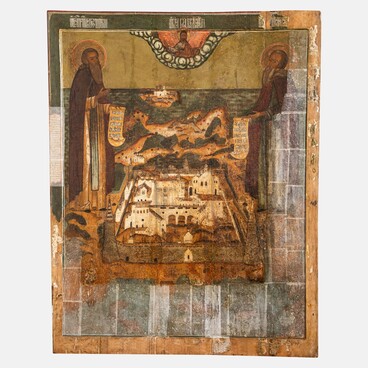
In the displayed icon, Saints Anthony and Theodosius are depicted on the clouds, below them is the Dormition Church. Although the image between the figures of the saints has been lost, researchers argue that the monks held the main shrine of the monastery — the Dormition Icon. It is believed that the sacred image was given by the Mother of God Herself. This is also indicated by the carved inscription in the upper part of the image and the scenes depicting this episode.
This iconographic composition was used almost unchanged throughout the 19th century. Engravings from prayer books and hagiographies published by the printing house of the Kyiv Pechersk Lavra were used as references.
There were no more than a hundred masters of carving in Kyiv and its suburbs. To create a carved image, first, a sheet blackened with charcoal on one side was placed on a wooden billet. The contour was traced with a pencil or a bone stick and then cut out with a knife. With the help of chisels, wood was cut out around the image, and lastly, inscriptions were made in the upper, less often the lower part of the icon. Under the carved image, a background of fabric, foil or colored paper was used with a wooden plate glued under it. The image was covered with glass.
Finished artifacts were sent to places of
pilgrimage: the Kyiv Pechersk Lavra, the St. Michael’s Golden-Domed Monastery,
and the St. Sophia Cathedral.