The museum’s collection includes over 70 books printed in secular publishing houses. These publications came from the library of Kargopol Duma and private collections of merchants and townspeople; some books originated from churches and monasteries, including the Alexander Oshevensky Monastery.
The library of the Oshevensky Monastery has been in part preserved. To date, it has been possible to identify 14 publications created or kept there: 11 manuscripts, two Cyrillic books and one published by the civil press. All of them are stored in different institutions.
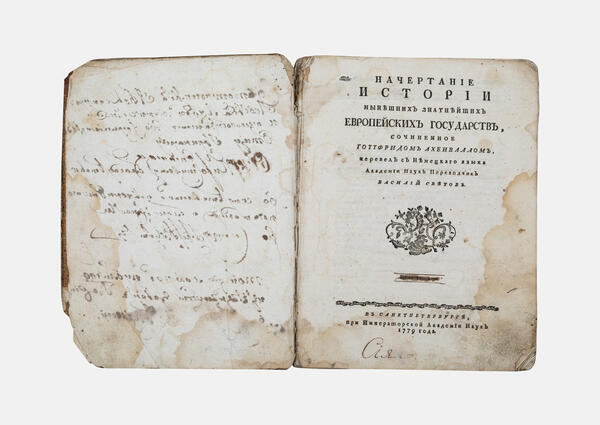
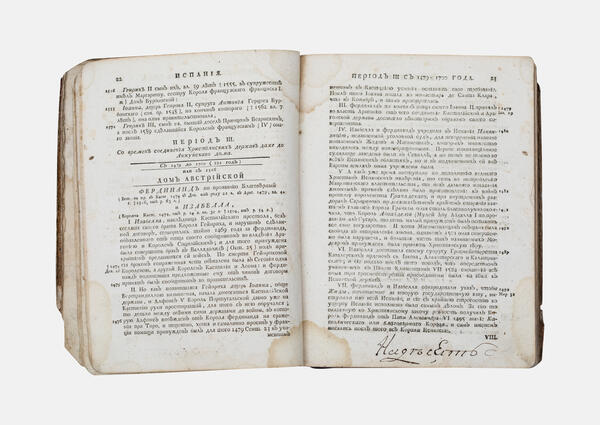
The author of “Constitution of the Present Leading European States”, German philosopher, historian, economist, educator, and lawyer Gottfried Achenwall (1719–1772), is known as one of the founders of statistics. In the preface to his work, he wrote about the need to know “the political state of prosperous… countries.” Further, the author described the history of Russia and its neighbors: Spain, France, Portugal, Poland, the Netherlands, Great Britain, Denmark, and Sweden. The book was translated into Russian by Vasily Prokofievich Svetov.
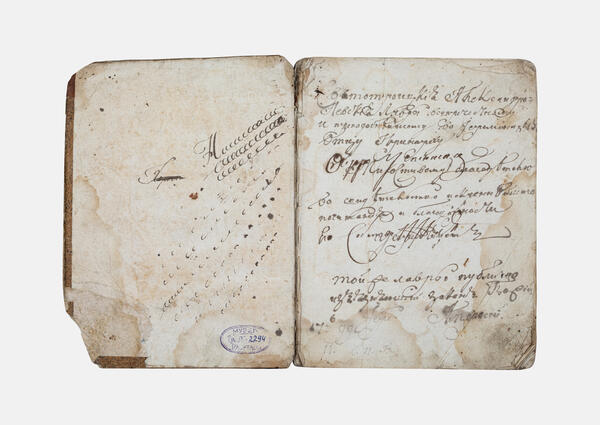
A series of dedicatory inscriptions allows us to trace the fate of the book.
Its first established owner was Ambrose, a teacher of the Law of God at the seminary at the Alexander Nevsky Lavra. On February 6, 1799, Ambrose, expressing his sincere respect, presented the book to one of the seminarians, Irinarch. After completing his studies, Irinarch left St. Petersburg for the Oshevensky Monastery, where he was appointed abbot, and brought the gift with him.
The following inscription is dated 1813, but does not specify the addressee. Probably, it could have been the hierodeacon of the Oshevensky Monastery, Nifont, since it was he who two years later left the following dedication: “to the student of the Novgorod Seminary, Fyodor Uspensky, I present this book as a sign of love and gratitude to the Alexander Oshevensky Monastery, Hierodeacon Nifont, October 6, 1815.”
It is known that Fyodor Uspensky became a priest in
Kargopol, in the Holy Spirit Parish, and in 1856 built a house on
Blagoveshchenskaya Street. However, it was not possible to establish further
movements of the book and the way in which it entered the museum’s collection.
It is possible that the “Constitution…” was among about 70 books of the civil
press from the collection of the founder of the museum Kapiton Grigoryevich
Kolpakov.