Font
Color
Graphics
Изображение точки

To see AR mode in action:

1. Install ARTEFACT app for iOS or Android;

2. Find the exhibition «Mamin-Sibiryak Memorial House-Museum»

3. Push the «Augmented reality» button and point your phone's camera at the exhibit;

Скрыть точки интересаПоказать точки интереса
Показать в высоком качестве

Items on the table of Dmitry Mamin-Sibiryak

0
Open in app
#2
Items on the table of Dmitry Mamin-Sibiryak
#17
Notepad of Dmitry Mamin-Sibiryak
#28
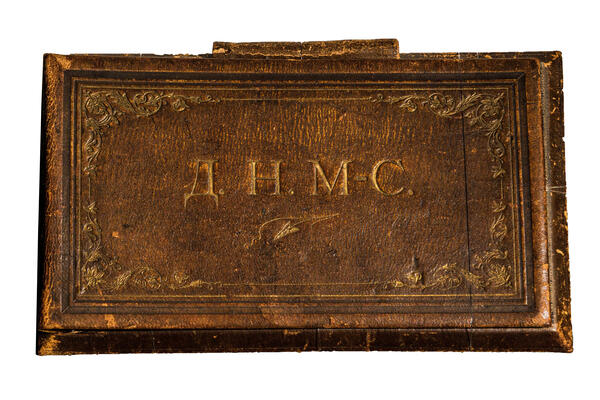
In the study of the House-Museum, there is a notepad which belonged to the writer Dmitry Mamin-Sibiryak. His wife, Olga Guvale, gifted it to him.

The notepad was made in the 19th century, and only the leather cover has been preserved to the present time. It is decorated with three stripes and a floral ornament in embossing technique along the edges. In the center, there are large gilt letters “D.N.M-S.” — the writer’s initial letters.

The writer traveled extensively in the Urals, studied Ethnography, Economics and History, participated in geological and archaeological excavations, researched people’s everyday life and interacted with ordinary people. For such trips, Dmitry Mamin-Sibiryak always took with him a notepad cover, a few blocks of paper for notes and a pair of well-sharpened pencils. He took notes, recorded important phrases from conversations, so as not to miss a single important detail.

The entries in the notepad became the basis for many of Mamin-Sibiryak’s documentary and fiction stories, in which he described the Ural nature and life of the local population. Among other works based on his observations, he wrote essays “From the Urals to Moscow”, “In the Stones”, “At the Border of Asia”, “In Bad Souls” and others.

In addition, during family meetings and conversations, Dmitry Mamin-Sibiryak collected and recorded the information discussed by his relatives. The writer’s niece Natalia Udintseva recalled that he always listened with interest and wrote down in his notepads the stories of his older brother: “Nikolay Narkisovich Mamin always told Dmitry Narkisovich Mamin about his adventures. Dmitry always listened to him with interest, and wrote down most of his stories in his notepad.”

Mamin-Sibiryak also used family stories as a texture for his works.
#39
The story “Bashka” should have been signed — “The Mamin Brothers”, because I told Mitya this story. I saw everyday life of one of the shelters for homeless people and told about it to my brother.
Brother Nikolay Mamin wrote to his nephew Boris Udintsev
#41
Some of the first works of this time were signed “D. Sibiryak”. Later, Dmitry Mamin added a pseudonym to his last name and became famous under the new name.
#18
Полное наименование: Notepad of Dmitry Narkisovich Mamin-Sibiryak 
Дата создания: the 19th century
Техника: cardboard, leather, moire ribbon, embossing, gilding
Размеры: 21.5×12.7 cm
Коллекция: United Museum of Ural Writers (UMUW)
Правообладатель изображений: United Museum of Ural Writers (UMUW)
Место создания: St. Petersburg
#19
View of the Chusovaya River
#29
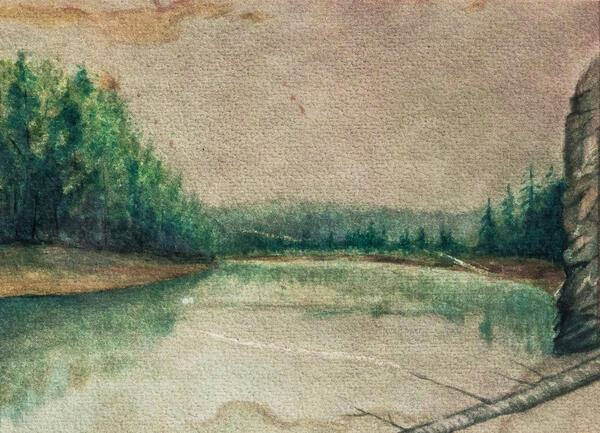
The writer Dmitry Mamin-Sibiryak was seriously interested in painting, he studied different schools and the artists who belonged to them. The collection of the house-museum contains a copy of a watercolor “View of the Chusovaya River”, which the writer created. The exhibit is kept in Mamin-Sibiryak’s study.

Researchers suggested that Dmitry Mamin-Sibiryak painted the landscape between 1868 and 1870. At that time, he went rafting on the river several times with the barge haulers — peasants who worked on river ships. Most likely, his observations became the documentary basis for the picture.

In the picture, the writer depicted the Chusovaya River, a famous Ural river, an important transport artery for the economy of the region. Until the end of the 19th century, until the railroad was built there, it connected the Urals with Europe. Copper and iron were sailed along the Chusovaya River to Russian and foreign markets, and large metallurgical plants and rich merchant villages appeared around it. Thousands of barge haulers came to Chusovaya in the hope of making money.

Chusovaya is the only river that originates on the eastern slope of the Ural Mountains, not far from Yekaterinburg. It flows westward, crosses the region, and flows into the Kama River. The river is 592 kilometers long.

In Mamin-Sibiryak’s time, the river was wider and fuller. Its steep, rocky shores were considered dangerous for barges and ships, and many barge haulers died in these places.

Dmitry Mamin-Sibiryak depicted both banks of the river. On the right, there is a large stone rock, and the trunk of a fallen tree lies in front of it. On the left — a flat bank, overgrown with dense bushes. On the horizon, one can see the forest, which covers the hills that stretch off into the distance. The sky is completely obscured by gray, lingering clouds, and the green of the landscape is reflected in the calm waters of the Chusovaya River.

The watercolor is displayed above the writer’s desk, between two windows. Dmitry Mamin-Sibiryak worked for hours in this study. “View of the Chusovaya River” allowed to switch activities and take a break from papers.

In the same room, there is a painting by Alexey Denisov-Uralsky, a friend and associate of the writer. Their landscapes are similar, but it is unknown whether they painted side by side or borrowed the idea from each other.
#20
Полное наименование: View of the Chusovaya River
Автор: Dmitry Narkisovich Mamin-Sibiryak
Дата создания: 1868 — 1870
Техника: paper, watercolor
Размеры: 15.5×21.5 cm, 31.5×25 cm in the overmat
Коллекция: United Museum of Ural Writers (UMUW)
Правообладатель изображений: United Museum of Ural Writers (UMUW)
Место создания: St. Petersburg
#22
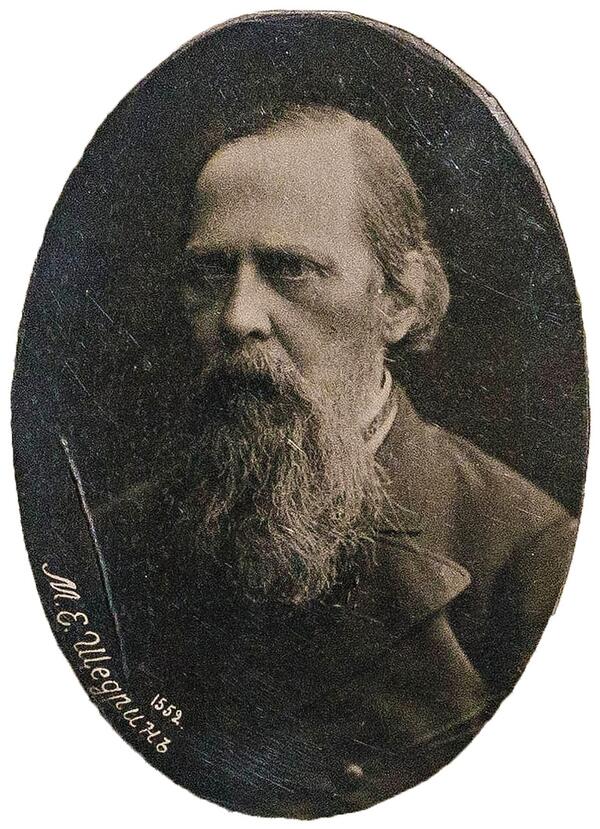
Photo of Mikhail Saltykov-Shchedrin
#30
A photograph of the writer, editor and publicist Mikhail Saltykov-Shchedrin in a carved wooden frame stands on the table in Dmitry Mamin-Sibiryak’s study. Mikhail Saltykov-Shchedrin became a teacher and an example for the Ural author, even though they met only once in their lives.

The writers met in 1877 in St. Petersburg, in the editorial office of the magazine “Patriotic Notes” [“Otechestvennye Zapiski”], where Saltykov-Shchedrin was chief editor. Mamin-Sibiryak was 25 years old at the time, and he just started publishing his works. The writer brought one of his early unfinished manuscripts to the publishing house. According to recollections, Saltykov-Shchedrin returned the text to him and said: “We do not accept such things.”

Back then, Mamin-Sibiryak wrote that he had been “obfuscated”, but the rejection made him work even harder. Five years later, in October 1882, he sent to the “Patriotic Notes” [“Otechestvennye Zapiski”] his essay “Zolotukha”. The editorial board accepted it for publication. The writer shared the news with his brother Vladimir Mamin:
#31
Volodka, rejoice! Cheer, jump and be merry! Today I’ve received a letter from Saltykov himself, saying that my essay “Zolotukha” was willingly accepted by the editors of the “Otechestvennye Zapiski”. I have never wished for more and do not wish for more.
#32
Then, Dmitry Mamin-Sibiryak published in the magazine an essay “Fighters”. Since then, the editor Saltykov-Shchedrin began to be more attentive to the writer: instead of brief replies, he began to send letters in which he shared with him the news and wrote about editorial difficulties.

In 1884, the magazine “Patriotic Notes” [“Otechestvennye zapiski”] was closed. But the correspondence and friendship between the editor and the author continued.
#33
I’m going to go to St. Petersburg in the first days of December to negotiate with publishers to see the elder Mikhail Evgrafovich.
Mamin-Sibiryak wrote to his mother
#34
In 1889, Saltykov-Shchedrin died. On June 6, the fortieth day after his death, a funeral service was held in the Ascension Church in Yekaterinburg. It was attended by local writers, actors, and directors. It is not known for certain whether Dmitry Mamin-Sibiryak was there. But researchers suggest that he attended the service to honor the memory of the friend and mentor.
#23
Полное наименование: Photo of Mikhail Evgrafovich Saltykov-Shchedrin
Дата создания: the 19th century
Размеры: 12×10 cm
Коллекция: United Museum of Ural Writers (UMUW)
Правообладатель изображений: United Museum of Ural Writers (UMUW)
Техника: photo paper, photo printing
Место создания: St. Petersburg
#24
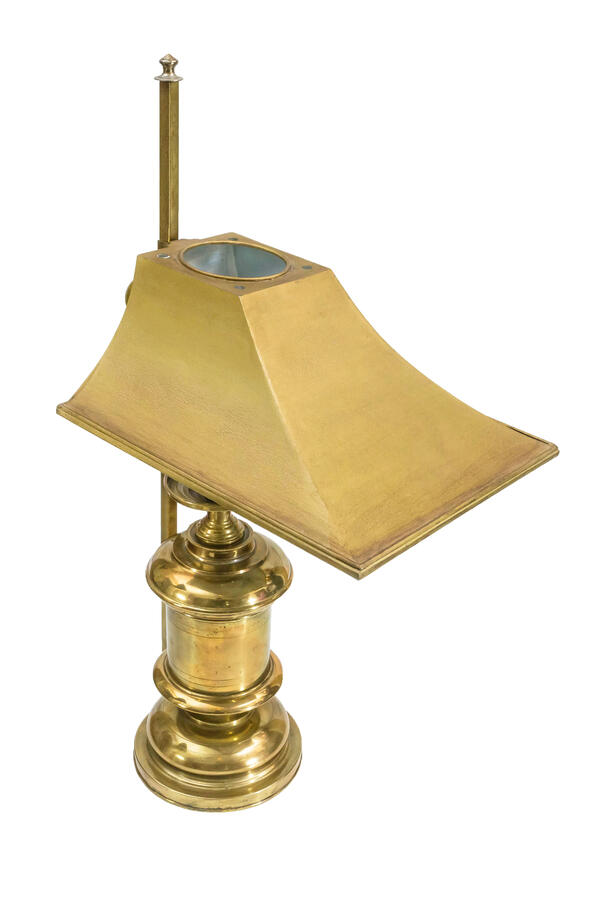
Desk lamp
#35
An electric lamp, which belonged to the writer stands on the desk in the study of Dmitry Mamin-Sibiryak. The lamp was made of copper at the end of the 19th century and covered with gilding. Mamin-Sibiryak originally used it as a kerosene burner, and later redesigned it.

The lamp was kept with the Mamins. In February 1936, Sofia Guvale, the sister of Olga Guvale, the writer’s wife, gave it to the museum of local history, and in 1953, the artifact went to the Mamin-Sibiryak Memorial House-Museum.

The lamp consists of two parts. At the bottom, there is a heavy hollow metal base, a former kerosene tank. Originally, a combustible substance was poured into the container, and from there it was dosed into the combustion zone by a cotton wick.

To prevent the formation of toxic smoke during the work, the burner had special holes. With their help, air was supplied to the reservoir and combustion products were drained. The light of the kerosene lamp was a little brighter than candle light. In case the lamp began to smoke, the wick was manually trimmed with sharp scissors.

A bulb holder was attached to the former tank. On top, on a tripod, is a lampshade — a visor to diffuse light. It can be raised and lowered with a screw. Inside the lampshade, there is a hole for the lamp glass, which used to protect the wick — this element was not preserved.

It is believed that the first kerosene lamps appeared in 1853, in Lviv. The Austrian pharmacists Ignacy Lukasiewicz and Jan Zech, who lived there, redesigned the oil lamp and began to use kerosene as a combustible substance. Serial production of such lamps began in 1856 in America, and they soon became popular in many countries around the world.

When electricity began to spread in Russia, in the late 19th and early 20th centuries, kerosene lamps were used less. During the 20th century, they were in demand in the villages and small towns.

Now lamps with a flammable substance are rarely used: only where there is no electricity, during emergencies, as well as in camping trips.
#25
Полное наименование: Desk lamp
Дата создания: the late 19th century
Техника: brass, stamping
Размеры: 63×25.5×34 cm
Коллекция: United Museum of Ural Writers (UMUW)
Правообладатель изображений: United Museum of Ural Writers (UMUW)
Место создания: Russian empire
#27
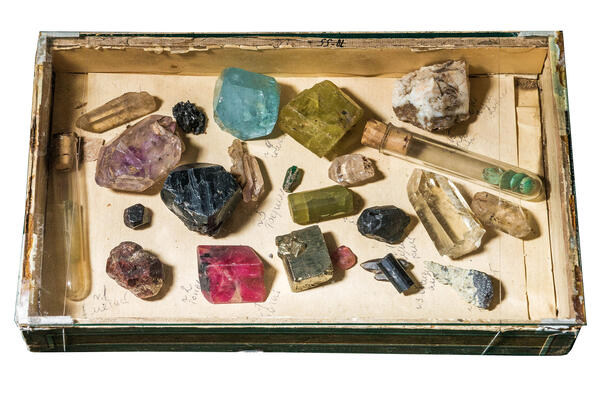
Minerals in a cigar box
#36
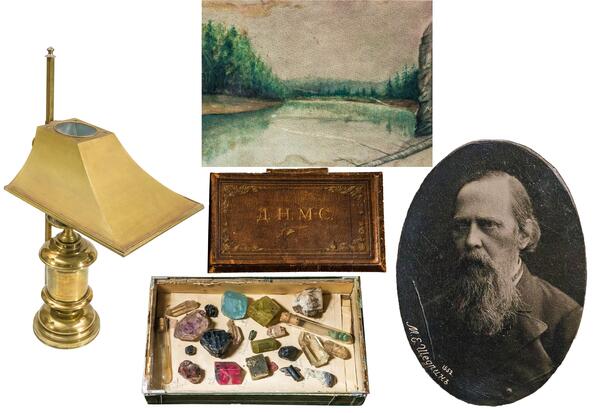
The exhibition contains a cigar box with Ural minerals inside. These are all remains from the vast collection of stones that belonged to Dmitry Mamin-Sibiryak.

He didn’t only write books, he also was a journalist, a society figure, studied the history of his native region, and collected rare minerals. Mamin-Sibiryak bought his first set from another collector, and then began to look for stones at excavations. More often, the writer added stones to his collection during his travels in the Urals. One day, he found a rare green colored gem, Volkonskoite, named after Prince Peter Volkonsky. Previously, this mineral was used to make paint for icons. It is also displayed in the collection of the house-museum.

The collection of Dmitry Mamin-Sibiryak also contained very large-sized minerals. That is why he kept the stones in a shed at 27, Sobornaya Street (now Pushkina Street). There, the writer spent a lot of time studying his specimens. Contemporaries recalled that before going to visit Mamin-Sibiryak guests picked up pockets full of small pebbles in the barn and gave them to him as souvenirs.

Ural minerals were an important theme in the work of the writer. Mamin-Sibiryak dedicated his essay “Gemstones” [“Samotsvety”], the story “Vertel” and other texts to them.
#37
There is hardly another corner on the globe where, in such, comparatively very insignificant space, nature dispersed its gifts with truly maddening generosity. According to a rough calculation, the High Mountain alone contains 35 billion poods of the best iron ore in the world — this is an example of the inexhaustible treasure that lies in the earth’s bowels.
Dmitry Mamin-Sibiryak wrote in one essay
#38
In “Vertel”, Mamin-Sibiryak described the work of a lapidary workshop, where precious stones are shaped. The work in such factory was dangerous: the workers inhaled the fine dust from the machining; severe lung diseases worsened, and some even died.

That’s how the character from the story “Vertel”, a little boy Proshka, died in the workshop, among his colleagues, who could not help him. Mamin-Sibiryak emphasized that his death was to blame for difficult working conditions and lack of safety.
#26
Полное наименование: Minerals in a cigar box
Дата создания: 19th century
Техника: wood, paper, minerals
Размеры: 4.2×22×13.5 cm
Коллекция: United Museum of Ural Writers (UMUW)
Правообладатель изображений: United Museum of Ural Writers (UMUW)
Место создания: Yekaterinbur
#16
read morehide
00:00
00:00
1x

Items on the table of Dmitry Mamin-Sibiryak

0
Point your smartphone camera to open in the app
Share
VkontakteOdnoklassnikiTelegram
Share on my website
Copy linkCopied
Copy
Open in app
To see AR mode in action:
  1. Install ARTEFACT app for 
  2. iOS or Android;
  3. Find and download the «Paintings in Details» exhibition
  4. Push the «Augmented reality» button and point your phone's camera at the painting;
  5. Watch what happens on your phone screen whilst you flip through the pictures.
 
We use Cookies
Cookies on the Artefact Website. We use cookies to ensure that we give you the best experience on our website. If you continue without changing your settings, we'll assume that you are happy to receive all cookies on the Artefact website. However, if you would like to, you can change your cookie settings at any time.
Learn more about useHide
Content is available only in Russian

X

Нашли опечатку?...

%title%%type%