#1
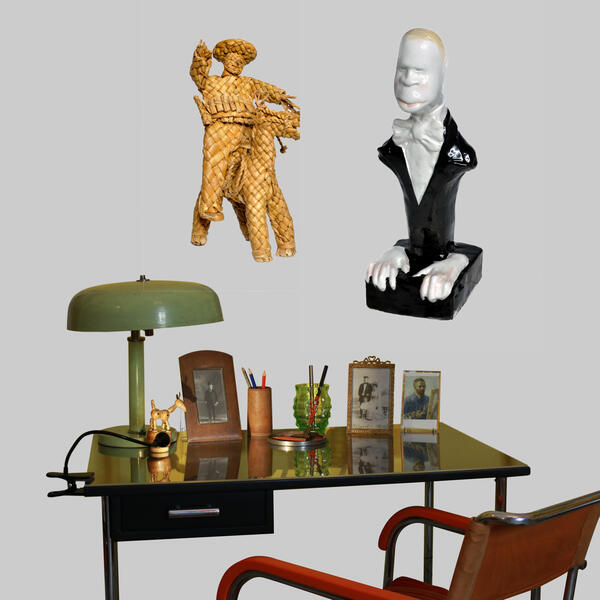
Charro, Prokofiev Caricature, Eisenstein’s desk
#9
#8
#7
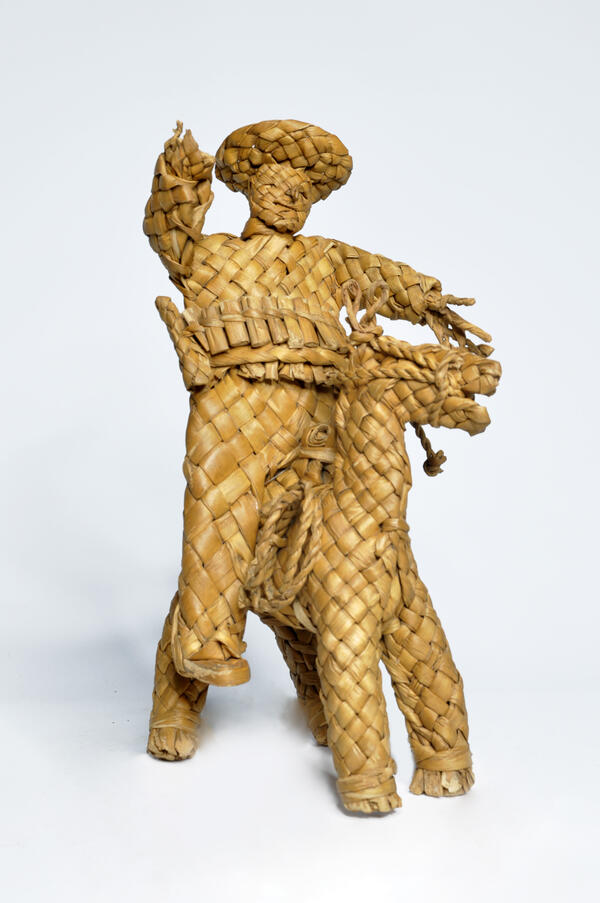
This straw figurine of a horseman sat on the top of a corner shelf, to the left of the desk in Eisenstein’s study in his PotYlikha apartment. The director brought it from Mexico, where he spent over a year—from December 1930 to February 1932—with his co-director Grigory Alexandrov and cameraman Eduard Tisse. They worked on the painting “¡Que viva México!” (“Long live Mexico!”). Unfortunately, Eisenstein was later unable to obtain the footage from American producers to create a cut of the film.
Wickerwork is a traditional Mexican craft. The director’s collection includes issues of Mexican Folkways magazine from the 1920s to the early 1930s, which featured articles on folk art, including on such figurines. The rider’s “brother”—a large woven carpet with the words “Viva Mexico”—hung on the wall of Eisenstein”s library.
There is an unusual history behind the wickerwork horseman. In 1929, during a trip to Europe, which came prior to the United States and Mexico trip, Eisenstein met the poet and expressionist playwright Ernst Toller (1893–1939) in Berlin. Many countries of the world staged several of his plays in the 1920s; one of the most famous productions — his play “The Mass Man” — was published in the USSR, translated by Ossip Mandelstam. When Eisenstein’s film Battleship Potemkin was shown in Berlin in 1926, Toller said that the Soviet director had succeeded in what he had only dreamed of.
In his memoirs, Eisenstein recalled how in 1929 he visited German playwright Ernst TOller and how he gave him a Mexican horseman. That account is supported by later interviews given by his widow, Pera Atasheva, to researchers. At the end of the visit, Ernst Toller said that, according to the Eastern custom, the guest can choose something from the host’s house as a souvenir. Eisenstein, embarrassed, began to look for something in duplicate with his eyes. Having found two figures of horsemen, he pointed to one of them. Toller turned pale, but carefully wrapped it up and handed the present to Eisenstein. Later it turned out that the horsemen were a gift from the actress Elizabeth Bergner, with whom Toller was in love, and she, ever faithful with her husband, only brought Toller travel souvenirs. When the Nazis came to power, Toller emigrated, and all his heritage was lost. But the horseman which he gave away was preserved. Thus, another profound Eastern thought was manifested: “You save that which you give away.”
Wickerwork is a traditional Mexican craft. The director’s collection includes issues of Mexican Folkways magazine from the 1920s to the early 1930s, which featured articles on folk art, including on such figurines. The rider’s “brother”—a large woven carpet with the words “Viva Mexico”—hung on the wall of Eisenstein”s library.
There is an unusual history behind the wickerwork horseman. In 1929, during a trip to Europe, which came prior to the United States and Mexico trip, Eisenstein met the poet and expressionist playwright Ernst Toller (1893–1939) in Berlin. Many countries of the world staged several of his plays in the 1920s; one of the most famous productions — his play “The Mass Man” — was published in the USSR, translated by Ossip Mandelstam. When Eisenstein’s film Battleship Potemkin was shown in Berlin in 1926, Toller said that the Soviet director had succeeded in what he had only dreamed of.
In his memoirs, Eisenstein recalled how in 1929 he visited German playwright Ernst TOller and how he gave him a Mexican horseman. That account is supported by later interviews given by his widow, Pera Atasheva, to researchers. At the end of the visit, Ernst Toller said that, according to the Eastern custom, the guest can choose something from the host’s house as a souvenir. Eisenstein, embarrassed, began to look for something in duplicate with his eyes. Having found two figures of horsemen, he pointed to one of them. Toller turned pale, but carefully wrapped it up and handed the present to Eisenstein. Later it turned out that the horsemen were a gift from the actress Elizabeth Bergner, with whom Toller was in love, and she, ever faithful with her husband, only brought Toller travel souvenirs. When the Nazis came to power, Toller emigrated, and all his heritage was lost. But the horseman which he gave away was preserved. Thus, another profound Eastern thought was manifested: “You save that which you give away.”
#6
Full name: Horse Rider (Charro) straw figurine
Date: 1920s
Technique: straw, wickerwork
Place: Mexico
Dimensions: 23.5×24×18 cm
Collection: Study
Copyright: Cinema museum
Goskatalog Number: 16572996
Date: 1920s
Technique: straw, wickerwork
Place: Mexico
Dimensions: 23.5×24×18 cm
Collection: Study
Copyright: Cinema museum
Goskatalog Number: 16572996
#5
Sergei Prokofiev Caricature
#4
#3
The three-dimensional caricature is much older than the drawn one. Satirical masks of ancient Greek, Italian, Chinese, and Japanese theaters are its direct predecessors. In the 19th century, small porcelain caricature statues of famous persons were quite popular. In 1832, Honoré Daumier sculpted caricatured clay busts of French politicians and a portrait of Charles Philipon, a journalist and Daumier’s personal friend, who commissioned the entire series. Daumier started sculpting in order to better capture the “nature” of the same characters in lithographs.
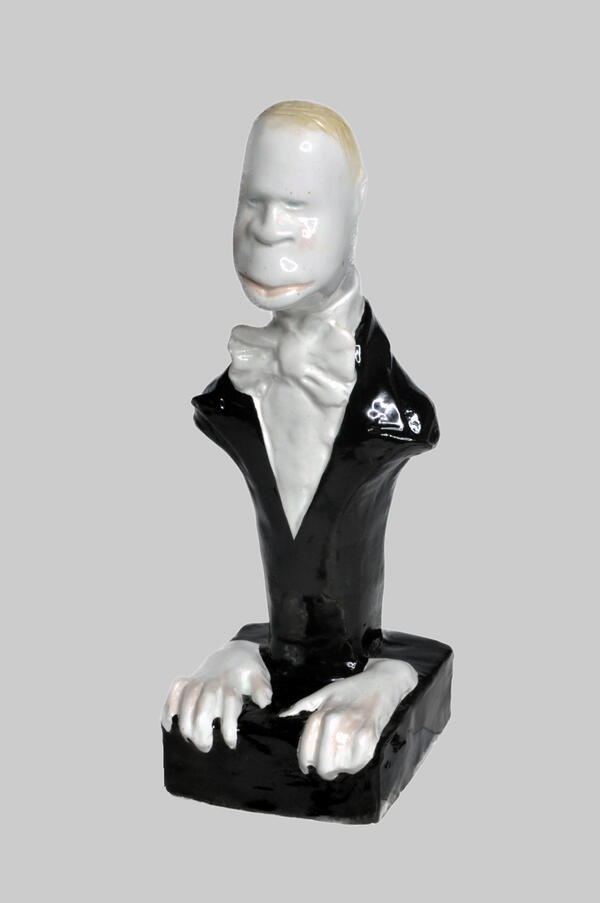
The friendly sculptural caricature of the composer Sergei ProkofiEv was created in the opposite way: first, there were drawings by the creative team of KukrynIksy, a plaster sculpture then was derived from these drawings, and the porcelain casts were derived from the sculpture. These porcelain busts were then glazed and painted. Colors of the painting varied.
The series of caricatures also includes portraits of directors KonstantIn StanislAvsky and VsEvolod MeyerhOld, actors VasIly KachAlov and IvAn MoskvIn. Eisenstein defiantly kept a Meyerhold statuette on a bookcase in his apartment even after his teacher’s arrest and death in 1940.
In all likelihood, it was Meyerhold who introduced Eisenstein to Prokofiev. There is a witness account of these three men visiting a book store together in 1936. Prokofiev, who returned to USSR from emigration, has settled in Moscow at that time. In 1936 he was working on the music for Meyerhold’s production of Boris Godunov that ultimately was never staged. In 1940, Eisenstein expressed interest in adapting that same tragedy by Alexander Pushkin for the screen using Prokofiev’s music.
The filmmaker and composer became friends and were on good terms with each other — a rare thing for Eisenstein. Eisenstein’s widow, Pera Atasheva, recalled that Eisenstein bought porcelain cartoons of Prokofiev and Meyerhold in the crockery store he visited while taking a stroll down Arbat St. When he came home, he called Prokofiev and said:
The friendly sculptural caricature of the composer Sergei ProkofiEv was created in the opposite way: first, there were drawings by the creative team of KukrynIksy, a plaster sculpture then was derived from these drawings, and the porcelain casts were derived from the sculpture. These porcelain busts were then glazed and painted. Colors of the painting varied.
The series of caricatures also includes portraits of directors KonstantIn StanislAvsky and VsEvolod MeyerhOld, actors VasIly KachAlov and IvAn MoskvIn. Eisenstein defiantly kept a Meyerhold statuette on a bookcase in his apartment even after his teacher’s arrest and death in 1940.
In all likelihood, it was Meyerhold who introduced Eisenstein to Prokofiev. There is a witness account of these three men visiting a book store together in 1936. Prokofiev, who returned to USSR from emigration, has settled in Moscow at that time. In 1936 he was working on the music for Meyerhold’s production of Boris Godunov that ultimately was never staged. In 1940, Eisenstein expressed interest in adapting that same tragedy by Alexander Pushkin for the screen using Prokofiev’s music.
The filmmaker and composer became friends and were on good terms with each other — a rare thing for Eisenstein. Eisenstein’s widow, Pera Atasheva, recalled that Eisenstein bought porcelain cartoons of Prokofiev and Meyerhold in the crockery store he visited while taking a stroll down Arbat St. When he came home, he called Prokofiev and said:
“Sergei Sergeevich! I didn”t know they made you into a piece of crockery”.
Eisenstein put the caricature of Prokofiev in the study within his PotYlikha apartment. In the same room there was a small BEchstein piano. Prokofiev played the themes for two films for which he wrote music: “Alexander NEvsky” (1938) and “Ivan the Terrible” (1941-1946) on this piano for the films' director. During the evacuation in AlmatY, where the shooting of the film “Ivan the Terrible” began and lasted until 1944 (the picture was completed in Moscow at MosfIlm), the director and composer also worked together. The newsreel footage from 1942, which captured them at work, has been preserved.
#2
Full name: Bust of Sergei Prokofiev A caricature in sculpture
Author: Kukryniksy (Mikhail Kupriyanov, Porfiriy Krylov, Nikolai Sokolov)
Date: 1936
Technique: porcelain, glaze, painting over glaze
Place: Kirov (formerly Pesochnya), Kaluga Region, USSR
Dimensions: 25×10.5×8.5 cm
Collection: Study
Copyright: Cinema museum
Goskatalog Number: 16573071
Date: 1936
Technique: porcelain, glaze, painting over glaze
Place: Kirov (formerly Pesochnya), Kaluga Region, USSR
Dimensions: 25×10.5×8.5 cm
Collection: Study
Copyright: Cinema museum
Goskatalog Number: 16573071
#10
Eisenstein’s desk
#11
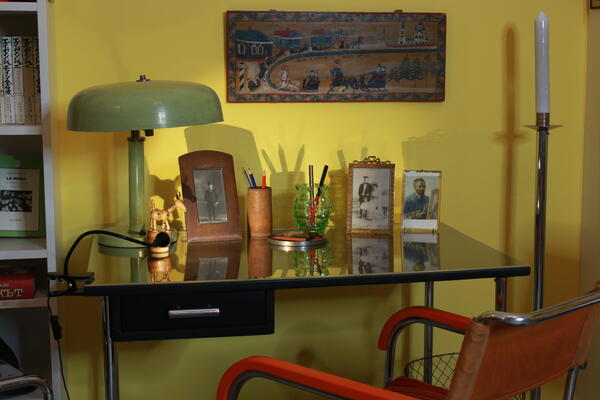
#13
The desk is one of the avant-garde pieces of furniture designed by BAuhaus designers in Germany in the mid-1920s. Later, in the 1930s, serial production of this furniture began in Germany, Austria, Czechoslovakia, either under license or with the invention of ‘analogues’. On this desk there is a mark from the famous branded department store in Prague. That store belonged to Joseph Roth.
It has been established that Bauhaus furniture was already in the apartment on PotYlikha Street in 1940 when the director staged Richard /’rihard/ WAgner’s ValkYrie opera. Evidence supporting this notion is found in the memoirs of the journalist Tatiana Tess, who came to visit Eisenstein. It is suggested that Eisenstein might have purchased the Bauhaus ensemble through an acquaintance in an embassy of a western nation in 1938–1939, or by way of Western Ukraine and Western Belarus when they were occupied by the Soviet forces. At the time, these regions traded goods with CzechoslovAkia.
On the table there are some items that the director used in his work. Eisenstein acquired the light green office lamp with a swivel arm in 1947: the director noticed this Bauhaus-style lamp in the office of the rector of All-Union State Institute of Cinematography and borrowed it from the rector, later All-Union State Institute of Cinematography allowed the director’s widow Pera Atasheva to keep the lamp.
There is a toy donkey near the lamp: there used to be one on the director’s table, only its head was preserved. It is known that as a child Sergei Eisenstein favored movable toys of this kind, with details on tight strings. There were two framed photographs nearby, they stood on the windowsill near the desk: a photo of his father in a wooden frame and a photo with his parents, in which the future director is one year old. The picture was taken at the Riga seaside in 1899. Eisenstein wrote in his memoirs that he felt like a child, ‘a Riga boy’, until his gray hair. A tray for small office supplies and a bamboo pencil cup are also from the director’s office.
There was also a postcard with Van Gogh’s self-portrait on Eisenstein’s desk. Eisenstein’s study is a fusion of his (and Van Gogh’s) favorite “colors of the universe”: sunny yellow walls are complemented by a blue chandelier ball. Eisenstein has crafted the electrolier himself from the XVIII century “lomonosovskoye” glass and a metal base from a XIX century chandelier. His creation was powered by the wonder of XX century: household electricity.
It has been established that Bauhaus furniture was already in the apartment on PotYlikha Street in 1940 when the director staged Richard /’rihard/ WAgner’s ValkYrie opera. Evidence supporting this notion is found in the memoirs of the journalist Tatiana Tess, who came to visit Eisenstein. It is suggested that Eisenstein might have purchased the Bauhaus ensemble through an acquaintance in an embassy of a western nation in 1938–1939, or by way of Western Ukraine and Western Belarus when they were occupied by the Soviet forces. At the time, these regions traded goods with CzechoslovAkia.
On the table there are some items that the director used in his work. Eisenstein acquired the light green office lamp with a swivel arm in 1947: the director noticed this Bauhaus-style lamp in the office of the rector of All-Union State Institute of Cinematography and borrowed it from the rector, later All-Union State Institute of Cinematography allowed the director’s widow Pera Atasheva to keep the lamp.
There is a toy donkey near the lamp: there used to be one on the director’s table, only its head was preserved. It is known that as a child Sergei Eisenstein favored movable toys of this kind, with details on tight strings. There were two framed photographs nearby, they stood on the windowsill near the desk: a photo of his father in a wooden frame and a photo with his parents, in which the future director is one year old. The picture was taken at the Riga seaside in 1899. Eisenstein wrote in his memoirs that he felt like a child, ‘a Riga boy’, until his gray hair. A tray for small office supplies and a bamboo pencil cup are also from the director’s office.
There was also a postcard with Van Gogh’s self-portrait on Eisenstein’s desk. Eisenstein’s study is a fusion of his (and Van Gogh’s) favorite “colors of the universe”: sunny yellow walls are complemented by a blue chandelier ball. Eisenstein has crafted the electrolier himself from the XVIII century “lomonosovskoye” glass and a metal base from a XIX century chandelier. His creation was powered by the wonder of XX century: household electricity.
#12
Full name: Bauhaus desk
Date: 1930s
Technique: wood, chromed metal, rubber, industrial manufacturing
Place: Europe
Dimensions: 75×97×62 cm
Collection: Study
Copyright: Cinema museum
Goskatalog Number: 16573141
Date: 1930s
Technique: wood, chromed metal, rubber, industrial manufacturing
Place: Europe
Dimensions: 75×97×62 cm
Collection: Study
Copyright: Cinema museum
Goskatalog Number: 16573141
read morehide
00:00
00:00
1x
Charro, Prokofiev Caricature, Eisenstein's desk
Collection
Exhibition
0
 Point your smartphone camera to open in the app
Open in app
Share