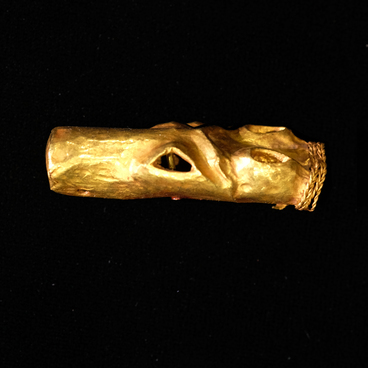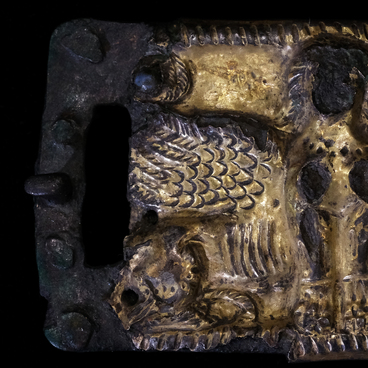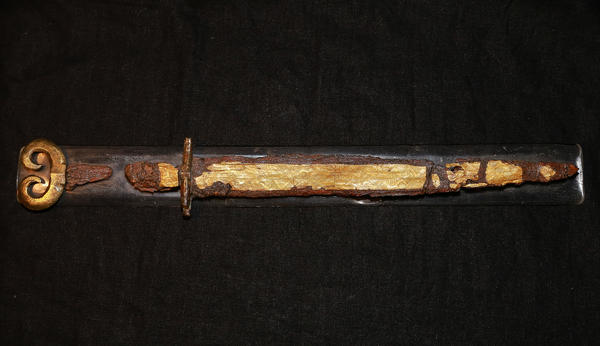
The dagger was found in the course of archaeological excavations in the vicinity of BarAnovka village of the ChernoYArsky District of Astrakhan region in 1972. The excavations were led by Herman FYOdorov-DavYdov, a Soviet historian and archaeologist, a specialist in numismatics of the Golden Horde and medieval Eastern Europe, head of the Volga archaeological expedition.
The dagger was made of iron in the 2nd - 3rd centuries AD. It is complemented with a decorative top - a figured bronze pommel. A bronze crosshair with gold foil on a scabbard has also survived.
That time, the Sarmatians had a common approach to decorating daggers: the front part of the scabbard and the handle were covered with a solid gold plate, which resembled the decoration of Scythian ceremonial swords. However, new elements also appeared: repoussé compositions in the animal style (depicting animals) were replaced by geometric patterns.
The Sarmatians were considered a very warlike people, this was even especially emphasized by ancient authors. The way of life among the tribes was largely associated with wars. After the conquest of Scythia, they became the most powerful people in the northeastern part of the ancient ecumene. The writings by Greek and Roman authors indicate that the Sarmatian tribes participated in many important military-political events in the Northern Black Sea region, in the Caucasus, on the Danube. The main worship item both among the Scythians and the Sarmatians was the sword that personified the god of war. The Roman historian Ammianus Marcellinus wrote: ‘They stick a sword into the ground and worship it with reverence like Mars.’ The main type of Sarmatian weapon was short swords no more than 50-60 cm long. Their scabbard was attached to the belt with a special clip through which a harness belt was passed. This method of attaching the sword was convenient only for horsemen. In addition to the sword, a dagger was obligatory for the Sarmatian. The dagger was fixed either on the belt or on the leg with straps.
In 2005, the iron dagger and other valuable finds were exhibited at the Astrakhan Steppe Treasures show at the National Museum of the Palazzo Venezia in Rome.
The dagger was made of iron in the 2nd - 3rd centuries AD. It is complemented with a decorative top - a figured bronze pommel. A bronze crosshair with gold foil on a scabbard has also survived.
That time, the Sarmatians had a common approach to decorating daggers: the front part of the scabbard and the handle were covered with a solid gold plate, which resembled the decoration of Scythian ceremonial swords. However, new elements also appeared: repoussé compositions in the animal style (depicting animals) were replaced by geometric patterns.
The Sarmatians were considered a very warlike people, this was even especially emphasized by ancient authors. The way of life among the tribes was largely associated with wars. After the conquest of Scythia, they became the most powerful people in the northeastern part of the ancient ecumene. The writings by Greek and Roman authors indicate that the Sarmatian tribes participated in many important military-political events in the Northern Black Sea region, in the Caucasus, on the Danube. The main worship item both among the Scythians and the Sarmatians was the sword that personified the god of war. The Roman historian Ammianus Marcellinus wrote: ‘They stick a sword into the ground and worship it with reverence like Mars.’ The main type of Sarmatian weapon was short swords no more than 50-60 cm long. Their scabbard was attached to the belt with a special clip through which a harness belt was passed. This method of attaching the sword was convenient only for horsemen. In addition to the sword, a dagger was obligatory for the Sarmatian. The dagger was fixed either on the belt or on the leg with straps.
In 2005, the iron dagger and other valuable finds were exhibited at the Astrakhan Steppe Treasures show at the National Museum of the Palazzo Venezia in Rome.