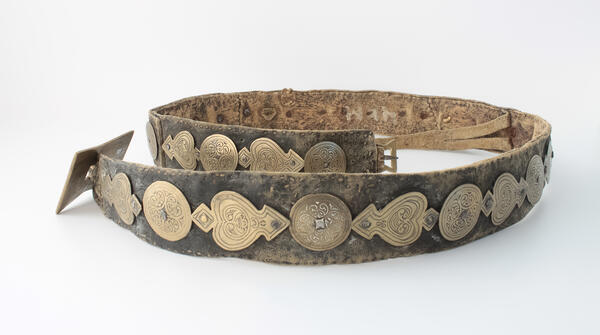
While nowadays Yakut men’s national costume features wide belts, in the 19th century Sakha men wore very narrow ones, about 5 centimeters wide. Women’s belts, on the contrary, were very wide — twice as wide as men’s.
The belt is a traditional part of the ceremonial costume.
The exhibit of the museum is a work of an unknown master of the second half of the 19th century. Since 1951, it has been housed in the collection of Andrey Andreyevich Savvin, the first director of the Churapchinsky Museum, ethnographer and local historian.
Figural plates are attached to the leather base strip with patterns placed at equal distances. The length of the exhibit is 117 centimeters.
Jewelry making in Yakutia has ancient origins. They stem from the traditional way of life of the people and the historical, cultural, geographical and climatic conditions that contributed to their formation. The experience of national artisans, who for the most part remained unknown, was accumulated. These collective achievements became a measure of beauty and perfection for future craftspeople and were passed on from generation to generation. The centuries-long and complex historical path of the Sakha people in close contact with other peoples and tribes has developed Yakuts’ ability to actively interact with them in the field of arts and crafts. Thus, the republic has noticeably enriched its own culture. For this reason, Yakut jewelry art with its traditional techniques and unique national coloring can be considered an area of independent artistic value.
The processing of metals, such as iron, bronze, copper, silver and gold, has a long tradition in Yakutia. Local blacksmiths have been known far beyond Siberia since time immemorial.
The oral folk epic “Olonkho”, which, according to
some sources, dates back about a thousand years, mentions various metal
paraphernalia. The first written evidence dates back to the middle of the 17th
century. In 1647, the voivode Vasily Nikitich Pushkin reported to the Russian
Tsar about the “best” iron made by Yakut blacksmiths and concluded,