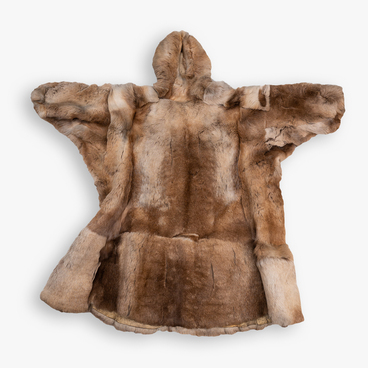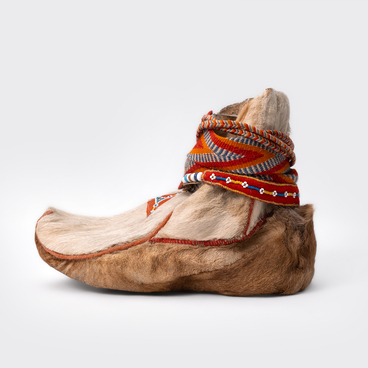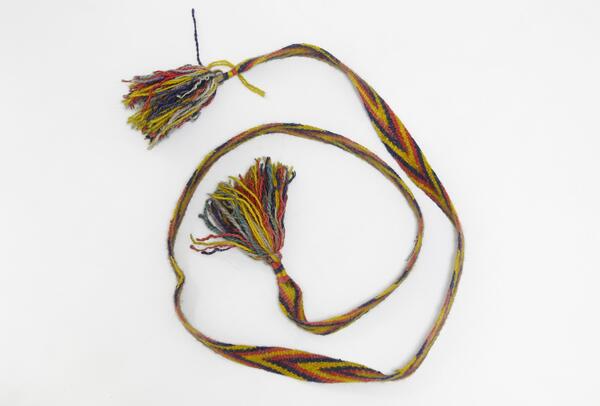
The Sami people of the Kola Peninsula, called Lapland in the olden days, have been creating original applied art throughout their history. Its distinct traditions are rooted in the necessity to make their own clothes, footwear and household items in the harsh conditions of the Far North. In addition to the fundamental need to make them comfortable, there was a desire to make them beautiful and linked to the rituals and beliefs of the people.
The Sami applied art is indicative of the high skill of the Sami people. The decorative pattern is based on geometric shapes: rhombuses, squares, triangles, semicircles and wavy lines. The language of Sami designs is laconic and simple. There were characteristic decorative solutions for different products. Sami people were very careful to use colors that symbolized certain phenomena of nature: yellow — the sun, blue — the sky, navy blue — water, green — leaves and grass, white — snow. The basic colors of national embroidery were white, blue and yellow. Black was never used.
Beads were one of the most common materials used by Sami craftswomen to decorate their work. Women’s and men’s belts and other items were embroidered with beads.
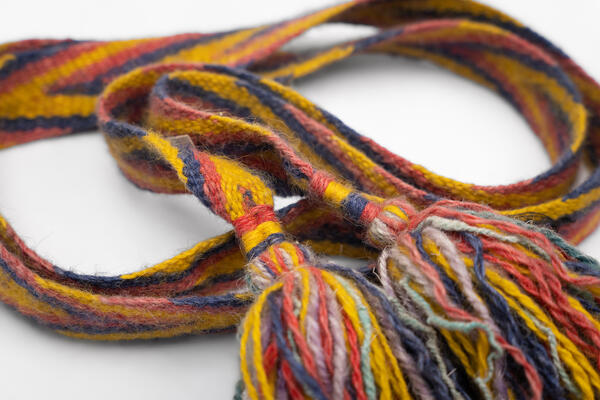
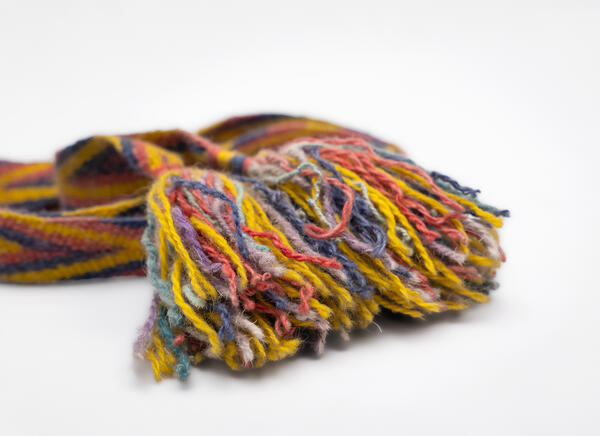
The belt was not only considered an essential attribute of clothing, but also served as an amulet: an unbelted person was considered unprotected from the evil eye. When women wove belts, they charmed each loop: for health, for happiness, for good luck. Belts were decorated with pendants, appliqué, beads and embroidery.
The Sami belt was an indispensable attribute of the costume and was worn over the clothes. The outer garment was girded, forming a small overlap, so that part of the garment hung loosely over the belt.
The belt could be made of deerskin or woven of dyed cotton and wool threads.
Men suspended from their belts a leather sheath with a hunting knife, a pouch with a flint, a purse, copper rings and amulets. Women always carried on their belts the keys of their simple household and, along with a knife and a bone spoon, a bone needle case and scissors. Women were engaged in needlework.
The Sami people developed and preserved those items
that best suited their everyday life, as well as geographical, natural and
climatic conditions.