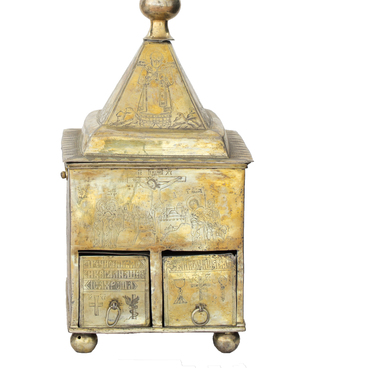
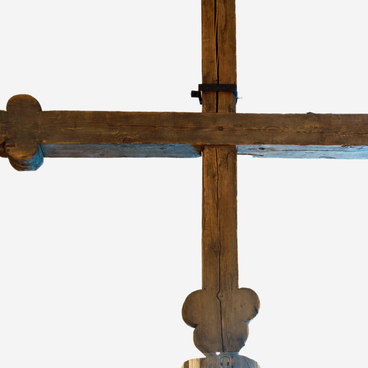
In 1692, the nobleman Semyon Rimorev made a rich contribution to the Antonievo-Siysky Monastery for the eternal commemoration of the boyar Ivan Miloslavsky (1635-1685), who was close to tsar Feodor, and a supporter of tsarina Sofia. One of his gifts was a silver chalice, made in a new for its time and very expensive technique of applying enamel on embossed relief and painting on enamel.


Chalice
Creation period
1687
Dimensions
16x28x16 cm
Technique
silver, enamel, chasing, engraving, gilding, enamel painting
Collection
3
Open in app#1
Unknown author
Chalice
#2
#3
A chalice is a liturgical vessel in the shape of a deep bowl on a tall leg with a round base, intended for the consecration of church wine. The chalice symbolizes the cup given by Jesus Christ at the Last Supper to his disciples and embodies the cup of His sufferings for the sins of the world.
#6
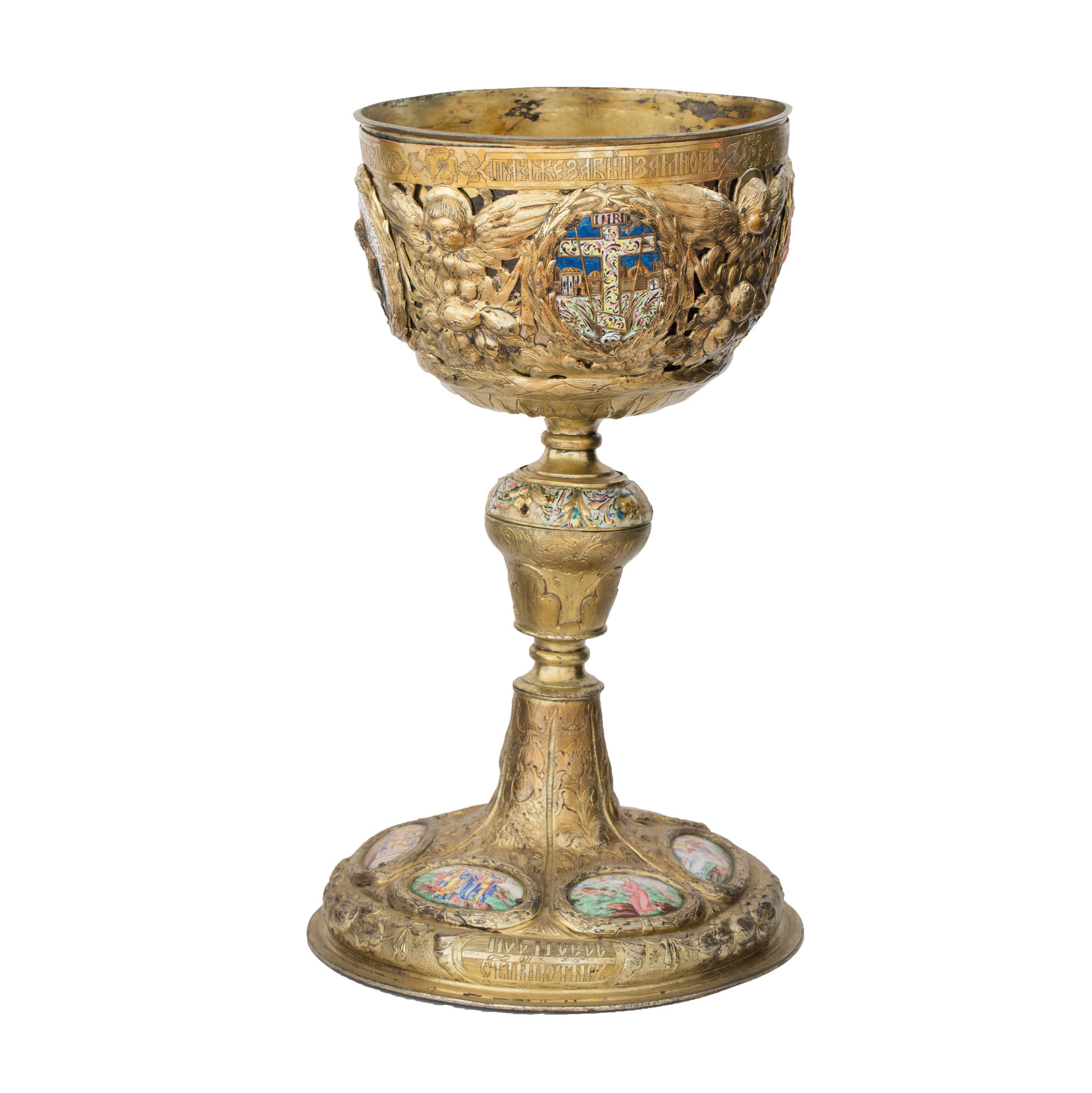
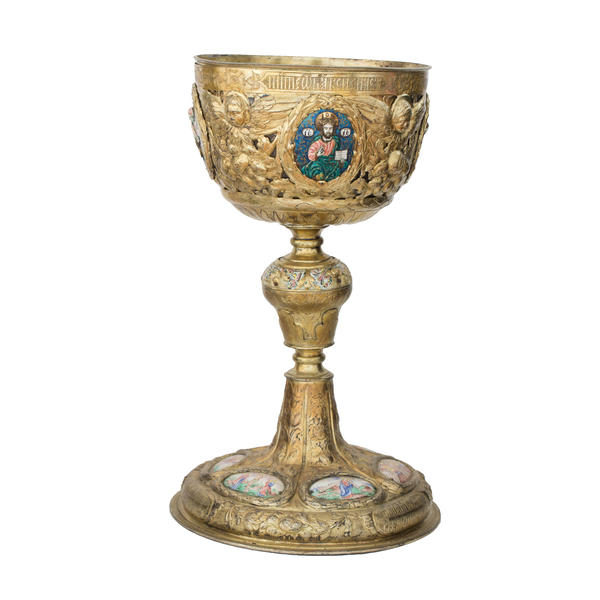
An embossed cover — ‘shirt’ — is attached to the smooth body of the chalice. Its intricate decor is complemented by four oval inserts — plaques with images of Christ, the Virgin Mary, John the Baptist and the Golgotha cross covered with coloured enamel over the embossed relief. Between the plaques, there are embossed figures of cherubs above the drapes with leaves and pomegranates.
On the rim of the cup there is a carved inscription: ‘DRINK FROM THIS THIS IS THE BLOOD OF MINE OF THE NEW TESTAMENT FOR YOU AND FOR MANY IT WAS SPILLED TO ATONE FOR THE SINS.’
The leg of the chalice is figured, the upper part of the ‘apple’ (a rounded thickening on the leg) is painted with enamel with a plant ornament. The bowl is decorated with six oval medallions, made in the technique of painting on enamel. They depict scenes of the Passions, the last week of Christ’s earthly life: praying for the chalice, kissing Judas, scourging at the pillar, carrying the cross, crucifixion, and descent from the cross. The main colours are emerald green, blue, pink, pale yellow and white.
On the rim of the cup there is a carved inscription: ‘DRINK FROM THIS THIS IS THE BLOOD OF MINE OF THE NEW TESTAMENT FOR YOU AND FOR MANY IT WAS SPILLED TO ATONE FOR THE SINS.’
On the lower edge of the bowl, in three medallions, there is an engraved inscription: “THIS HOLY CHALICE IS FOR THE ETERNAL MEMORY OF BOYAR IVAN MILOSLAVSKY”.
#8
Enamel-painted reliefs appeared in Russia only in the second half of the 17th century, but already at the end of the century, local enamel art reached an unprecedented peak. This technology requires a lot of skill.
A thick enamel mass is applied evenly to volumetric areas of the surface, then the object is placed in a furnace and kept there until the enamel spreads over the surface. In convex areas, enamel sometimes drips off or burns out. If areas of bare metal or cracks appear, a new layer of enamel mass is applied to them, after which firing is repeated. A strict firing order from low-melting to churlish, as well as the use of high-quality enamels, are an important condition for working in the enamelled relief technique.
#9
Arkhangelsk regional museum
read morehide
00:00
00:00
1x
Chalice
Creation period
1687
Dimensions
16x28x16 cm
Technique
silver, enamel, chasing, engraving, gilding, enamel painting
Collection
3
 Point your smartphone camera to open in the app
Open in app
Share