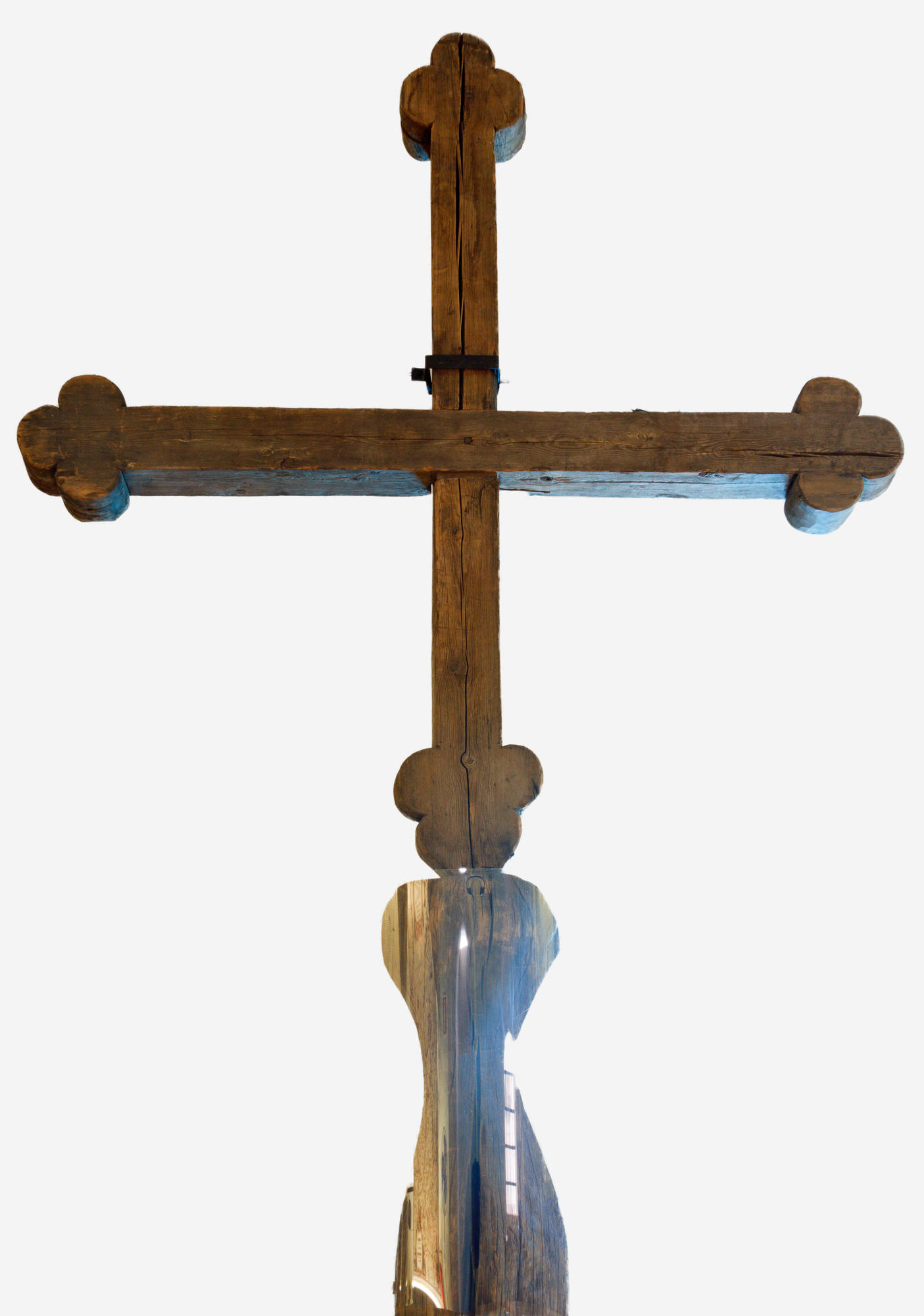
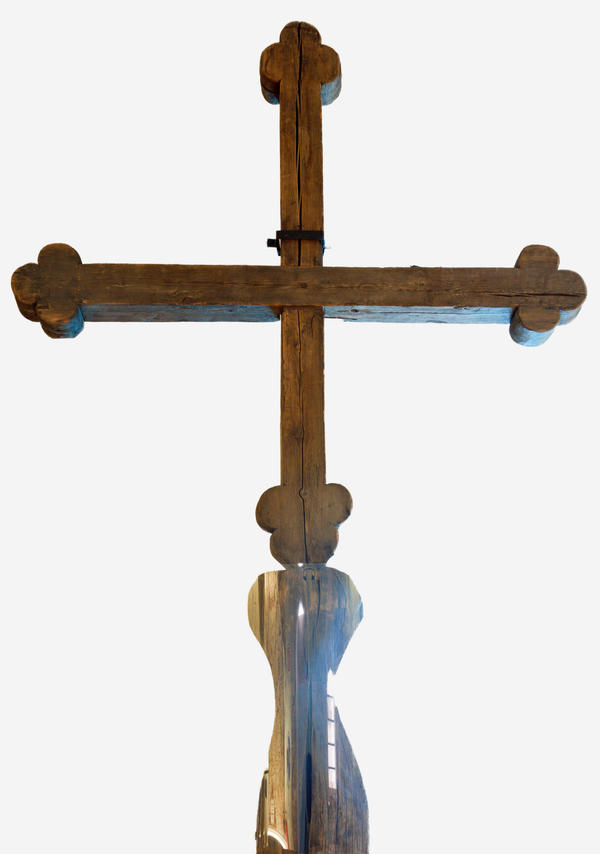
The tsar’s yacht was badly damaged: “It was hit badly by the waves, and the sails were torn, and the mast was broken, and the cords were ripped”. During the three days when the weather was bad, the ship was repaired with the help of the locals. During this time, Peter carved a cross out of pine logs with his own hands and set it on the seashore. On the cross, he carved an inscription in Dutch: DAT KRUVS MAKEN KAPTEIN PITER VAN A CHT 1694 (“This cross was set up by captain Peter in the year of our Lord 1694”).
At the end of the 18th century, due to rotting, the cross was transferred to the Assumption Church of the Pertominsky Monastery, and in 1805, at the request of the Arkhangelsk residents and with the permission of Emperor Alexander I, was delivered to Arkhangelsk. On June 29, 1805, the relic was installed in the Trinity Cathedral, where it was placed under a specially designed canopy. In April 1929, when dismantling the internal structures of the cathedral, the cross was transferred to the museum. Currently, it is taking its rightful place in the permanent historical exhibition of the museum.
The commemorative inscription carved by Peter the Great on the base of the cross is barely preserved. St. Petersburg journalist Nikolai Leykin, who visited Arkhangelsk in the early 20th century and examined the cross in the Trinity Cathedral, wrote about its absence: “I searched for the inscription on the cross itself, but did not find it. The wood of the cross has decayed in places, including the place where Peter”s own handwritten inscription was.” At the very bottom of the base of the cross, there are barely visible remains of the date “1694”.