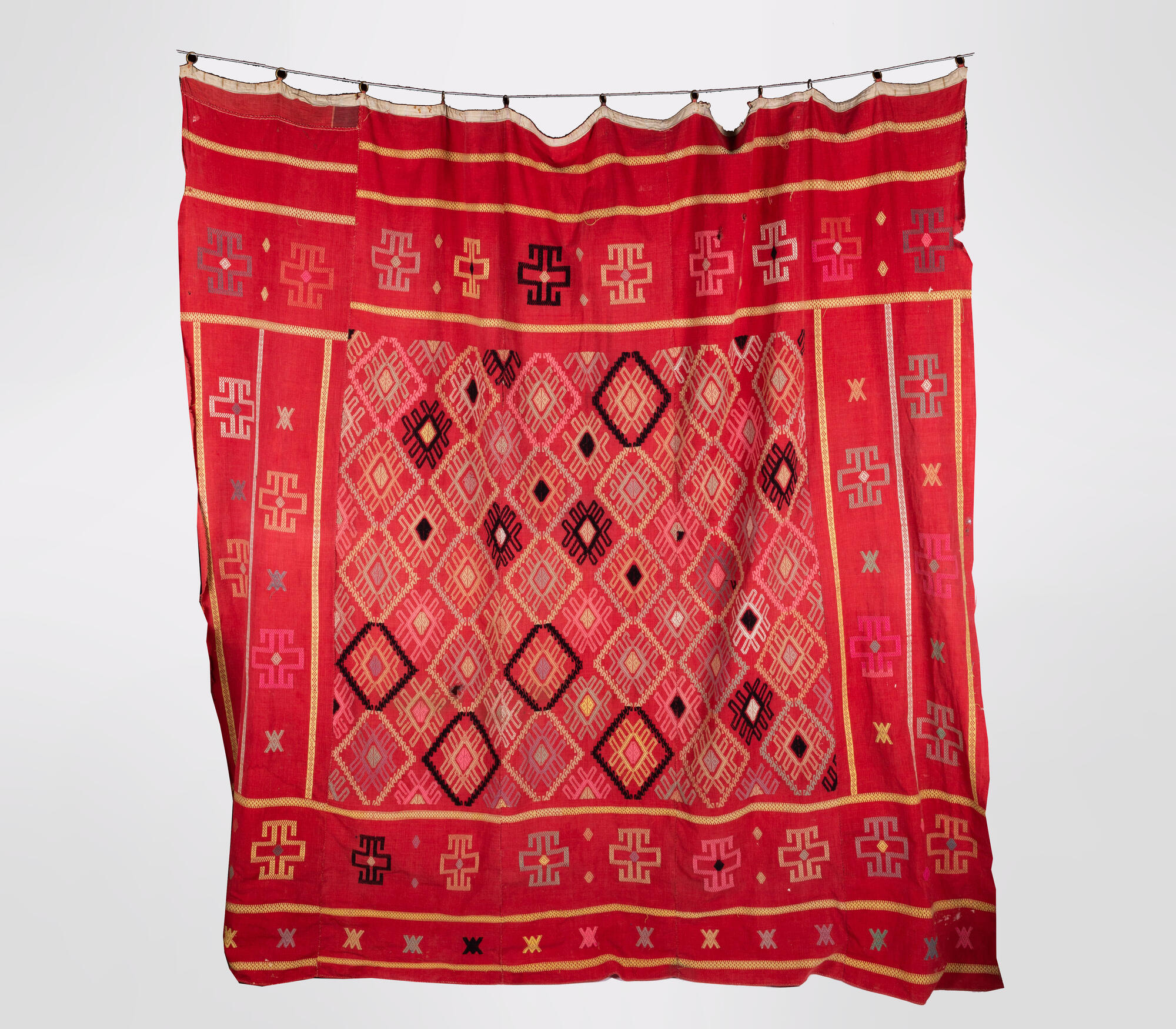


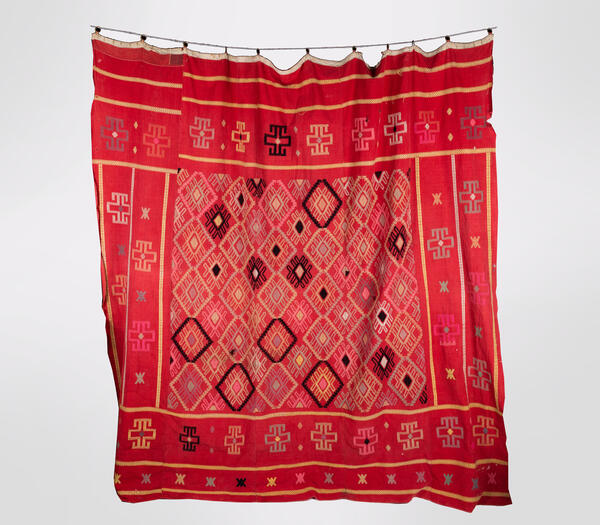
In the traditional BashkIr culture, a house was divided into two sections. The male part was for guests, the female part was for the household. Beautiful patterned curtains — sharshau — usually divided those sections. These curtains were usually made of a cotton, or canvas cloth. Most often, they were coloured in different shades of red, very seldom one could find curtains with a white background. A sharshau was sewn from separate stripes, thoroughly fitting parts of the pattern to each other in order to get a symmetrical pattern in the end. A textile stripe decorated the edge of the curtain.
The curtain was over 3.5 meters long. It was hung along the ceiling log. Sharshau was spread along the entire length of the house covering the space from the front wall to the door to hide the household part of a house from the sight of guests who sat on plank beds. The curtain composition and design were to show the weaving skills of the hostess, her diligence and talent.
The principal figure of the ornament was located in the center of the curtain. The pattern could be zoomorphic, vegetable, floral, or geometric. Bashkir craftswomen used the central ornament over the whole cloth edged with a wide stripe. Patterns were placed in squares, polygons, medallions, large and small design groups. Each group had a figure with an intricate composition. The curtain edge was often decorated with several rows of small design groups: medallions, polygons, and squares. The pattern designs reminded of designs typical of the Central Asia carpets.
The pattern was woven over the whole cloth which was about 40–50 centimeters wide. After that, the cloth was cut into stripes of equal length. These stripes were sewn pattern to pattern in order to get a symmetrical pattern in the end. The border was woven separately and sewn to the finished part of the curtain.
Sometimes, a sharshau was decorated with embroidery and appliques.
The curtain was a mandatory item in a bride’s dowry. The sharshaw was presented to newly-weds during the wedding ceremony.
The curtain was over 3.5 meters long. It was hung along the ceiling log. Sharshau was spread along the entire length of the house covering the space from the front wall to the door to hide the household part of a house from the sight of guests who sat on plank beds. The curtain composition and design were to show the weaving skills of the hostess, her diligence and talent.
The principal figure of the ornament was located in the center of the curtain. The pattern could be zoomorphic, vegetable, floral, or geometric. Bashkir craftswomen used the central ornament over the whole cloth edged with a wide stripe. Patterns were placed in squares, polygons, medallions, large and small design groups. Each group had a figure with an intricate composition. The curtain edge was often decorated with several rows of small design groups: medallions, polygons, and squares. The pattern designs reminded of designs typical of the Central Asia carpets.
The pattern was woven over the whole cloth which was about 40–50 centimeters wide. After that, the cloth was cut into stripes of equal length. These stripes were sewn pattern to pattern in order to get a symmetrical pattern in the end. The border was woven separately and sewn to the finished part of the curtain.
Sometimes, a sharshau was decorated with embroidery and appliques.
The curtain was a mandatory item in a bride’s dowry. The sharshaw was presented to newly-weds during the wedding ceremony.