The famed Swedish entrepreneur Lars Magnus Ericsson founded his phone-making workshop in Saint Petersburg in 1897. After the revolution of 1905, the Ericsson enterprise was reformed into the Russian Joint-Stock Company, and in 1924, it was renamed to the Electro-technical Association of Low Current Production Facilities and became part of the Krasnaya Zarya Telephone Plant. The facility produced telephones, in addition to minting gold coins.
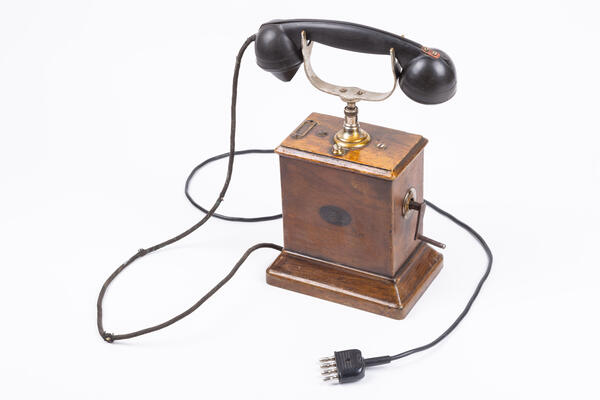
In 1928, Krasnaya Zarya introduced a unique telephone, based on the CB, or Central Battery, system. It did not have a dialer and instead connected to a hotline. This telephone was inductive; to make calls, the user had to rotate a special crank on its body. The receiver rested on an ergonomic fork-shaped holder on top of the device. This model connected directly to the telephone station’s power source.
To use a telephone of this type, you had to pick up the receiver and rotate the inductor crank on the device’s side several times. The more vigorously you rotated the crank, the more likely your call was to come through. Generally, users had to rotate it at least three times per second.
Inside the telephone’s body, was an inbuilt signal that made a ringing noise. In certain special cases, the telephone could be equipped with special lamps instead; thus the ringing was replaced with light indicators.
The Krasnaya Zarya telephones did not have the capacity to ensure proper sound quality, as special sound amplifiers had not been invented yet. If you wanted to clearly hear the person on the other end of the line, the room had to be perfectly quiet. The phone manufacturers also advised users to cover the other ear with their hand.
The materials that were used for making telephones during the first half of the twentieth century were not particularly original, or durable either. In most cases, telephones were made out of wood—but this does not mean that they were a class of deluxe designer furniture. On the contrary, many telephones were bulky, unwieldy, and far from aesthetically pleasing.
During the 1930s, such devices were often installed in the studies of high-ranking officials and used for confidential work-related conversations.
In 1928, Krasnaya Zarya introduced a unique telephone, based on the CB, or Central Battery, system. It did not have a dialer and instead connected to a hotline. This telephone was inductive; to make calls, the user had to rotate a special crank on its body. The receiver rested on an ergonomic fork-shaped holder on top of the device. This model connected directly to the telephone station’s power source.
To use a telephone of this type, you had to pick up the receiver and rotate the inductor crank on the device’s side several times. The more vigorously you rotated the crank, the more likely your call was to come through. Generally, users had to rotate it at least three times per second.
Inside the telephone’s body, was an inbuilt signal that made a ringing noise. In certain special cases, the telephone could be equipped with special lamps instead; thus the ringing was replaced with light indicators.
The Krasnaya Zarya telephones did not have the capacity to ensure proper sound quality, as special sound amplifiers had not been invented yet. If you wanted to clearly hear the person on the other end of the line, the room had to be perfectly quiet. The phone manufacturers also advised users to cover the other ear with their hand.
The materials that were used for making telephones during the first half of the twentieth century were not particularly original, or durable either. In most cases, telephones were made out of wood—but this does not mean that they were a class of deluxe designer furniture. On the contrary, many telephones were bulky, unwieldy, and far from aesthetically pleasing.
During the 1930s, such devices were often installed in the studies of high-ranking officials and used for confidential work-related conversations.