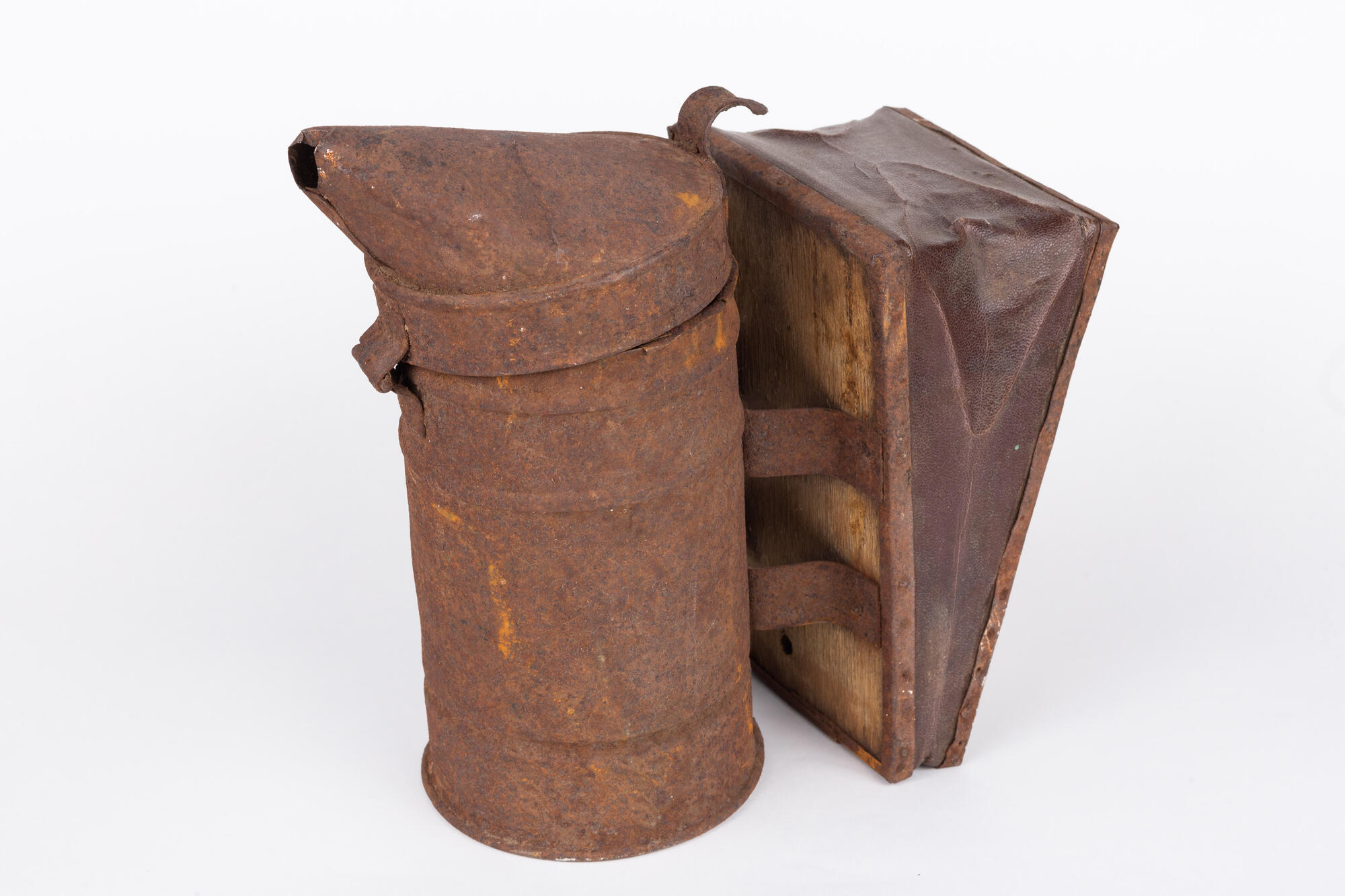


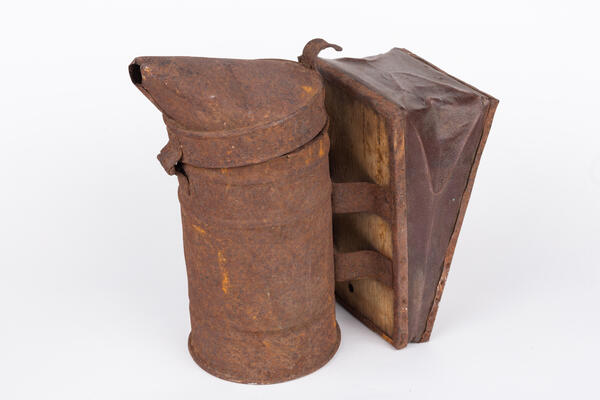
A bee smoker is a special device for calming down bees. It is used for ensuring the bee keeper’s safety as they inspect bee hives and collect honey: if not calmed down, the bees might sting the person that disturbs them.
The main body of a bee smoker is an iron cylinder with a conical lid. It is attached to bellows for blowing air over coals. Inside the smoker, is a metal cup with a grated bottom. The small gap between the cup and the rest of the smoker is meant for collecting ash.
The cup is filled with flammable fuel, which produces dense, opaque smoke. Some fuel varieties may include dry horse manure or rotting wood.
The bellows are most commonly made out of wooden planks linked by a ball joint. The planks are wrapped tightly into a waterproof material, usually faux leather. Some bee smokers have metal bellows instead, but they are used much less often as they become too hot too fast and may burn the beekeeper.
The holes in the bellows and the smoker’s body are located on the same axis, and the smoke travels in between them.
Humans noticed that bees could be calmed down by smoke a long time ago. The first bee smokers were crafted in Ancient Egypt. This ancient version was a clay vessel with two holes. The construct’s shape resembled a turtle. The fuel was fed into the larger hole, while the smaller hole emitted smoke. Such basic smokers are still used by beekeepers today; some examples include the indigenous peoples of Algeria.
One of the popular types of animal husbandry in Ancient Rus' was honey hunting in the woodlands. The honey hunters, known as bortniks, would calm down wild bees by carrying a charred, smoking piece of wood.
Scientists did not discover why bees were calmed down by smoke until the twentieth century. It turns out that a bee colony responds to smell as a danger signal. Smoke masks these signalling smells, and the bees remain unaware of the potential threat. Furthermore, where there is smoke, there is fire, and once they smell smoke, the bees start preparing for a fire evacuation by stuffing their honey pouches. In this state, a bee is incapable of attacking or stinging anyone: its abdomen will simply fail to bend at the right angle.
The main body of a bee smoker is an iron cylinder with a conical lid. It is attached to bellows for blowing air over coals. Inside the smoker, is a metal cup with a grated bottom. The small gap between the cup and the rest of the smoker is meant for collecting ash.
The cup is filled with flammable fuel, which produces dense, opaque smoke. Some fuel varieties may include dry horse manure or rotting wood.
The bellows are most commonly made out of wooden planks linked by a ball joint. The planks are wrapped tightly into a waterproof material, usually faux leather. Some bee smokers have metal bellows instead, but they are used much less often as they become too hot too fast and may burn the beekeeper.
The holes in the bellows and the smoker’s body are located on the same axis, and the smoke travels in between them.
Humans noticed that bees could be calmed down by smoke a long time ago. The first bee smokers were crafted in Ancient Egypt. This ancient version was a clay vessel with two holes. The construct’s shape resembled a turtle. The fuel was fed into the larger hole, while the smaller hole emitted smoke. Such basic smokers are still used by beekeepers today; some examples include the indigenous peoples of Algeria.
One of the popular types of animal husbandry in Ancient Rus' was honey hunting in the woodlands. The honey hunters, known as bortniks, would calm down wild bees by carrying a charred, smoking piece of wood.
Scientists did not discover why bees were calmed down by smoke until the twentieth century. It turns out that a bee colony responds to smell as a danger signal. Smoke masks these signalling smells, and the bees remain unaware of the potential threat. Furthermore, where there is smoke, there is fire, and once they smell smoke, the bees start preparing for a fire evacuation by stuffing their honey pouches. In this state, a bee is incapable of attacking or stinging anyone: its abdomen will simply fail to bend at the right angle.