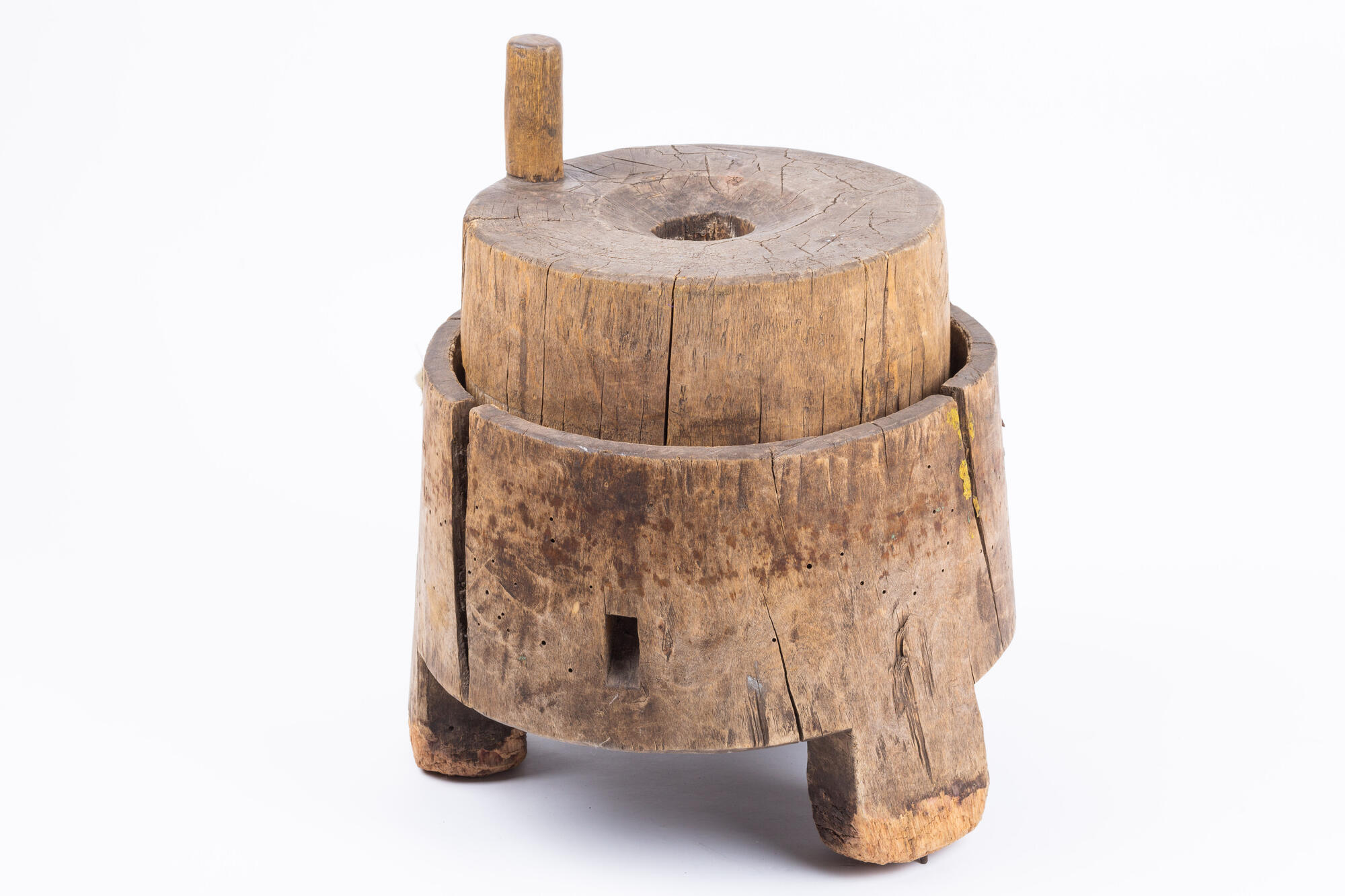


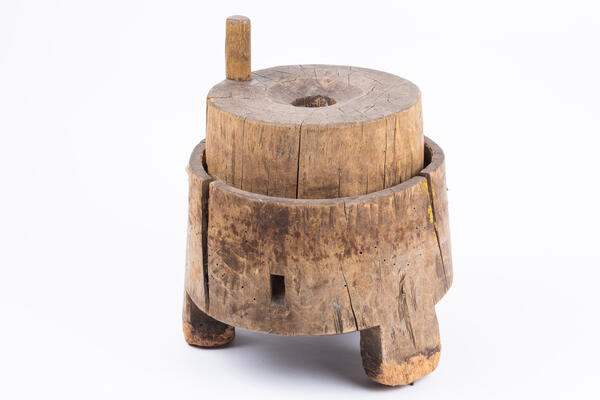
This exhibit, called zhernova in russian, is a handmill, the most basic flour-grinding tool.
When humans first learned to cultivate grain, they realized that they needed a tool to process their harvest. After all, crushing single grains one after another took too long, and was far too inefficient, especially with the large amounts of flour needed. And thus, handmills were invented. Known as zhernova, or grinding stones, they were used actively by the Bashkir peoples up until the early 20th century. According to old Bashkir tradition, handmills could only be used by women.
To make such a handmill, two flat discs were sawn off a birch log, about 25 centimeters in diameter. An iron or wooden rod was inserted in the middle of the lower disc. The upper disc had a fairly large hole made in it, for the rod to fit into.
Where the disc surfaces touched one another, they were covered in shards of a cast iron pot, positioned edgewise. Usually, the lower disc was a bit convex in the middle, while the upper disc was concave. There was a peg-like crank (for rotating the mill discs) affixed to the upper disc.
Both discs were covered in deep grooves that divided them into several segments. These flat disc sections were the grinding surfaces. The grooves also had smaller indentations branching out from them, known as the plumes. Together, the grooves and the plumes formed a whole system: the cutting edge.
The grinding surfaces had rows of deep notches, with a coarse, abrasive texture in between them. To keep the handmill functional, the notches had to be retraced from time to time. As the grains were caught in between the upper and lower grooves, the notch edges cut into them and tore them apart in smaller fractions, until they exited the grooves as ground-up mass.
When operating a handmill, women would often place it on top of a protective layer of calf or foal hide, with the inner membrane facing upward. After the first grinding cycle, grain would turn into groat; fine flour would be produced after the third to fifth cycle.
Smaller handmills were sometimes made of stone rather than wood. The grinding discs in this case were flat chunks of sandstone, about 25 cm in diameter.
When humans first learned to cultivate grain, they realized that they needed a tool to process their harvest. After all, crushing single grains one after another took too long, and was far too inefficient, especially with the large amounts of flour needed. And thus, handmills were invented. Known as zhernova, or grinding stones, they were used actively by the Bashkir peoples up until the early 20th century. According to old Bashkir tradition, handmills could only be used by women.
To make such a handmill, two flat discs were sawn off a birch log, about 25 centimeters in diameter. An iron or wooden rod was inserted in the middle of the lower disc. The upper disc had a fairly large hole made in it, for the rod to fit into.
Where the disc surfaces touched one another, they were covered in shards of a cast iron pot, positioned edgewise. Usually, the lower disc was a bit convex in the middle, while the upper disc was concave. There was a peg-like crank (for rotating the mill discs) affixed to the upper disc.
Both discs were covered in deep grooves that divided them into several segments. These flat disc sections were the grinding surfaces. The grooves also had smaller indentations branching out from them, known as the plumes. Together, the grooves and the plumes formed a whole system: the cutting edge.
The grinding surfaces had rows of deep notches, with a coarse, abrasive texture in between them. To keep the handmill functional, the notches had to be retraced from time to time. As the grains were caught in between the upper and lower grooves, the notch edges cut into them and tore them apart in smaller fractions, until they exited the grooves as ground-up mass.
When operating a handmill, women would often place it on top of a protective layer of calf or foal hide, with the inner membrane facing upward. After the first grinding cycle, grain would turn into groat; fine flour would be produced after the third to fifth cycle.
Smaller handmills were sometimes made of stone rather than wood. The grinding discs in this case were flat chunks of sandstone, about 25 cm in diameter.