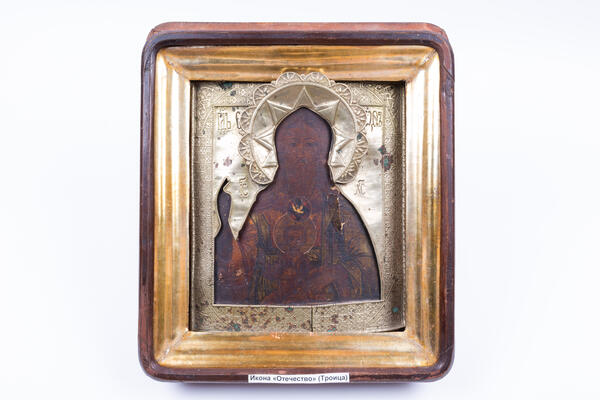
The exposition of the Dyurtyuli Local History Museum showcases the Paternity Icon, which is considered one of the most non-typical icons in the Orthodox tradition. It depicts the God in three HypostAses or Faces embodying the Christian dogma about the Holy Trinity.
In the central part of the canvas, one can see the God depicted as the Heavenly Father: a wise old man like the prophet Daniel saw the God in his visions. The fingers of His right hand are folded in a blessing gesture. The young Son of God is sitting solemnly in His lap. A dove is depicted above the Son’s head representing the hypostasis of the Holy Spirit. The image reminds of the Baptism of the Lord, during which “the Holy Spirit descended on Him in bodily form like a dove” (Luke 3:21-22).
These figures united in the center, indicate the unity of the three hypostases of God, as well as the incomprehensible depth of the Divine essence and its incarnation.
On the canvas, there is also an inscription “Lord of Sabaoth (Lord Almighty).” This name of the God is mentioned in the Book of Prophet Isaiah. Chapter 6 of the old text states:
“In the year that King Uzziah died, I saw the Lord seated on a throne, high and exalted, and the train of his robe filled the temple.
Above him were seraphs, each with six wings: with two wings they covered their faces, with two they covered their feet, and with two they were flying.
And they were calling to one another: 'Holy, holy, holy is the Lord Almighty; the whole earth is full of his glory.'”
Sabaoth is the Greek-Slavic variant of spelling and pronunciation of the Jewish word “Tzevaot” which means “Armies”. So, the phrase “Lord of Sabaoth” can be translated as “Lord of Hosts.”
Although a more traditional image of the Trinity in the Orthodox tradition is Andrei Rublev’s icon ‘The Trinity, ’ the image showcased in the exposition became a very popular variant in Russia in the 15th-17th centuries. Specialists suppose that the Paternity Icon could have been created under the influence of the West-European Medieval art, where this concept of the Divine essence was quite common. One of the earilest icons of this type was The Paternity icon from Novrogod of the 14th century.
In the central part of the canvas, one can see the God depicted as the Heavenly Father: a wise old man like the prophet Daniel saw the God in his visions. The fingers of His right hand are folded in a blessing gesture. The young Son of God is sitting solemnly in His lap. A dove is depicted above the Son’s head representing the hypostasis of the Holy Spirit. The image reminds of the Baptism of the Lord, during which “the Holy Spirit descended on Him in bodily form like a dove” (Luke 3:21-22).
These figures united in the center, indicate the unity of the three hypostases of God, as well as the incomprehensible depth of the Divine essence and its incarnation.
On the canvas, there is also an inscription “Lord of Sabaoth (Lord Almighty).” This name of the God is mentioned in the Book of Prophet Isaiah. Chapter 6 of the old text states:
“In the year that King Uzziah died, I saw the Lord seated on a throne, high and exalted, and the train of his robe filled the temple.
Above him were seraphs, each with six wings: with two wings they covered their faces, with two they covered their feet, and with two they were flying.
And they were calling to one another: 'Holy, holy, holy is the Lord Almighty; the whole earth is full of his glory.'”
Sabaoth is the Greek-Slavic variant of spelling and pronunciation of the Jewish word “Tzevaot” which means “Armies”. So, the phrase “Lord of Sabaoth” can be translated as “Lord of Hosts.”
Although a more traditional image of the Trinity in the Orthodox tradition is Andrei Rublev’s icon ‘The Trinity, ’ the image showcased in the exposition became a very popular variant in Russia in the 15th-17th centuries. Specialists suppose that the Paternity Icon could have been created under the influence of the West-European Medieval art, where this concept of the Divine essence was quite common. One of the earilest icons of this type was The Paternity icon from Novrogod of the 14th century.