The traditional clothing of a Tatar woman typically included a lot of different hand jewellery. There were no social or age restrictions on which women could wear bracelets, resulting in the broadest variety of accessories. For instance, women from wealthy families often preferred gilded filigree bracelets inlaid with jewels. Those with less money at their disposal could only afford simpler, less intricate bracelets made of low-grade silver.
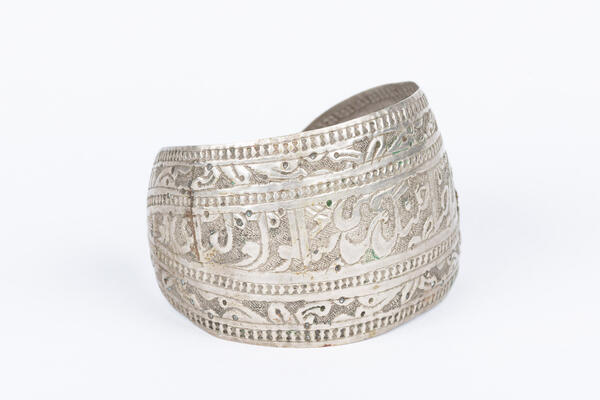
The traditional bracelets came in two types: solid and segmented. Solid bracelets were wrought from a single metal plate or a piece of wire or arrow tip. Curved plate bracelets were particularly popular. They did not have any fastenings by design and were meant to be worn by being bent slightly to fit the woman’s wrist. Such bracelets could be both narrow (no more than 1.5 cm wide) and more massive, reaching up to 8 cm.
Segmented bracelets had several elements that were attached to one another with a clasp, loop, or hook. Sometimes, the clasp would be affixed to a pin, creating a structure reminiscent of a door hinge. Some experts believe that the Tatar jewellers had borrowed this technique from Central Asia.
The bracelet ornaments also varied greatly. It was quite fashionable to wear engraved jewellery, augmented with inlaid gems or coin bangles. Embossed bracelets were quite common as well. And in some cases, master jewellers even managed to combine several techniques within a single piece.
The patterns that adorned the bracelets were usually inspired by nature: for instance, they could include stylised floral motifs. Inscriptions in Arabic, such as quotes from the Qur’an or prayers, were also common. If a bracelet was custom-made it could also feature the name of its owner.
Out of segmented bracelets, the most labour-intensive variety was exquisite flattened skan', or filigree. The individual segments of such accessories could be square, rectangular, round, or festooned. The bracelets were coated in gold or silver and encrusted with gemstones. Such lavish jewellery was only accessible to the top of the social hierarchy.
The traditional bracelets came in two types: solid and segmented. Solid bracelets were wrought from a single metal plate or a piece of wire or arrow tip. Curved plate bracelets were particularly popular. They did not have any fastenings by design and were meant to be worn by being bent slightly to fit the woman’s wrist. Such bracelets could be both narrow (no more than 1.5 cm wide) and more massive, reaching up to 8 cm.
Segmented bracelets had several elements that were attached to one another with a clasp, loop, or hook. Sometimes, the clasp would be affixed to a pin, creating a structure reminiscent of a door hinge. Some experts believe that the Tatar jewellers had borrowed this technique from Central Asia.
The bracelet ornaments also varied greatly. It was quite fashionable to wear engraved jewellery, augmented with inlaid gems or coin bangles. Embossed bracelets were quite common as well. And in some cases, master jewellers even managed to combine several techniques within a single piece.
The patterns that adorned the bracelets were usually inspired by nature: for instance, they could include stylised floral motifs. Inscriptions in Arabic, such as quotes from the Qur’an or prayers, were also common. If a bracelet was custom-made it could also feature the name of its owner.
Out of segmented bracelets, the most labour-intensive variety was exquisite flattened skan', or filigree. The individual segments of such accessories could be square, rectangular, round, or festooned. The bracelets were coated in gold or silver and encrusted with gemstones. Such lavish jewellery was only accessible to the top of the social hierarchy.