The southern mammoth was the first animal to lack a thick woolly coat. In fact, it was almost entirely hairless. Scientists believe that this species emerged during the Pliocene, approximately 5 million years ago.
The southern mammoths migrated from Africa to what is now Europe, and over the three million years that followed, their appearance changed dramatically: their tusks became more massive, and they grew a thicker coat.
Many animal species grew in size during the Last Glacial Period, commonly known as the Ice Age; but all the same, mammoths still remained the largest animals on Earth. The strongest male mammoths could be 3.5 meters tall and weighed up to 100 kilos. Mammoths had a massive body and short legs. They were coated in dense fur that was at least one meter long and provided excellent protection from the cold. Their tusks reached a whopping 4 m in length. They proved very handy when digging food from under the snow.
The mammoth habitat spanned North America, Japan, China, Europe, and Chukotka. They were migratory animals, preferring to travel through river valleys in small, compact herds.
They ate shrubs, tree branches, and grass. Their strong molars helped them chew their rough fodder. The mammoth had four molars, two on each jaw. Eventually, they would wear down and fall out, only to be replaced with new teeth. This cycle could repeat for up to five times throughout the mammoth’s life.
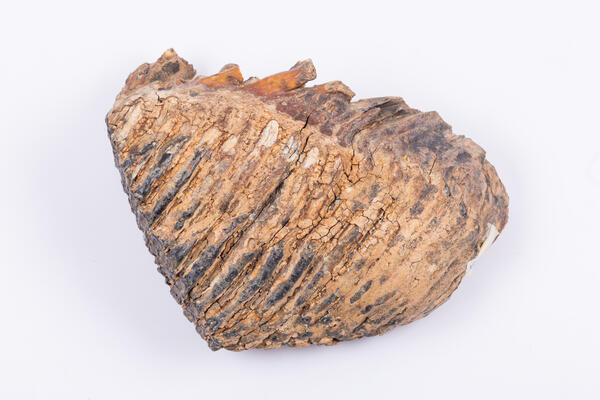
Visually, these teeth resembled enormous graters, each made out of separate dentine plates. The plates were coated in enamel and cemented together by a special substance. The molars' chewing surface was oval and covered in rigid bumps. Due to their sheer strength, mammoth teeth are a far more common find than any other bones of these animals.
Scientists believe that mammoths died out approximately 10,000 years ago. They were a very popular quarry for human hunters, which largely contributed to their extinction. But the actual date when the very last mammoths disappeared is a very rough approximation, as the extinction was spread unevenly across different continents.
The southern mammoths migrated from Africa to what is now Europe, and over the three million years that followed, their appearance changed dramatically: their tusks became more massive, and they grew a thicker coat.
Many animal species grew in size during the Last Glacial Period, commonly known as the Ice Age; but all the same, mammoths still remained the largest animals on Earth. The strongest male mammoths could be 3.5 meters tall and weighed up to 100 kilos. Mammoths had a massive body and short legs. They were coated in dense fur that was at least one meter long and provided excellent protection from the cold. Their tusks reached a whopping 4 m in length. They proved very handy when digging food from under the snow.
The mammoth habitat spanned North America, Japan, China, Europe, and Chukotka. They were migratory animals, preferring to travel through river valleys in small, compact herds.
They ate shrubs, tree branches, and grass. Their strong molars helped them chew their rough fodder. The mammoth had four molars, two on each jaw. Eventually, they would wear down and fall out, only to be replaced with new teeth. This cycle could repeat for up to five times throughout the mammoth’s life.
Visually, these teeth resembled enormous graters, each made out of separate dentine plates. The plates were coated in enamel and cemented together by a special substance. The molars' chewing surface was oval and covered in rigid bumps. Due to their sheer strength, mammoth teeth are a far more common find than any other bones of these animals.
Scientists believe that mammoths died out approximately 10,000 years ago. They were a very popular quarry for human hunters, which largely contributed to their extinction. But the actual date when the very last mammoths disappeared is a very rough approximation, as the extinction was spread unevenly across different continents.