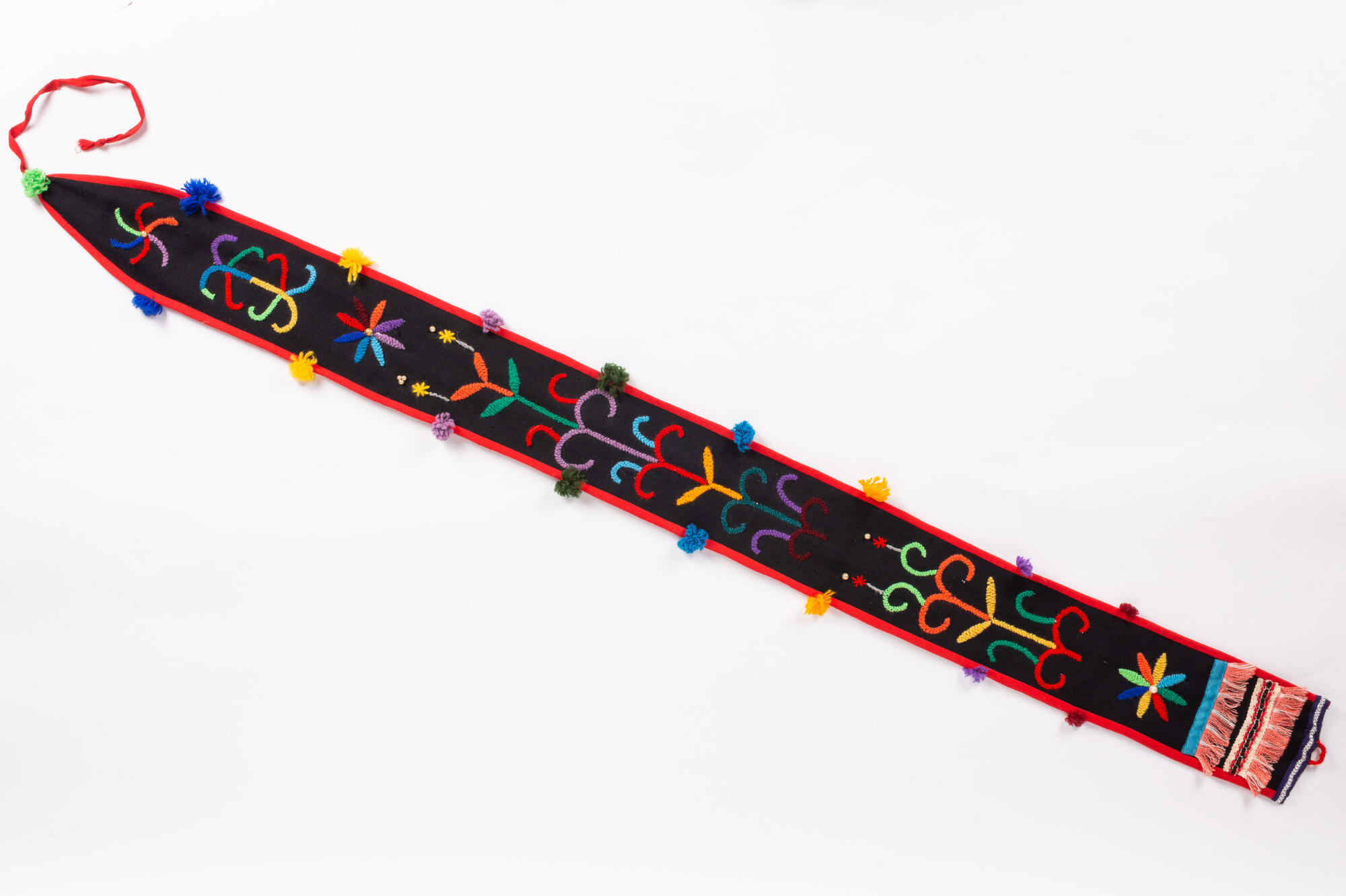


The museum exposition features the BashkIr decorative band. It holds up pillows piled on the chest. The band is made of a black cloth edged with a red strip and embroidered with red, violet, purple, green, and orange woolen threads.
In old times, the Bashkirs were a nomadic people and often moved from one place to another. Numerous trips required special devices for convenient transportation of things, in particular bedding. So, women used special bands—"tartma’ or “tushak tartma"—to tie up household utensils. They were decorated with intricate embroidery and beads, as well as with lace, ribbons, and coins.
Following ancient household rites, the Bashkir hostesses often use bands even today. Today, they are most often used to fasten the bed linen laid on plank beds.
The band can be over 1.5 meters long and usually 12–17 centimeters wide. Modern bands are as richly decorated as the old ones. A pattern sample is cut out of paper. Then, the stencil is sewn onto a fabric with wide running stitches. The sample contour is sewn over with tambour stitches. After that, the paper is removed, and the inner space is filled with an oblique net. Often, an oblique net decorates the whole surface without pattern contours. Decorative elements are embroidered with a standard needle.
Cotton, woolen, or silk threads are used for embroidery. Velvet or thick cloth are used as the basis. The ornament background can be green, or red. However, it is considered that a pattern looks the brightest and most impressive against a black background. The ornament is embroidered with warm-colored threads, contrasting the background fabric.
The technique and artistic features of embroidery allow you to determine what people or a tribe possessed the band. Unique traditional patterns and decorations are typical of certain territories.
The key elements of a classic ornament are: paired lamb’s horns, S-shaped lines, or a combination of lines crossing like the letter X. Decorative bands often depict plants, various symbols, and other stylized images.
In old times, the Bashkirs were a nomadic people and often moved from one place to another. Numerous trips required special devices for convenient transportation of things, in particular bedding. So, women used special bands—"tartma’ or “tushak tartma"—to tie up household utensils. They were decorated with intricate embroidery and beads, as well as with lace, ribbons, and coins.
Following ancient household rites, the Bashkir hostesses often use bands even today. Today, they are most often used to fasten the bed linen laid on plank beds.
The band can be over 1.5 meters long and usually 12–17 centimeters wide. Modern bands are as richly decorated as the old ones. A pattern sample is cut out of paper. Then, the stencil is sewn onto a fabric with wide running stitches. The sample contour is sewn over with tambour stitches. After that, the paper is removed, and the inner space is filled with an oblique net. Often, an oblique net decorates the whole surface without pattern contours. Decorative elements are embroidered with a standard needle.
Cotton, woolen, or silk threads are used for embroidery. Velvet or thick cloth are used as the basis. The ornament background can be green, or red. However, it is considered that a pattern looks the brightest and most impressive against a black background. The ornament is embroidered with warm-colored threads, contrasting the background fabric.
The technique and artistic features of embroidery allow you to determine what people or a tribe possessed the band. Unique traditional patterns and decorations are typical of certain territories.
The key elements of a classic ornament are: paired lamb’s horns, S-shaped lines, or a combination of lines crossing like the letter X. Decorative bands often depict plants, various symbols, and other stylized images.