

The word arithmometer has two greek compounds, meaning ‘number’ and ‘measurer.’ This device is capable of adding, subtracting, multiplying, and dividing numbers with maximum precision.
The Soviet Union produced arithmometers between 1929 and 1978. Statistics from different periods show that there were as many as 300 thousand such devices manufactured in the USSR in 1969, and about 203 thousand in 1970. And even though it would be impossible to pinpoint the exact number of all desktop arithmometers ever made, historians believe that the various industrial enterprises produced several million arithmometers over this period.
Arithmometers were usually assembled at major facilities, like the Moscow Plant of Computing and Analytical Equipment, the Penza Computing Plant, and Schyotmash in Kursk.
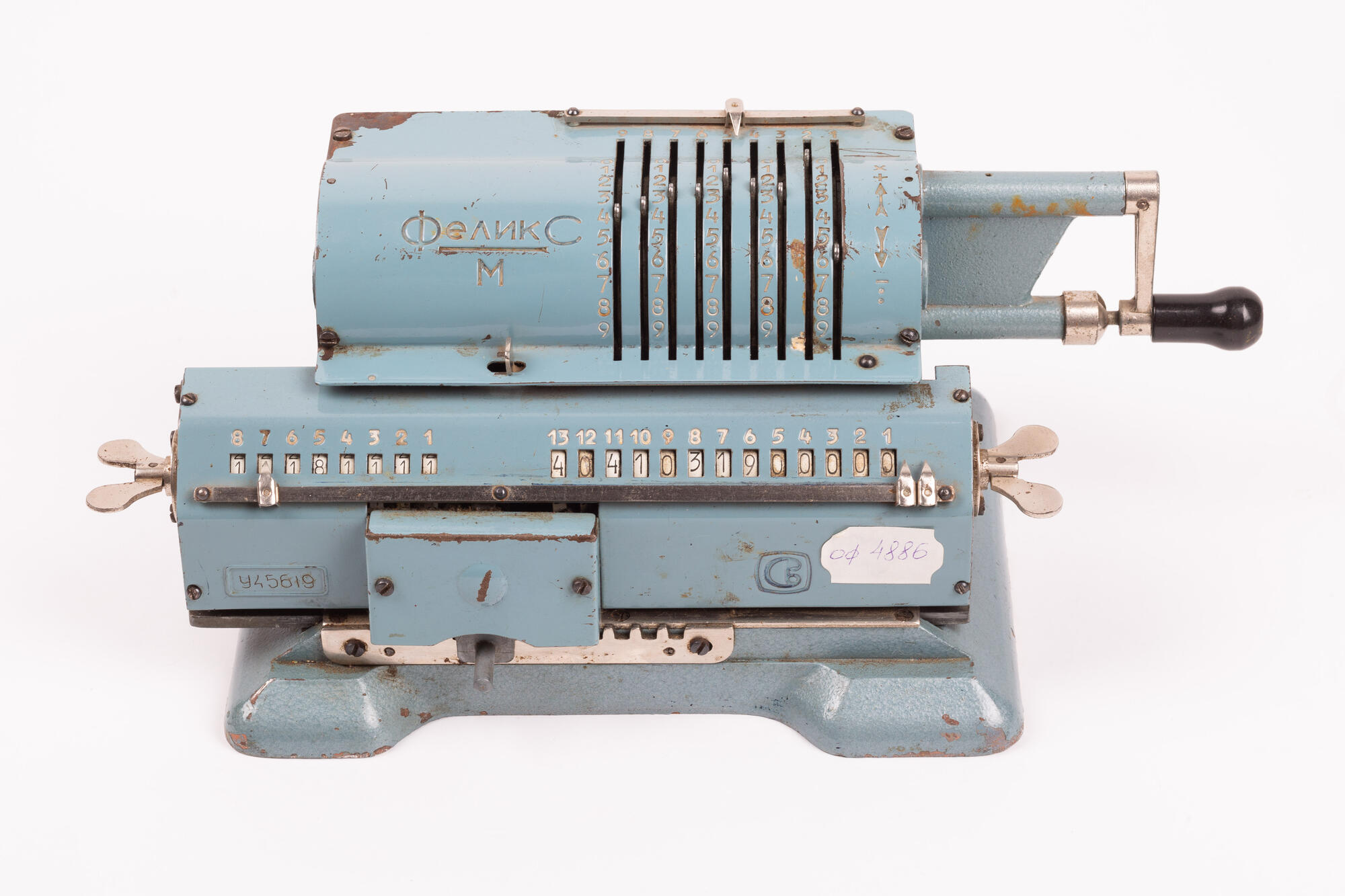
Our museum’s collection features a Felix arithmometer: a mechanical desktop model that was one of the device’s most popular versions in the Soviet Union. The Felix modification was capable of processing nine-digit numbers and displaying calculation results of up to 13 digits. The subtraction results could be up to eight digits long.
Shortly after launch, this universal device quickly gained popularity both in schools and at industrial facilities. It was so easy to use that even a child could operate it, and many accountants and engineers managed to expand the arithmometer’s functions beyond the four basic operations: they used it for finding percentages and roots as well.
The device’s parameters changed with each new and improved modification. But regardless of innovation, the essential calculation principles remained the same.
A whole separate part of the arithmometer was a set of sliders that showed the position of the decimal point. The device’s carriage could be shifted by a special lever. The number input was handled by the counting wheels. A wheel like this allowed for moving the digits a higher order to once the previous one was full.
Starting in the 1970s, the Soviet Union began using electronic calculators. Bulky at first, they gradually became more and more compact. Small and intuitive, this new invention became a practical addition to working desks around the nation, effortlessly dethroning the arithmometer, which could weigh about 3.5 kilos.
The Soviet Union produced arithmometers between 1929 and 1978. Statistics from different periods show that there were as many as 300 thousand such devices manufactured in the USSR in 1969, and about 203 thousand in 1970. And even though it would be impossible to pinpoint the exact number of all desktop arithmometers ever made, historians believe that the various industrial enterprises produced several million arithmometers over this period.
Arithmometers were usually assembled at major facilities, like the Moscow Plant of Computing and Analytical Equipment, the Penza Computing Plant, and Schyotmash in Kursk.
Our museum’s collection features a Felix arithmometer: a mechanical desktop model that was one of the device’s most popular versions in the Soviet Union. The Felix modification was capable of processing nine-digit numbers and displaying calculation results of up to 13 digits. The subtraction results could be up to eight digits long.
Shortly after launch, this universal device quickly gained popularity both in schools and at industrial facilities. It was so easy to use that even a child could operate it, and many accountants and engineers managed to expand the arithmometer’s functions beyond the four basic operations: they used it for finding percentages and roots as well.
The device’s parameters changed with each new and improved modification. But regardless of innovation, the essential calculation principles remained the same.
A whole separate part of the arithmometer was a set of sliders that showed the position of the decimal point. The device’s carriage could be shifted by a special lever. The number input was handled by the counting wheels. A wheel like this allowed for moving the digits a higher order to once the previous one was full.
Starting in the 1970s, the Soviet Union began using electronic calculators. Bulky at first, they gradually became more and more compact. Small and intuitive, this new invention became a practical addition to working desks around the nation, effortlessly dethroning the arithmometer, which could weigh about 3.5 kilos.