#1

Portraits in the library
#22
#21

#20
Eisenstein acquired a postcard depicting a bust of the ancient Greek philosopher SOcrates (470/469 BC–399 BC) in Germany or, possibly, in a used book store in Moscow. The antique bust itself is kept in Munich GlYptothek (a collection of works of ancient Greek and Roman sculpture). Eisenstein tucked the postcard into an old frame and hung it on the bookshelf, right below the photograph of Frederic-Lemaitre and the profile portrait of Edgar Degas.
Sergei Eisenstein said that Socrates was the best teacher in the history of mankind because he did not utter ‘ultimate truths’ and did not offer ready solutions for various issues, but posed questions to his interlocutors and taught them to think and look for answers themselves. Eisenstein also discussed the solution to each problem when staging educational sketches together with students in a ‘slow creative process’. He called the group of students ‘the twenty-headed director’ and strove to teach his students the methods of art so they could understand it, rather making them memorize ‘techniques.’ He considered fostering of creative individuality the foremost task of any teacher, and often joked that he doesn’t want to “raise a litter of Eisenpups”.
From his workshop in Proletkult came the comedy directors Grigory Alexandrov and Ivan Pyriev, the actors Maxim Shtraukh and Judith Glizer; from the workshop of the State Cinema School came the creators of Chapaev, the named Vasiliev brothers, directors Mark Donskoy and Vladimir Legoshin, scriptwriter Katerina Vinohradskaya; Valentin Kadochnikov, Mikhail Schweitzer, Vladimir Vengerov, Stanislav Rostotsky, Eldar Ryazanov and many others have went through his workshops.
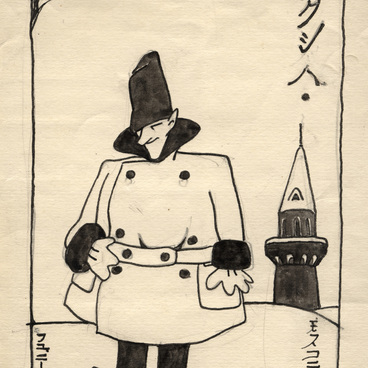
Sergei Eisenstein not only taught classes in his workshop, of which there were many transcripts, but also compiled the world’s first film directing course for institutes and universities, wrote the textbook ‘Directing. The art of mise-en-scène “, developed a” workshop’ methodology for fostering creative skills his students, whom he treated with sincere respect. The students loved their professor and once drew a friendly cartoon on him, in which Eisenstein’s “Socratic” forehead rose above the clouds. Indeed, the outline of Eisenstein’s high forehead resembles that of the ancient Greek philosopher.
#19
Full name: Sculptural portrait of Socrates. Postcard
Date: first third of the 20th century
Technique: paper, printing
Place: Munich
Dimensions: 14×8 cm; 16.8×10.8×1 cm (frame)
Collection: Library
Copyright: Cinema museum
Date: first third of the 20th century
Technique: paper, printing
Place: Munich
Dimensions: 14×8 cm; 16.8×10.8×1 cm (frame)
Collection: Library
Copyright: Cinema museum
#18
Portrait of Edgar Degas
#17

#16
This profile portrait of the French painter Edgar Degas was created in 1885 by his friend, an artist, a typographer, and a pioneer of photomechanical printing: Michel Manzi (1849–1915).
The French post-impressionist Edgar Degas /de’ga/ was one of Sergei Eisenstein’s favorite artists. The director considered him an equal to titans of the Renaissance—El Greco, Titian, Tintoretto—and the masters of the New Time: Daumier, Van Gogh, and Valentin Serov. In his theoretical works and at lectures at All-Union State Institute of Cinematography, Eisenstein often referred to the works of Degas to illustrate the masterful composition skills of the artist, the way he combined different phases of movement in the gestures of the characters, and how the ‘impressionistically captured instantaneousness of immediate impression’ and the harmony of the general structure was balanced in the paintings. Sergei Eisenstein believed that his students could learn to build compositions of frames Degas’s paintings; to “open” the frame of the image, and let the viewers perceive the objects outside of the picture’s scope.
Eisenstein amassed a big collection of Degas' albums and monographs about him in Russian, French, English and German; he carefully read memoirs about Edgar Degas and artist’s own letters in order to understand his character, his creative aspirations, his life circumstances, and friendships. A complex approach to the works and personal affairs of the artist have allowed Sergei Eisenstein to show that Degas' stylistically innovative masterpieces had predecessors that developed similar principles, and that the artist’s discoveries were rooted in profound psychological premises. Eisenstein’s method became a completely new approach to analyzing the composition of a work and the creative process itself. His analysis of Degas’s ‘Bathing women’ series of paintings has foretold some of the ideas and methods in the history and theory of art of the late XX and early XXI centuries.
In Eisenstein’s apartment, a portrait of Degas hung in the library right beneath a photograph of the 19th-century French actor FrederIc LemAItre. The director believed that with the help of new technology cinema realizes the oldest aspiration of art — to preserve moving forms of life in the unity of space and time. Many expressive means of cinematography carry on the centuries of worlds' cultural heritage.
#15
Full name: Portrait of Edgar Degas
Author: Michel Manzi
Date: first third of the 20th century
Technique: paper, printing
Dimensions: 11×15.5 cm (image); 17.3×13 cm (frame)
Collection: Library
Copyright: Cinema museum
Date: first third of the 20th century
Technique: paper, printing
Dimensions: 11×15.5 cm (image); 17.3×13 cm (frame)
Collection: Library
Copyright: Cinema museum
#14
A portrait of Toussaint Louverture
#13

#12
The lithograph depicts Franсois Dominique Toussaint Louverture (1743–1803), the leader of the Slave Revolt in 1791 on the island of Haiti in the Caribbean Sea. The island was a French colony at that time. After the French Revolution of 1789, the mulatto demanded equal rights for the white and colored population of Haiti, but the French refused to release the colonies. So, in August 1791, the Haitian Revolution began.
In 1803, Napoleon lured Toussaint Louverture to Paris. They threw the well-educated and humane black leader into prison and killed him. The Haitians massacred all the white people on the island out of anger and Henri Christophe (1767–1820), a former associate of Toussaint Louverture, came to power. The revolution ended with the island declaring its independence from France in 1804, and in 1811, Henri Christophe declared himself King of Haiti and appeared to be a much more terrible tyrant than the French. An American writer John Vandercook wrote a novel about him, entitled Black Majesty. Inspired by this novel, Eisenstein wanted to produce a film about the ‘tragedy of the revolutionary leader transforming into a despot.’ He hoped to cast an African American actor and singer Paul Robson. However, at that time in Hollywood, one could not even mention a film about the black revolution.
In 1932, back home, Eisenstein received a script from the historian and writer AnatOly VinogrAdov about the first period of the Haitian revolution. It was called the Black Consul and featured Toussaint Louverture. This new project lit up Sergei Eisenstein. In the leading role, he planned to cast a director and actor, head of the State Jewish Theater SolomOn MikhOels (1890–1948). Paul Robson was supposed to play the role of General Dessalines. Still, the officials from the Soviet cinematography did not accept this idea. Eisenstein’s guess that Mikhoels held the talent of a great tragic actor proved to be true: three years later he brilliantly played King Lear.
In 1933, the Soviet Literature publishing house issued Vinogradov’s novel The Black Consul, which the historian dedicated to Eisenstein. The book is kept in the Film Museum. The inscription on the flyleaf says: ‘Author to author. The prevarication of our headquarters is going to have a secondary effect on you and a primary one on me. A. V.’ Eisenstein placed the photocopied lithograph of Toussaint Louverture’s portrait, painted by Nicolas Eustache Maurin. (1799–1850) and printed by Francois Seraphin Delpech (1778–1825), in a small frame behind the glass.
#11
Full name: Toussaint Louverture. Reproduction of a lithograph by F. S. Delpech of a painting by N. E. Maurin
Author: Francois Seraphin Delpech, Nicolas Eustache Maurin
Date: 1920s–1930s
Technique: photographic paper, photo printing
Place: Moscow
Dimensions: 14.5×10.5 cm (page); 19×13.5 cm (edges)
Collection: Library
Copyright: Cinema museum
Date: 1920s–1930s
Technique: photographic paper, photo printing
Place: Moscow
Dimensions: 14.5×10.5 cm (page); 19×13.5 cm (edges)
Collection: Library
Copyright: Cinema museum
#10
A photo of Frédérick Lemaître
#9

#8
This photograph depicts Antoine Louis Prosper Lemaître, who lived between 1800 and 1876, a Parisian actor and playwright who performed under the stage name of Frédérick Lemaître. He democratized the French theater, suffused the art of reciting with a vivid folksy touch, and mocked the old-fashioned dancing style of the French court theater.
Lemaître was one of the most famous actors in the Parisian boulevard theater scene. Comedy, as well as other genres of boulevard performances—melodramas and detective stories—that brought fame to Frederick Lemaitre, later transferred to the cinematography realm. In his classical study, Pathos, Eisenstein devoted a chapter entitled ‘The Aging Lion’ to Frédérick Lemaître’s personality and acting style, where he wrote: “Could there be anything more magnificent for his time than the ardor of this melodrama king, this passionate lion and the unchallenged master of the Parisian stage…” The director saw the secret to this ardor in the skill to blend polar traits of personality into a role and use the temperament to reach out to the viewer.
In July 1823, Frédérick Lemaître first played the fugitive villain Robert Macaire in the drama L’Auberge des Adrets based on the play by Benjamin Antier, Saint-Amand and Polyanthe. The authors were astonished by the way he turned a drama into a satirical comedy. Robert Macaire played by Frédérick Lemaître—charming and impudent, brave and cynical, witty and predatory—challenged the police: he turned into the chairman of a joint-stock company and shamelessly robbed shareholders. The character created by Lemaître was so representative of the emergent years of French capitalism that it inspired a series of satirical engravings by French graphic artist Honoré Daumier, while the coinage ‘Macairism’ became a legitimate term. After 85 performances, the play was censored. In 1840, Lemaître starred in Balzac’s play Vautrin, where he made himself up as adventurer Eugène-François Vidoc (the prototype of his character). The make-up also resembled King Louis-Philippe, so the play was banned by the Minister of the Interior shortly after the premiere.
This photo of the actor was shot in the 1860s by Etienne Carjat (1828–1906), a poet and photographer who later became a mouthpiece for the Paris Commune. This portrait of Frédérick Lemaître was highly appreciated by the great master of 19th-century photography, Nadar, who described the photo as being “as delicate as Holbein and as fluent as van Dyck.” Eisenstein had an authentic copy of the photomechanical print of the portrait hung on the rack in his library.
The names of Frédérick Lemaître and his contemporary Charles Deburau, who revolutionized the pantomime, were enshrined in Marcel Carne’s movie Children of Paradise (1945).
#7
Full name: A portrait photograph of actor and playwright Frédérick Lemaître
Author: Etienne Carjat
Date: circa 1870
Technique: paper, woodburytype
Place: France
Dimensions: 23.3×20 cm (mat opening); 28.3×25×1.2 cm (frame)
Collection: Library
Copyright: Cinema museum
Author: Etienne Carjat
Date: circa 1870
Technique: paper, woodburytype
Place: France
Dimensions: 23.3×20 cm (mat opening); 28.3×25×1.2 cm (frame)
Collection: Library
Copyright: Cinema museum
#6
Ivan the Terrible. Painted portrait
#5

#4
The director had this a photographic copy of one of the earliest portraits of the 16-th century Russian Tsar Ivan the Fourth (1530–1584) hung under the portrait of Toussaint LouvertUre on the bookshelf. Eisenstein obtained it while preparing to direct the movie Ivan the Terrible. He kept the painted portrait of the Tsar in his apartment as a memory of the unfinished and banned film: the second episode of Ivan the Terrible was prohibited; the footage of the third episode, partially filmed, was destroyed in 1951.
Eisenstein, though scrupulously studied the historical sources, was far from meticulous imitation of Ivan the Terrible. He primarily sought to create an expressive image of the autocrat: to show how unlimited power inevitably destroys the state and the sovereign. As the famous movie expert LeonId KozlOv put it, this film by Eisenstein is ‘not so much a story as a theory of autocratic power.’ In this sense, the movie went beyond the 15th century and beyond Russia.
In preparing for the film, Eisenstein drew hundreds of sketches for different scenes in which the image of Ivan the Terrible was changing. A teenager, frightened by the boyars (members of the highest rank of the feudal nobility, second only to the ruling princes from the 10th century to the 17th century), became a romantic young man who had himself crowned with the Monomakh’s Cap “for the sake of the great Russian kingdom” and finally freed Moscow from the Tatar-Mongol yoke. His suspicion, cruelty, and impunity change him dramatically. Some historians criticized the director for deviating from the facts known to science, but Eisenstein was convinced that art is not an illustration of a history textbook, but a way to emotionally relive and understand the meaning of historical processes and personalities through powerful images. Alexander Pushkin adhered to this exact principle in his tragedy Boris Godunov, where he figuratively embodied the inevitable mental anguish of the ruler responsible for all the blood, although perhaps in reality Tsar Boris was not guilty of the death of Tsarevich Dmitry. He also created a convincing image of Salieri as a sinful envious man, although the real-life composer did not actually poison Mozart. In his movie about Tsar Ivan, Sergei Eisenstein consciously followed Pushkin’s tradition.
When Eisenstein showed the photographic copy of Tsar Ivan’s painted portrait to Nikolai Cherkasov, he jestly teased the great actor: “You look nothing like him!” However, the product of their artistic union,
the tragic image of the first Russian autocrat forever joined the classics of world art.
#3
Full name: Ivan the Terrible. Painted portrait from the collection of the National Museum of Denmark. Photographic reproduction
Author: unknown
Date: early 1940s
Technique: paper, photo printing
Dimensions: 14.1×8.7 cm (photographic reproduction); 16.2×12 cm (edges)
Collection: Library
Copyright: Cinema museum
Author: unknown
Date: early 1940s
Technique: paper, photo printing
Dimensions: 14.1×8.7 cm (photographic reproduction); 16.2×12 cm (edges)
Collection: Library
Copyright: Cinema museum
read morehide
00:00
00:00
1x
0
 Point your smartphone camera to open in the app
Open in app
Share