#1
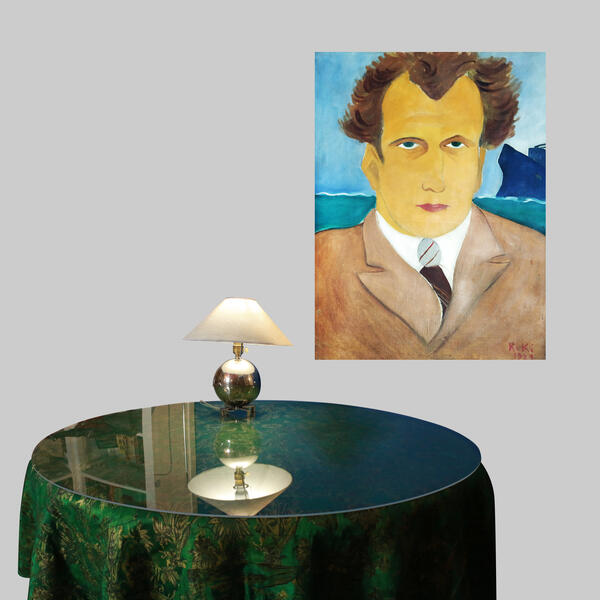
Sergei Eisenstein’s portrait, A round table
#9
#8
#7
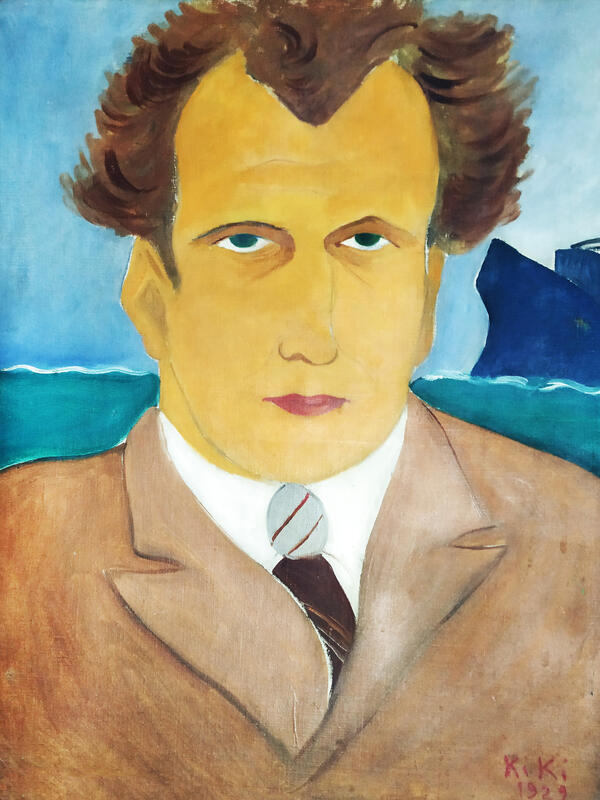
This picturesque portrait of Sergei Eisenstein was painted by AlIce ErnestIne Prin /’pren/ (1901–1953), known in the history of art as KikI de MontparnAsse. She wasn’t just a model for the artists that flocked to Paris in 1920's from all around the world. She was the muse of Montparnasse, the ‘artistic capital’ and a major center of the creative world at the time. There her friends, including AmedEo Modigliani /modi’ljani/, taught her how to paint. Here is what she had to say: “I have found my natural environment! The artists have adopted me. My sorrows are gone! ”. Ernest Hemingway, in the foreword to her memoir, which Kiki wrote at the age of 28, argued that “she was more prominent in the era of Montparnasse than Queen Victoria was in the Victorian era.”
Kiki herself was multilaterally gifted: she sang and danced beautifully, was the hostess of a cabaret, starred in the films of the French Avant-garde - “Intermission” by Rene Clair, “Mechanical Ballet” by Fernand Leger, “Inhuman” by Marcel L’Herbier. More than a hundred photographs of her were taken by American avant-garde artist Man Ray. She also learned painting from the artists she modelled for. Eisenstein posed for Kiki at the end of 1929 in Paris, where he stayed for a while on the long journey to Hollywood with his cameraman Edouard TissEt /ti’sse/ and his assistant GrigOry AlexAndrov. Eisenstein was introduced to Kiki by the artist Fernand Léger, the poet Robert Desnos and the ethnographer Georges-Henri Riviere. Parisian friends invited Eisenstein to the famous pub in Montmartre - “Bull on the Roof”. Later, the director recalled: “In its basement I met the one and only Kiki - a model to all major Montparnasse artists. Kiki, who was belly dancing on a piano lid in Spanish shawls while Georges-Henri Riviere of the Musee du Trocadero played that same piano. Kiki, who gifted me a copy of her memoirs with the following inscription: “Car moi aussi j”aime les gros bateaux et les matelots” (“Because I also like big boats and sailors”). And then, finally, Kiki, who now herself started painting; painting my portrait. Right at the end of our second session, Grisha [Grigoriy Aleksandrov] walks in. She squints her huge almond-shaped eyes of the invariably supportive mare from under her long eyelashes towards Aleksandrov and… the lips of the future director of “Merry Fellows” are painted on my portrait.’
When German forces occupied Paris in 1940, Kiki moved far into the country, to a remote village where she would not have to contact with the nazis. She returned to the city only when the city was liberated. Eisenstein’s portrait is the only work of Kiki in Russia.
Kiki herself was multilaterally gifted: she sang and danced beautifully, was the hostess of a cabaret, starred in the films of the French Avant-garde - “Intermission” by Rene Clair, “Mechanical Ballet” by Fernand Leger, “Inhuman” by Marcel L’Herbier. More than a hundred photographs of her were taken by American avant-garde artist Man Ray. She also learned painting from the artists she modelled for. Eisenstein posed for Kiki at the end of 1929 in Paris, where he stayed for a while on the long journey to Hollywood with his cameraman Edouard TissEt /ti’sse/ and his assistant GrigOry AlexAndrov. Eisenstein was introduced to Kiki by the artist Fernand Léger, the poet Robert Desnos and the ethnographer Georges-Henri Riviere. Parisian friends invited Eisenstein to the famous pub in Montmartre - “Bull on the Roof”. Later, the director recalled: “In its basement I met the one and only Kiki - a model to all major Montparnasse artists. Kiki, who was belly dancing on a piano lid in Spanish shawls while Georges-Henri Riviere of the Musee du Trocadero played that same piano. Kiki, who gifted me a copy of her memoirs with the following inscription: “Car moi aussi j”aime les gros bateaux et les matelots” (“Because I also like big boats and sailors”). And then, finally, Kiki, who now herself started painting; painting my portrait. Right at the end of our second session, Grisha [Grigoriy Aleksandrov] walks in. She squints her huge almond-shaped eyes of the invariably supportive mare from under her long eyelashes towards Aleksandrov and… the lips of the future director of “Merry Fellows” are painted on my portrait.’
When German forces occupied Paris in 1940, Kiki moved far into the country, to a remote village where she would not have to contact with the nazis. She returned to the city only when the city was liberated. Eisenstein’s portrait is the only work of Kiki in Russia.
#6
Full name: Sergei Eisenstein"s portrait
Author: Alice Ernestine Prin, also known as Kiki de Montparnasse
Date: 1929
Technique: oil on canvas
Place: France, Paris
Dimensions: 55×39 cm
Collection: Library
Copyright: Cinema museum
Goskatalog Number: 17962648
Author: Alice Ernestine Prin, also known as Kiki de Montparnasse
Date: 1929
Technique: oil on canvas
Place: France, Paris
Dimensions: 55×39 cm
Collection: Library
Copyright: Cinema museum
Goskatalog Number: 17962648
#5
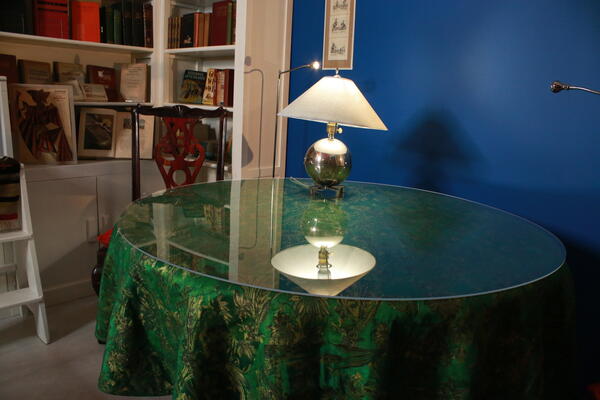
A round table in the library room
#4
#3
This round dining table, originally with a sliding table top, belonged to the director’s mother, YUlia Eisenstein née KonEtskaya. As a family legend goes, she brought it from St. Petersburg to RIga as a wedding dowry, which also included chairs with carved backrests in neo-Gothic style and many other furnishings. After splitting with her husband, Yulia Eisenstein left for her birthplace in St. Petersburg and settled in a house on TavrIcheskaya Street. After the official divorce, she took the dowry back. In 1935, Yulia moved to Moscow, to her son’s former room in a communal apartment at 23 ChistoprUdny Boulevard, apartment 2. She gave several pieces of furniture for her son’s new apartment on PotYlikha Street, including this table (without sliding boards), which stood in the library room.
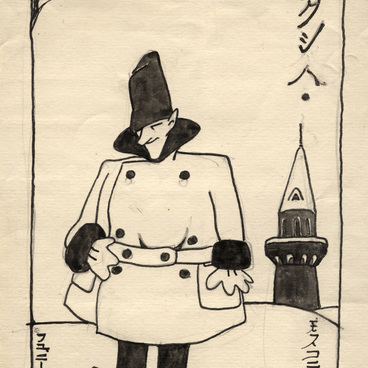
Sergei Eisenstein put a BAuhaus lamp with a steel sphere base on the table. He probably purchased this lamp during one of his business trips to the USA or Europe in 1929–1932. His self-caricature with the reflection in the lamp’s sphere base has been preserved to this day. Presumably in 1945-1946 Eisenstein laid the table with a green tablecloth made of the remains of brocade, which he received for the costumes for Ivan the Terrible before the Revolution.
Several carved chairs are also kept in the museum. Sergei Eisenstein wrote about the years of early childhood in the same chapter of memoirs: ‘Daddy the Terrible kept me in a great rigor. For instance, I was simply not allowed into the living room, and as the dining room was connected to the living room by an arch, the arch was chocked up with a line of chairs, which I crawled on, looking out from the dining room into the promised land of the living room.’ After Yulia Eisenstein moved to Moscow, the chairs were placed at the cottage in Kratovo.
Several carved chairs are also kept in the museum. Sergei Eisenstein wrote about the years of early childhood in the same chapter of memoirs: ‘Daddy the Terrible kept me in a great rigor. For instance, I was simply not allowed into the living room, and as the dining room was connected to the living room by an arch, the arch was chocked up with a line of chairs, which I crawled on, looking out from the dining room into the promised land of the living room.’ After Yulia Eisenstein moved to Moscow, the chairs were placed at the cottage in Kratovo.
The festive dowry service, probably the one used during the evening parties, Yulia Eisensten also took to Moscow. It was custom-made by M.S.Kuznetsov Partnership in the late 19th century. The shape and decor were in Rococo style: one of the sources of Art Nouveau style. The service is partially preserved.
#2
Full name: A round dining table. Sergei Eisenstein"s memorial item
Date: late 19th century
Technique: wood (oak), carving, handicraft
Place: Saint Petersburg
Dimensions: 127×75 cm
Collection: Library
Copyright: Cinema museum
Date: late 19th century
Technique: wood (oak), carving, handicraft
Place: Saint Petersburg
Dimensions: 127×75 cm
Collection: Library
Copyright: Cinema museum
read morehide
00:00
00:00
1x
Sergei Eisenstein's portrait, A round table
Collection
Exhibition
0
 Point your smartphone camera to open in the app
Open in app
Share