

Hieronymus Hopfer was a German Renaissance engraver and armorer, a key figure in the renowned Hopfer family of artists from Augsburg. Working primarily in etching and chisel engraving, he produced exquisite ornamental designs, heraldic compositions, and biblical scenes.
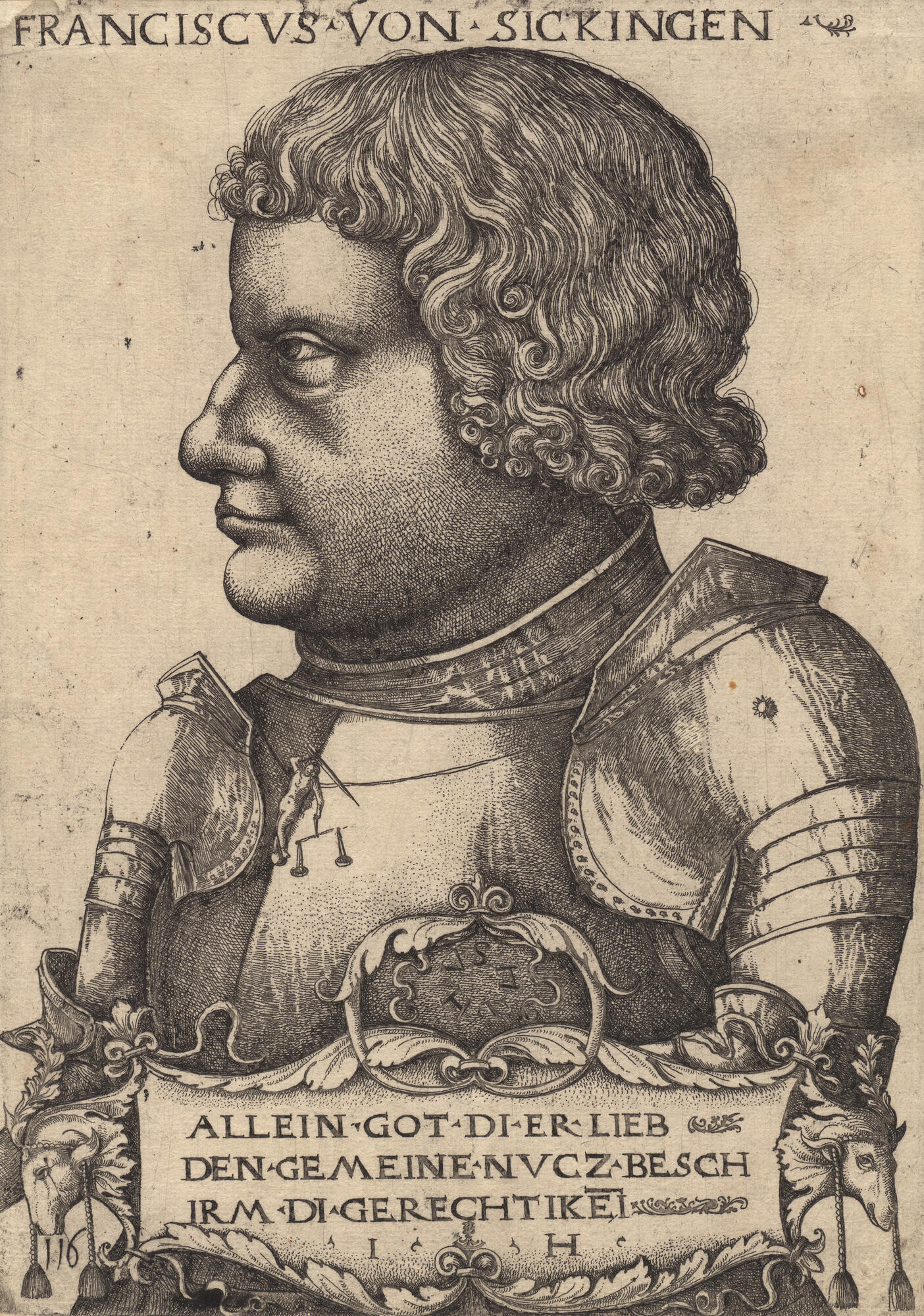
One of his most compelling works is an expressive portrait of Franz von Sickingen (1481–1523), depicted in full armor adorned with intricate heraldry. Sickingen was a legendary — and controversial — figure of the early Reformation: the last great representative of the fading German knightly class and leader of the ill-fated Knights’ Revolt of 1522–1523.
Sickingen combined martial prowess with political ambition. He styled himself as a defender of the oppressed, yet also led raids against merchants and townspeople, a practice common among impoverished knights of his era. Under the influence of his close friend, the humanist Ulrich von Hutten, he became an ardent supporter of Martin Luther. His castles — notably Ebernburg and Landstuhl — served as sanctuaries for persecuted reformers. His 1522 rebellion marked the final, desperate attempt by the imperial knights to resist the centralizing power of German princes and bishops. In 1523, Sickingen was besieged in his fortress at Landstuhl and mortally wounded during its fall.
It is often noted — though without documentary proof — that Albrecht Dürer’s famous 1513 engraving, “Knight, Death and Devil”, may be an allegorical portrait of Sickingen. In Dürer’s image, the stoic knight rides unwaveringly past the specters of death and temptation — a powerful metaphor for Sickingen’s own defiant, doomed struggle. Hopfer was a contemporary of Dürer.
Like his father, Daniel Hopfer, and his brother Lambert, Hieronymus gained fame as a master decorator of arms and armor. His engravings adorned the ceremonial armor of Emperor Charles V and other European nobles. Together with his family, he helped pioneer and refine metal etching techniques in the 16th century, merging the precision of goldsmithing with the expressive freedom of Renaissance art.
His works are held in major collections in Vienna, Berlin, and Nuremberg. They exemplify the transition from late Gothic ornamentation to the Renaissance aesthetic. Beyond weaponry, Hopfer’s ornamental motifs influenced book illustration.