

The Dance of Death — or Danse Macabre — is a powerful allegorical theme in medieval and Renaissance art, embodying the universality and inevitability of death. Personified as a skeletal figure, Death leads individuals from every stratum of society — popes and emperors, merchants and peasants, even children — to the grave.
Though the earliest known visual representations date to the 1370s — often accompanied by rhyming verses beneath drawings — the theme’s roots stretch back to Antiquity. Originating in Germany, the Danse Macabre genre rapidly spread across Europe: it flourished in France and England, while in Italy it merged with the related genre of The Triumph of Death. In Spain, uniquely, figures often resisted Death — a reflection of a more defiant, less fatalistic cultural attitude than in more northern regions of Europe.
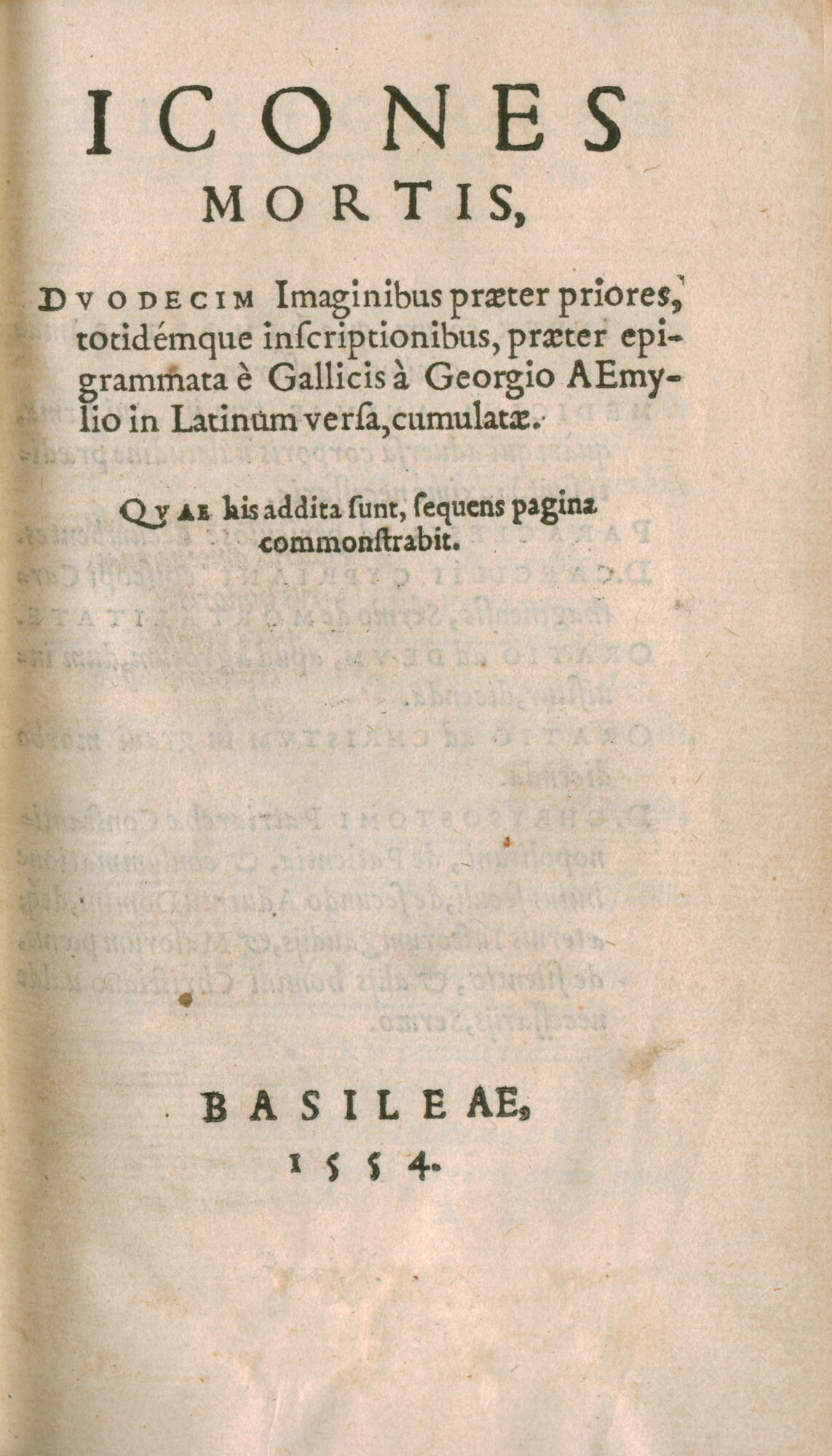
The most celebrated and influential embodiment of the genre is the series of 41 woodcuts by Hans Holbein the Younger, first published in 1538 (titled “Les Simulachres & Historiées Faces de la Mort”) — a small book of moralizing images. Accompanied by French verses by Gilles Corrozet and biblical quotations selected by Erasmus of Rotterdam, Holbein’s version revolutionized the tradition: his Death does not merely dance with the living, but intrudes into their daily lives to expose the vanity of worldly pursuits. Later editions expanded the cycle, eventually reaching 54 scenes — the most comprehensive version of the Dance of Death ever assembled. The Irbit State Museum of Fine Arts holds an edition comprising 53 images, bound in a volume of 94 pages.
Holbein’s imagery reflects a humanist skepticism toward institutional power — particularly that of the Church: he subtly critiques the clergy’s entanglement in political, economic, cultural, and even intellectual spheres. This anticlerical undercurrent is most evident in the scene with the Pope: he remains oblivious as Death arrives at the pinnacle of his earthly authority — during the coronation of an emperor. Two demons are also included in the scene, underscoring the moral and spiritual peril of worldly ambition.
Hans Holbein the Younger (1497–1543) was a preeminent German Renaissance artist, born in Augsburg to a family of painters — his father, Hans Holbein the Elder, was a celebrated master in his own right. After spending formative years in Basel, Switzerland, Holbein became closely associated with leading European humanists, most notably Erasmus of Rotterdam, whose writings he illustrated. His artistic mastery spanned multiple genres, from portraiture to religious painting, but he achieved particular brilliance in book illustration and graphic art. Holbein’s work served as a vital bridge between the ideals of the Italian Renaissance and the Northern European tradition — seamlessly fusing classical harmony with the meticulous detail and psychological depth, characteristic of the North.