#1
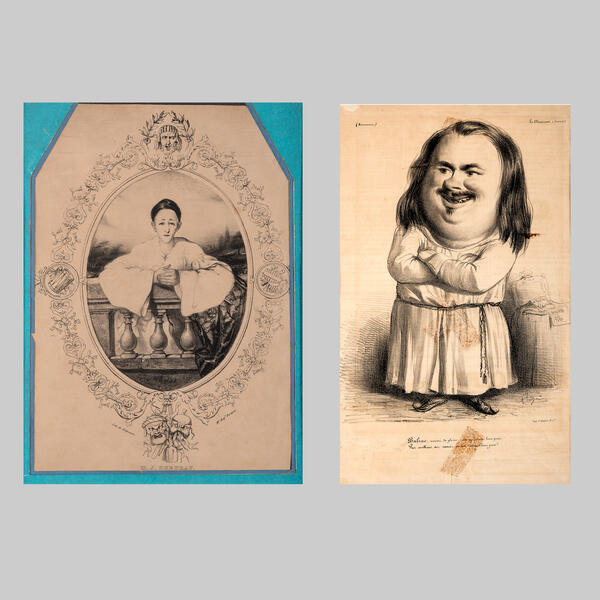
Portrait of Baptiste Deburau, Honoré de Balzac
#2
#3
#5
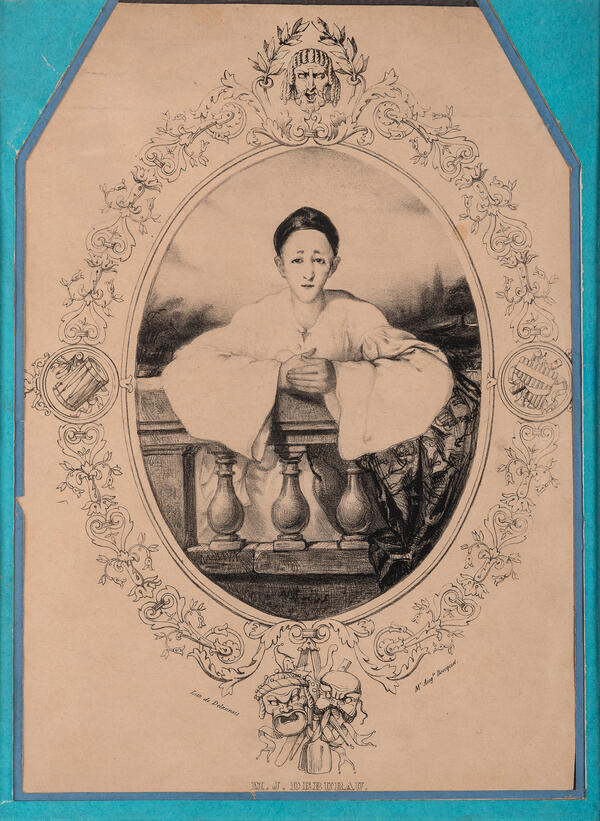
This portrait by AugUste Bouquet /bu’kei/ depicts the mime Jean-BaptIste-Gaspard /gas’par/ Deburau /debju’ro/ (1796–1846), one of the leading figures of the Parisian boulevard theater “FunambUEle” and creator of the famous Pierrot /pje’ro/ persona. Deburau revived the ancient pantomime and reintroduced the ‘eloquent silence’ to the theatre. His art and fame were promoted by the fact that at the beginning of the 19th century, only ‘silent’ performances were permitted at the Boulevard Temple: in 1806, Napoleon the First, fearing the ‘subversive’ influence of folk shows and their competition with the court theater, ordered to present only pantomimes, ballets and circus numbers on stage. But the plastic expressiveness of the pantomime actors turned out to be stronger than the outdated ‘high style’ of declamations in the Comédie Francaise theatre, and small boulevard theaters drew in the Parisian public. Even when Napoleon’s prohibition was lifted, and “talking” genres (melodrama, detective, folk comedy) were once again dominating the boulevard theatres, pantomimes — comic and lyrical — retained their popularity.
Contemporaries called Deburau “the greatest actor of his age.” He possessed a rare ability to combine humour and tragedy on stage, mixing the farcical with the lyrical. He turned a ramshackle performance that occupied the middle ground between theatre and circus, and turned it into “philosophy on stage”, accessible even to the simplest audiences. Deburau’s work was continued in the 20th century by the great comedians of silent films — Max Linder, Charlie Chaplin, Buster Keaton, and others. Later, his traditions were revived in France by Jean-Louis Barrot and Marcel Marceau on stage, and by Jacques Tati and Pierre Etex in cinema.
Eisenstein knew and loved Deburau’s work as it was described to him by the actor’s contemporaries and theatre scholars in their studies. The image of the sad Pierrot, to whom has given psychological depth, appears in Deburau’s earliest theatrical sketches influenced by the Italian comedy of masks. Sergei Eisenstein was concerned with the issues of expressive movement from the earliest years of his career — the actor had to convey without words the deep movements and contradictions of the human soul. For that reason he often referred to Deburau’s works in his career as a film director as well as in his theoretical works and the lectures he gave at All-Union State Institute of Cinematography. Eisenstein had portraits of the great mime and his antipode friend FrederIc-LemAItre long before the French director MarcEl Carnet /kar’ne/ made his film Children of the Rayk (1945) about them.
Contemporaries called Deburau “the greatest actor of his age.” He possessed a rare ability to combine humour and tragedy on stage, mixing the farcical with the lyrical. He turned a ramshackle performance that occupied the middle ground between theatre and circus, and turned it into “philosophy on stage”, accessible even to the simplest audiences. Deburau’s work was continued in the 20th century by the great comedians of silent films — Max Linder, Charlie Chaplin, Buster Keaton, and others. Later, his traditions were revived in France by Jean-Louis Barrot and Marcel Marceau on stage, and by Jacques Tati and Pierre Etex in cinema.
Eisenstein knew and loved Deburau’s work as it was described to him by the actor’s contemporaries and theatre scholars in their studies. The image of the sad Pierrot, to whom has given psychological depth, appears in Deburau’s earliest theatrical sketches influenced by the Italian comedy of masks. Sergei Eisenstein was concerned with the issues of expressive movement from the earliest years of his career — the actor had to convey without words the deep movements and contradictions of the human soul. For that reason he often referred to Deburau’s works in his career as a film director as well as in his theoretical works and the lectures he gave at All-Union State Institute of Cinematography. Eisenstein had portraits of the great mime and his antipode friend FrederIc-LemAItre long before the French director MarcEl Carnet /kar’ne/ made his film Children of the Rayk (1945) about them.
#4
Full name: Portrait of Baptiste Deburau as Pierrot
Author: Auguste Bouquet
Date: circa 1830
Technique: paper, lithograph
Place: France
Dimensions: 27.5×19 cm (in light)
Collection: Library
Copyright: Cinema museum
Goskatalog Number: 17962623
Author: Auguste Bouquet
Date: circa 1830
Technique: paper, lithograph
Place: France
Dimensions: 27.5×19 cm (in light)
Collection: Library
Copyright: Cinema museum
Goskatalog Number: 17962623
#6
Honoré de Balzac Cartoon
#7
#9
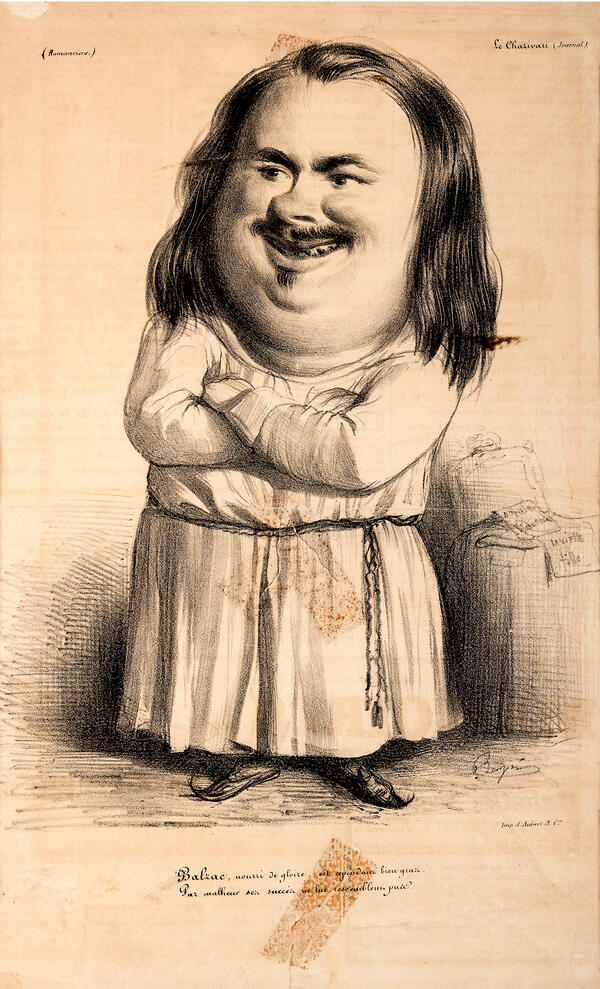
This caricature cartoon portrait of the French writer Honoré /ono’re/ de BalzAc (1799-1850) hung in the library of Eisenstein’s PotYlikha apartment, at the bottom of the side of the shelf, to the right of the bedroom door. The author of the cartoon, BenjamIn Roubaud /ru’bo/ (1811–1847), is a renowned cartoonist who worked in the satirical Parisian newspapers La Caricature and Charivari together with Honoré Daumier and Granville since 1830. Roubaud also created “The CharivarI Pantheon”: 100 caricatures of the most influential personalities of his time.
The artist often signed his cartoons simply Benjamin, like on this sheet from the “Charivari” (Le Charivari) newspaper from October 12, 1838. In this lithograph, Roubaud Balzac stands with his arms crossed. He is wearing a robe and house slippers, and sheets of paper with the names of his works lie on the bed. One of the names on these papers is legible: “La vieille fille” (the novel “The Old Maid”, written in 1836). The way he has been depicted here is not accidental: Balzac did not write about exotic countries, romantic adventures, or demonic heroes; but rather about the daily life of modern France and its inhabitants. There is a short poem inscribed under the cartoon: “Balzac, nourri de gloire, est cependant bien gras. Par malheur ses succès ne lui ressemblent pas.” Translated from French, it reads: “Balzac, nourished by glory, is nevertheless very stout. Unfortunately, his successes do not resemble him.”
However, Honoré de Balzac’s fame has endured throughout history. In his grandiose cycle of novels, novellas, and short stories ‘The Human Comedy, ’ he created a collective image of modern society comprising many psychologically and socially accurate portraits of people. Balzac’s works are now considered literary classics, and the development of French and world literature is unimaginable without them.
Eisenstein believed that directors, screenwriters, and actors could learn from Balzac’s expressiveness and imagery when creating their characters. In the director’s theoretical works, there are many references to the writer’s creative experience; Eisenstein gave examples from his works in the classroom with students at the All-Union State Institute of Cinematography. Educational study ‘The Arrest of Vautrin’ based on an episode from Balzac’s novel “Father Goriot” which Eisenstein included in his course became a classic educational tool for understanding the art of mise-en-scène. The film director dreamed of staging the novel “Cousin Betta” in the Moscow Theater of the Revolution, starring his Proletkult student Judith Glieser as the main heroine, but that ambition was never fulfilled.
The artist often signed his cartoons simply Benjamin, like on this sheet from the “Charivari” (Le Charivari) newspaper from October 12, 1838. In this lithograph, Roubaud Balzac stands with his arms crossed. He is wearing a robe and house slippers, and sheets of paper with the names of his works lie on the bed. One of the names on these papers is legible: “La vieille fille” (the novel “The Old Maid”, written in 1836). The way he has been depicted here is not accidental: Balzac did not write about exotic countries, romantic adventures, or demonic heroes; but rather about the daily life of modern France and its inhabitants. There is a short poem inscribed under the cartoon: “Balzac, nourri de gloire, est cependant bien gras. Par malheur ses succès ne lui ressemblent pas.” Translated from French, it reads: “Balzac, nourished by glory, is nevertheless very stout. Unfortunately, his successes do not resemble him.”
However, Honoré de Balzac’s fame has endured throughout history. In his grandiose cycle of novels, novellas, and short stories ‘The Human Comedy, ’ he created a collective image of modern society comprising many psychologically and socially accurate portraits of people. Balzac’s works are now considered literary classics, and the development of French and world literature is unimaginable without them.
Eisenstein believed that directors, screenwriters, and actors could learn from Balzac’s expressiveness and imagery when creating their characters. In the director’s theoretical works, there are many references to the writer’s creative experience; Eisenstein gave examples from his works in the classroom with students at the All-Union State Institute of Cinematography. Educational study ‘The Arrest of Vautrin’ based on an episode from Balzac’s novel “Father Goriot” which Eisenstein included in his course became a classic educational tool for understanding the art of mise-en-scène. The film director dreamed of staging the novel “Cousin Betta” in the Moscow Theater of the Revolution, starring his Proletkult student Judith Glieser as the main heroine, but that ambition was never fulfilled.
#8
Full name: Honoré de Balzac Cartoon
Author: Benjamin Roubaud
Date: 1838
Technique: paper, lithograph
Place: France
Dimensions: 34.5×22 cm
Collection: Library
Copyright: Cinema museum
Goskatalog Number: 17962610
Author: Benjamin Roubaud
Date: 1838
Technique: paper, lithograph
Place: France
Dimensions: 34.5×22 cm
Collection: Library
Copyright: Cinema museum
Goskatalog Number: 17962610
read morehide
00:00
00:00
1x
Portrait of Baptiste Deburau, Honoré de Balzac
Collection
Exhibition
0
 Point your smartphone camera to open in the app
Open in app
Share