#1
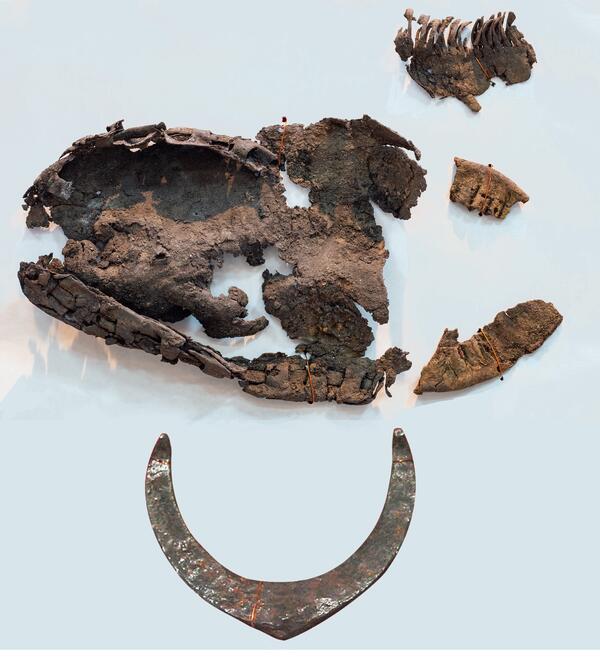
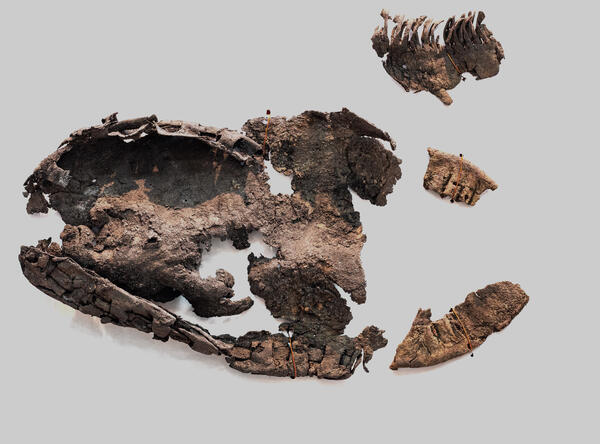
One-piece leather-hide shoes ‘Porshni’, calk
#11
#4
#6
Manufacturing of footwear was a robust business in Kuznetsk. During archaeological excavations shoemaker’s tools were found: grinder, piercers, needles, thimble.
One-piece leather-hide shoes (“porshni”) were the cheapest and simplest casual shoes. They had no heels or bootlegs, they were made of tanned or raw hide leather.
By the design, porshni may be divided into three types: simple, open work and compound. To manufacture the first two types of porshni, a rectangular sheet of leather was taken, 2-2,5 cm thick. The length and width of the leather sheet corresponded to the foot size plus the allowance for bootleg height in the toe and heel part of the shoe. The open work porshni were notable for elegance and a more complicated decorative design of the foot front. Its open work design was implemented by making rows of parallel slots. In the middle of each slot straps were inserted and interlaced, tightening the foot front edges. Such porshni resembled sandals though made of a finer and softer material.
Compound porshni were made of two sheets of compact thick leather. The corners of the blank were cut away and an additional element – a triangular leather piece- was stitched in. The heel part was also sewed together manually. Such type of porshni resembled Indian moccasins. The notes of Vladimir Dal contain a description of heir manufacturing method: “Porshni are nor sewn but rather bent from a single sheet of raw leather or skin (with fur) with a threaded ribbon (“vzdyOrka”), cord (“Ochura”) or belt (“remyOnnaya obOra”); usually they are made of horse skin, or better of pork skin, they may be made of seal skin, or others…’ Porshni remained in everyday use until early XX century.
‘When winter came with severe cold spell, they put on porshni… “. The etymology of the word is not defined. A linguist and a literary scholar Igor Vakhros believed that it derives from the adjective “prabos” and the verb “prabositi”, meaning “wear the shoes into holes”
In written sources the word “porshen”(sing.of porshni) was first encountered in patriarch Nikon”s chronicles of 1074
Simple to fabricate and comfortable, those shoes were very popular with various peoples. Thus, in Poland they are called “chodaki”, in Latvia — “kurpe”, in Dagestan — “dirikhi”. Judging by the shoe size, porshni were worn by children, women and men though in Moscow, small size porshni (below 24 cm) are encountered more frequently. This allows to assume that porshni were teenager shoes. The size of the largest found porshni was 34 cm.
One-piece leather-hide shoes (“porshni”) were the cheapest and simplest casual shoes. They had no heels or bootlegs, they were made of tanned or raw hide leather.
By the design, porshni may be divided into three types: simple, open work and compound. To manufacture the first two types of porshni, a rectangular sheet of leather was taken, 2-2,5 cm thick. The length and width of the leather sheet corresponded to the foot size plus the allowance for bootleg height in the toe and heel part of the shoe. The open work porshni were notable for elegance and a more complicated decorative design of the foot front. Its open work design was implemented by making rows of parallel slots. In the middle of each slot straps were inserted and interlaced, tightening the foot front edges. Such porshni resembled sandals though made of a finer and softer material.
Compound porshni were made of two sheets of compact thick leather. The corners of the blank were cut away and an additional element – a triangular leather piece- was stitched in. The heel part was also sewed together manually. Such type of porshni resembled Indian moccasins. The notes of Vladimir Dal contain a description of heir manufacturing method: “Porshni are nor sewn but rather bent from a single sheet of raw leather or skin (with fur) with a threaded ribbon (“vzdyOrka”), cord (“Ochura”) or belt (“remyOnnaya obOra”); usually they are made of horse skin, or better of pork skin, they may be made of seal skin, or others…’ Porshni remained in everyday use until early XX century.
‘When winter came with severe cold spell, they put on porshni… “. The etymology of the word is not defined. A linguist and a literary scholar Igor Vakhros believed that it derives from the adjective “prabos” and the verb “prabositi”, meaning “wear the shoes into holes”
In written sources the word “porshen”(sing.of porshni) was first encountered in patriarch Nikon”s chronicles of 1074
Simple to fabricate and comfortable, those shoes were very popular with various peoples. Thus, in Poland they are called “chodaki”, in Latvia — “kurpe”, in Dagestan — “dirikhi”. Judging by the shoe size, porshni were worn by children, women and men though in Moscow, small size porshni (below 24 cm) are encountered more frequently. This allows to assume that porshni were teenager shoes. The size of the largest found porshni was 34 cm.
#7
Full name One-piece leather-hide shoes “Porshni”
Date XVII century
Place Russia
Technique cutting and sewing of leather sheet
Copyright Kuznetsk fortress
Collection XVII – XVIII cent. Kuznetsk ostrOg – the town of Kuznetsk. Excavations of various years
Date XVII century
Place Russia
Technique cutting and sewing of leather sheet
Copyright Kuznetsk fortress
Collection XVII – XVIII cent. Kuznetsk ostrOg – the town of Kuznetsk. Excavations of various years
#10
Calk
#5
#8
In XVII–XVIII cent. there existed three types of shoe calks. The first and earliest type that was popular until mid. XVII century was the cut-in shoe calk. In the earlier half XVII century there appeared composite calks. The third type are the tapped calks, including those extending into the sole. It existed between the half of XVII, and XVIII century.
Among the archaeological discoveries in various Siberian cities, half-moon-shaped tapped calks of later times prevail. They were suited for both broad and narrow heels and had a universal application. Tapped calks had no nails, so they were easier to manufacture.
Shoemaking industry was a robust business in Kuznetsk. Most common footwear were high boots dyed with mineral pigments. Both men and women wore high red boots, most popular in those times. Such boots were frequently encountered in the Russian fairy-tales and illustrations to those.
Customs books hold the records of the batches of red leather of different quality that were sold in various Siberian cities. The heels and soles were made from several layers of leather glued together. The heels were of various shape and height: low and wide, or narrow and high. Initially, the toecaps were pointed and cocked, later they became wide and straight.
High boots of the service class people in XVII century had long bootlegs, high heels and pointed cocked toes. They were made of leather and dyed in different colors. The boots of rank and file Cossacks were made of coarse leather. High boots of ‘desyAtniks’ and ‘sOtniks: (command military ranks among the Cossacks) were not stylish but were made of “yuft” (Russian calf leather) – a finer and more expensive leather.
According to historical sources of XVII century, the calks were called “boot calks”, or “calks for boots”, “boot calks with nail”. They were attached to the heel and sole with sparrow bills. To fabricate the calks, bloomery iron and low-carbon steel were used. That quality of metal was sufficient for the calks to wear well.
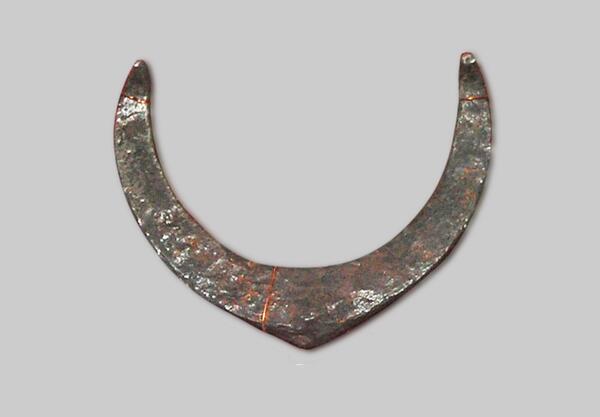
The shoe calk protected the soft leather sole of the boot from quick wear. Those artifacts are most frequent archaeological findings in Kuznetsk excavations. The calk from the exhibition belongs to the early type. It is a cut-in half-moon shaped calk, sufficiently thick to secure the heel from wear. The calk has three spikes for attaching it to the footwear – one in the middle and two at the ends. Such calks could only be attached to the boot heels.
Among the archaeological discoveries in various Siberian cities, half-moon-shaped tapped calks of later times prevail. They were suited for both broad and narrow heels and had a universal application. Tapped calks had no nails, so they were easier to manufacture.
Shoemaking industry was a robust business in Kuznetsk. Most common footwear were high boots dyed with mineral pigments. Both men and women wore high red boots, most popular in those times. Such boots were frequently encountered in the Russian fairy-tales and illustrations to those.
Customs books hold the records of the batches of red leather of different quality that were sold in various Siberian cities. The heels and soles were made from several layers of leather glued together. The heels were of various shape and height: low and wide, or narrow and high. Initially, the toecaps were pointed and cocked, later they became wide and straight.
High boots of the service class people in XVII century had long bootlegs, high heels and pointed cocked toes. They were made of leather and dyed in different colors. The boots of rank and file Cossacks were made of coarse leather. High boots of ‘desyAtniks’ and ‘sOtniks: (command military ranks among the Cossacks) were not stylish but were made of “yuft” (Russian calf leather) – a finer and more expensive leather.
According to historical sources of XVII century, the calks were called “boot calks”, or “calks for boots”, “boot calks with nail”. They were attached to the heel and sole with sparrow bills. To fabricate the calks, bloomery iron and low-carbon steel were used. That quality of metal was sufficient for the calks to wear well.
The shoe calk protected the soft leather sole of the boot from quick wear. Those artifacts are most frequent archaeological findings in Kuznetsk excavations. The calk from the exhibition belongs to the early type. It is a cut-in half-moon shaped calk, sufficiently thick to secure the heel from wear. The calk has three spikes for attaching it to the footwear – one in the middle and two at the ends. Such calks could only be attached to the boot heels.
#9
Full name Shoe calk
Date XVII century
Technique forge work
Place Russia
Dimensions Total width - 6,2 cm, plate thickness - 1,3 cm, plate width - 1,8 cm
Copyright Kuznetsk fortress
Collection XVII – XVIII cent. Kuznetsk ostrOg – the town of Kuznetsk. Excavations of various years
Restorers Scheglakov A.P.
Date XVII century
Technique forge work
Place Russia
Dimensions Total width - 6,2 cm, plate thickness - 1,3 cm, plate width - 1,8 cm
Copyright Kuznetsk fortress
Collection XVII – XVIII cent. Kuznetsk ostrOg – the town of Kuznetsk. Excavations of various years
Restorers Scheglakov A.P.
read morehide
00:00
00:00
1x
2
 Point your smartphone camera to open in the app
Open in app
Share