A powder flask is a container of various shapes for storing and carrying a small amount of gunpowder. They were in demand from the 15th to the late 19th century, when muzzleloading rifles were used before the advent of cartridges. And small indigenous peoples used them until the early 20th century. The need for powder flasks disappeared with the introduction of unitary cartridges.
Since most rifles were loaded through the muzzle, they required hunting supplies consisting of a gunpowder container, a powder measuring cup, two or three canvas pouches for bullets, shot, and wadding. Contrary to the rough hunting equipment, powder flasks were usually notably refined and elegantly decorated, as expensive gunpowder required careful storage. They were made in towns by skilled craftsmen and sold at local markets. They were closed with a stopper, or with a metal screw cap. Hunting powder flasks were distinguished by their high quality and elegance, and different techniques were used in producing them: carving, embossing, painting. Painting and patterns were not only ornamental, but also identified the owner.
There are different types of powder flasks in terms of material: horn and bone, leather and metal. Along with such materials as wood, metal, and leather, powder flasks were made of bone and, more often, horn, hence the common name “powder horn” or “horn”. Gunpowder horns were made not only in Russia, but also in Europe and Asia from the early 16th century. They were usually bull horns, sealed at the base and drilled at the top so that gunpowder could be poured in. In the North, elk horns were used.
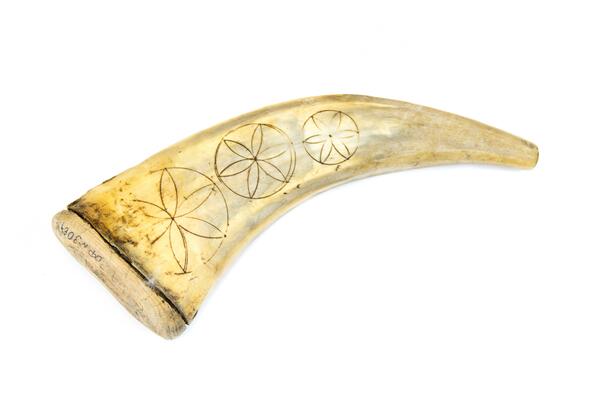
The exhibit is made of cow
horn. The wide part of the o-shaped horn is covered with a tight lid. On the
narrow side of the horn there is a round hole. The walls of the horn have
outline drawings in the form of rings on the outside, inside the rings is a
geometric pattern of six petals. The horn is arched and has a leather cord
running through the hole on the convex side.