All tea glass holders (podstakanniks) can be divided into two large conventional groups — those of the Soviet and pre-Soviet periods. These groups, in turn, can be subdivided into smaller thematic groups — those with Christian motifs, fairy tale subjects and Soviet symbols, as well as signed, created for certain events and others. Tea glass holders were made in different techniques: stamping, artistic casting, embossing, and from different metals: silver, copper, brass. They were both mass-produced and made to order. In the 19th — early 20th centuries all the podstakanniks made to order were stamped with the trademark of the company and the date of manufacture. They are traditionally used in railway transport as an obligatory element of the table setting and significantly increase the stability of glasses during movement, which is why people believe that the history of the utensil began with the emergence of trains, but it happened much earlier.
According to some sources, the podstakannik came into use at the end of the 18th century. At least since that time there are records of the tea glass holder as an element of Russian tea drinking. It gained its popularity in 1889, when Sergei Yulievich Witte was the Director of the Department of Railway Affairs. The Department placed an order for the production of tea glass holders to one of the largest Russian non-ferrous metal works, the “Association of Brass and Copper Rolling Plants of Alexander Kolchugin” located in the Vladimir Governorate. Thanks to this order, the plant began to receive at least 30% of the profits, which were generated by the tableware production shop. And the main products were those tea glass holders, which were necessary for the railroad. In the USSR more than 15 plants were producing podstakanniks, decorated mainly with Soviet symbols — stars, the sickle and hammer. After the launch of the first Artificial Earth satellite in 1957, space became a frequent motif of decoration.
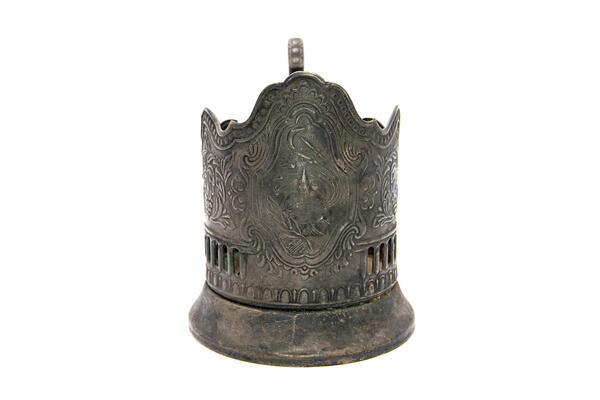
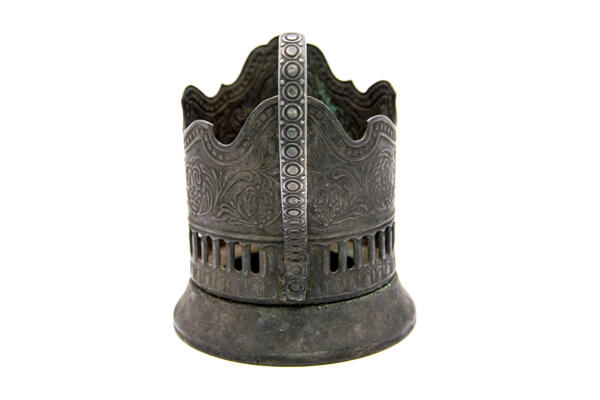
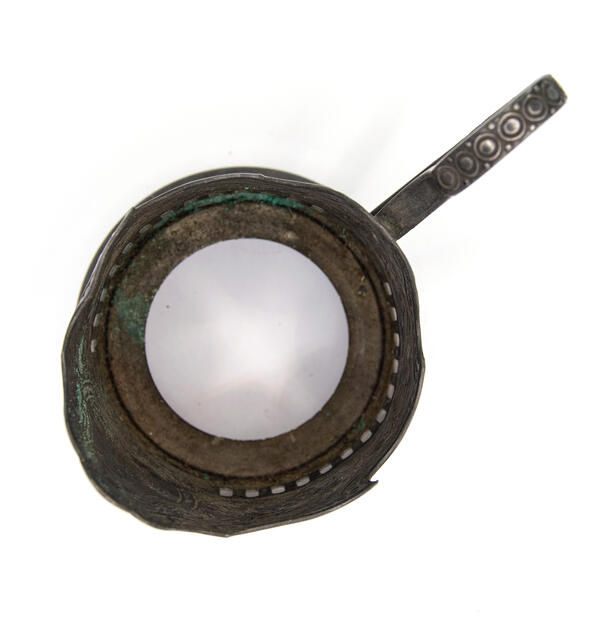
This exhibit is a silver-coated cupronickel tea glass holder from the “Soviet Space” series. This is a cylindrical stand, covering and supporting a tea glass with a handle so that the hot glass does not burn the hands. The tea glass holder was produced in 1963 at the Kolchugino Factory.